
10.6 Symmetry, ancillas, measurement, and architecture
On this page · Permalink · Source line 4285
10.6.1 Beyond subgroup word metrics
On this page · Permalink · Source line 4293
Some of the most important quantum resource enlargements are not inclusions of groups. Measurement introduces branches, reset is irreversible, and ancillas enlarge the Hilbert space. The appropriate abstraction is a nested pair of realization categories
with a cost assigned to generating morphisms.
For a target channel \(\Phi\) in the restricted category, define
and similarly \(c_{\mathrm{amb}}(\Phi)\). The value \(+\infty\) is allowed. A finite positive difference is a metric defect; an infinite difference is an existence defect.
10.6.2 Symmetry-preserving circuits
On this page · Permalink · Source line 4310
Let \(Q\) be a conserved charge and let
Restricted circuits use gates commuting with \(Q\). Ambient circuits may temporarily leave \(H_Q\) but must return to a charge-preserving endpoint.
Examples include:
particle-number conservation,
parity conservation,
total spin or magnetization,
lattice gauge constraints,
stabilizer or CSS sector preservation,
block-diagonal representation sectors.
The Hilbert space decomposes as
A restricted circuit is block diagonal. An ambient catalyst may couple sectors, use the enlarged route, and decouple them at the endpoint.
Research template
A symmetry-breaking catalyst has three obligations:
quantify how far the path leaves the symmetry algebra;
prove exact return, not merely return on a chosen input state;
compare the cost with every symmetry-preserving realization of the full target operator.
10.6.3 Sector-flow invariants
On this page · Permalink · Source line 4342
Let \(P_q\) be the projector onto sector \(q\). For an intermediate unitary \(U_t\), define transfer blocks
A restricted path has \(T_{q,r}=0\) for \(q\ne r\). Ambient paths may populate off-diagonal blocks. Possible excursion measures include
These are analogues of strict-upper rank and bandwidth in the unitriangular theory.
10.6.4 Clean and dirty ancillas
On this page · Permalink · Source line 4357
A clean ancilla starts in a specified state, usually \({\lvert 0\rangle}\), and must be returned to that state. A dirty ancilla starts in an unknown state and must be restored for every input.
Let \(U\) act on the data register. A clean-ancilla realization is a unitary \(W\) satisfying
A dirty-ancilla realization requires
The second condition is strictly stronger.
Ancillas define a family of defects
where \(a\) is the number of ancillary qubits or modes. Stable ancilla capacity asks whether a fixed number of reusable ancillas can yield an unbounded saving as the data size grows.
10.6.5 Measurement and feedforward
On this page · Permalink · Source line 4382
A measurement-assisted realization is described by an instrument with classical outcomes \(m\), conditional channels \(\Phi_m\), and feedforward operations. Exact deterministic implementation of a unitary target requires every branch, after correction, to induce the same channel.
The cost vector may include
A measurement can create an existence defect by realizing a channel unavailable unitarily under the same locality or depth constraints, or a metric defect by reducing one resource while increasing another.
Definition 10.14: Branch-catalytic realization
A measurement-assisted circuit is branch catalytic when the intermediate classical or quantum branch information is absent from the final data channel and all declared work systems are reset or discarded according to the model.
10.6.6 Teleportation as a canonical ambient excursion
On this page · Permalink · Source line 4401
Gate teleportation replaces direct implementation by:
The ambient category contains resources not present in the target channel: entanglement, measurement outcomes, and feedforward. The endpoint can nevertheless be a deterministic unitary.
This is an archetypal realization defect, but careful accounting is mandatory. A claimed saving must include resource-state preparation or explicitly treat the state as an external catalyst.
10.6.7 Architecture-constrained gates
On this page · Permalink · Source line 4414
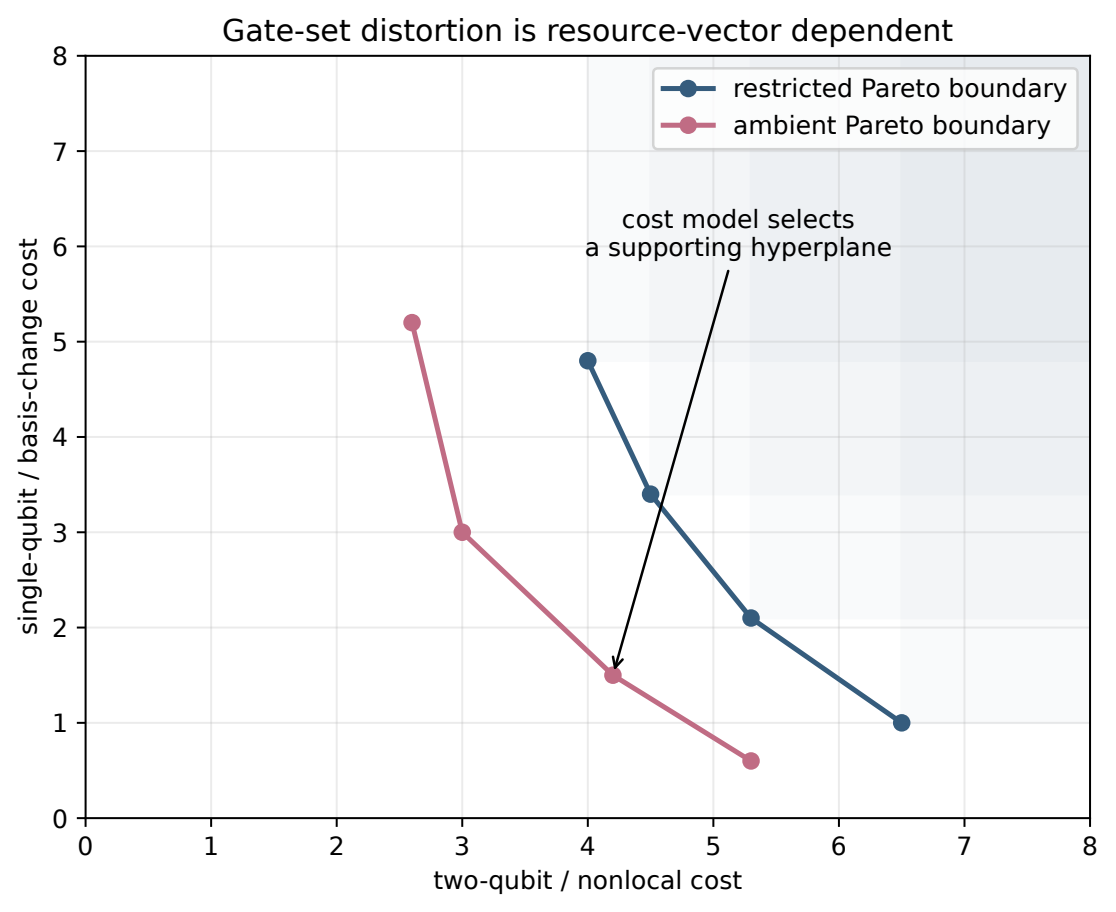
Let \(\Gamma=(V,E)\) be a hardware graph. A restricted two-qubit gate may act only on edges of \(E\). The ambient model may permit a small number of nonlocal interactions, temporary logical relabelings, teleportation edges, or bus-mediated gates.
For a target \(U\), define
and compare it with an enlarged graph \(\Gamma'\). A matched routing excursion has the form
where \(\pi\) is a logical permutation. The excursion is profitable when many gates in \(W\) become local in the permuted frame.
10.6.8 Depth, count, and space-time volume
On this page · Permalink · Source line 4438
Let \(g_t\) be the set of gates scheduled in layer \(t\). Common scalar costs are
A catalyst may reduce count but increase depth, or vice versa. Space-time volume is often the more stable hardware quantity.
For stochastic error rates \(p_g\), a first-order weighted cost is
This additive approximation can be inserted directly into Dijkstra search. It does not capture coherent or correlated errors, but it produces a declared and reproducible metric.
10.6.9 Approximate synthesis
On this page · Permalink · Source line 4455
For continuous gate sets, define
There are two distinct border phenomena:
algebraic border length, where a target lies in the closure of a bounded exact word locus;
analytic approximation length, where an error tolerance is explicitly permitted.
They should not be conflated.
A catalyst can improve the asymptotic Solovay–Kitaev or number-theoretic approximation constant even when exact synthesis is impossible in both models.
10.6.10 Resource theories and monotones
On this page · Permalink · Source line 4471
A quantum resource theory provides free states, free operations, and monotones. Gate-set distortion adds a path-sensitive question: the endpoint may be free even though the path temporarily creates resource.
A state monotone \(M(\rho)\) alone may fail because the catalyst acts at the channel level. Useful channel-level quantities include:
robustness or magic capacity,
entangling power,
operator Schmidt rank,
Choi-state resource measures,
symmetry asymmetry of the channel,
amortized resource generation.
A lower bound must relate the cumulative or peak resource to the declared gate cost and account for cancellation.
10.6.11 A categorical amplification principle
On this page · Permalink · Source line 4485
Suppose a monoidal category admits a tensor product and a cost satisfying
If restricted cost is additive on a target family, then any one-copy defect amplifies linearly under independent tensor powers. Superlinear amplification requires a normalization in which dimensions multiply, as in the matrix tensor rule of the core theory, or a joint-synthesis synergy across copies.
10.6.12 Experimental standards
On this page · Permalink · Source line 4494
Every architecture, measurement, or ancilla claim should state:
gate alphabet and native connectivity;
clean, dirty, catalytic, or consumable ancilla convention;
deterministic or postselected implementation;
exact or approximate endpoint condition;
total, weighted, depth, or Pareto cost;
whether resource-state preparation is included;
whether qubit relabeling is free;
certificate of restoration on all inputs.
Without these declarations, two reported “gate counts” may refer to incomparable problems.
Conjectural frontier
For several common symmetry and architecture restrictions, a constant-size restored excursion should yield an unbounded saving on structured target families. The unitriangular construction proves this phenomenon for directed linear information flow; analogous theorems for charge sectors, measurement branches, and nonlocal routing remain open.