
4.8 Few bosons and few fermions
On this page · Permalink · Source line 1277
4.8.1 Bosonic occupation space
On this page · Permalink · Source line 1282
For \(N\) indistinguishable bosons in \(m\) modes, a Fock basis state is an occupation vector
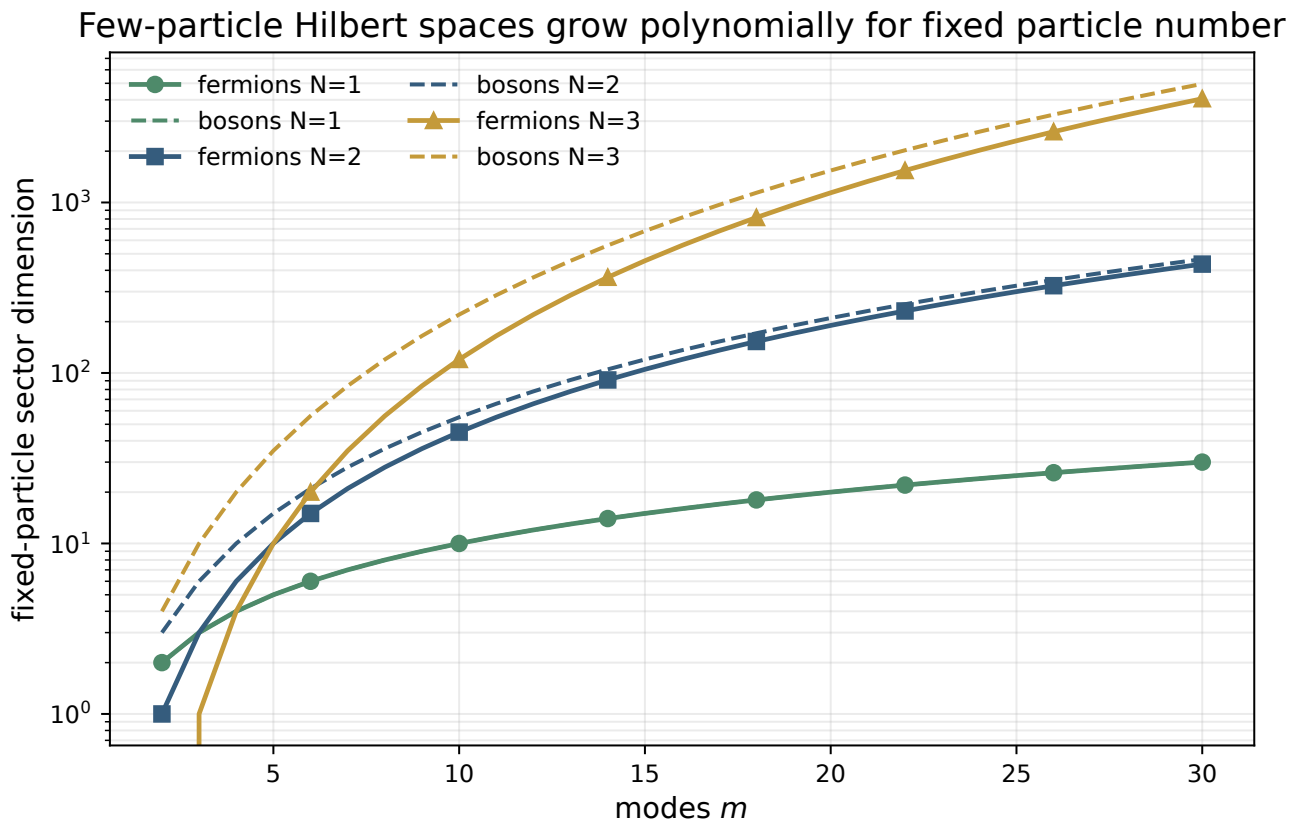
The dimension is
For fixed \(N\), this is \(O(m^N)\).
4.8.2 Fermionic occupation space
On this page · Permalink · Source line 1298
For \(N\) fermions in \(m\) modes, each mode is occupied at most once and
For fixed \(N\), this is also polynomial in \(m\).
Corollary 4.10: Few-particle collapse
A polynomial-size number-preserving bosonic or fermionic circuit with a fixed number of particles is classically polynomial-time simulable if its initial occupation coordinates, mode-gate updates, and final observable are computable in polynomial time in the occupation basis.
Proof
Use Equation (4.11) and Equation (4.12) and Theorem 3.7.
4.8.3 Gate updates
On this page · Permalink · Source line 1322
A number-preserving one-body unitary acts on mode creation operators by
A generic dense mode transformation can induce many occupation-basis transitions, but for fixed \(N\) the basis dimension remains polynomial. Local hopping and phase gates are sparse. Few-body interactions remain polynomial to apply for fixed \(N\), although the exponent can grow with \(N\).
4.8.4 Where the theorem stops
On this page · Permalink · Source line 1331
If \(N\) scales linearly with \(m\), both dimensions become exponential. The fixed-number symmetry still reduces the full Fock space, but it does not prove polynomial simulation. Boson-sampling-type interference also shows that a fixed total particle number is not enough when the particle count itself scales with input size and the output asks for detailed many-body amplitudes.
Scope boundary
The corollary is a fixed-particle theorem. It is not a claim that general many-boson or many-fermion quantum dynamics are classically easy.