
9.4 Catalytic normal forms and the six-role threshold
On this page · Permalink · Source line 1446
The universal atom is one instance of a root-conjugation mechanism. This section isolates that mechanism and explains the count twenty.
9.4.1 Root conjugation identities
On this page · Permalink · Source line 1450
Let \(p<q<y\) and \(x<p<q\). Direct multiplication gives
and
A single forbidden upper transvection can therefore turn one lower interaction into two lower effects. Interactions of the forms \(x\to p\) and \(q\to y\) commute through the excursion without duplication. We call the duplicated interactions cross interactions and the unduplicated interactions phase interactions.
Definition 9.23: Simple one-catalyst word
A simple one-catalyst word has the form
where every \(h_i\) is lower directed and is one of
with \(x<p<q<y\). Auxiliary rows are distinct unless stated otherwise.
The circuit is read from right to left in the matrix product and from left to right as a gate list. The opening and closing operations temporarily place the \(q\) component in row \(p\).
Proposition 9.24: Cross-interaction accounting
Let a simple one-catalyst word have \(m\) middle interactions, of which \(c\) are cross interactions. Its target admits a lower-directed realization of length at most
Consequently, if the ambient word of length \(m+2\) is strictly shorter than every lower word, then
Proof
Conjugate each middle generator using Equation (9.8) and Equation (9.9). A phase interaction remains one lower transvection, while a cross interaction becomes a product of two lower transvections. This gives length at most \(m+c\). If \(c\le2\), then \(m+c\le m+2\), so the ambient excursion cannot be strictly better.
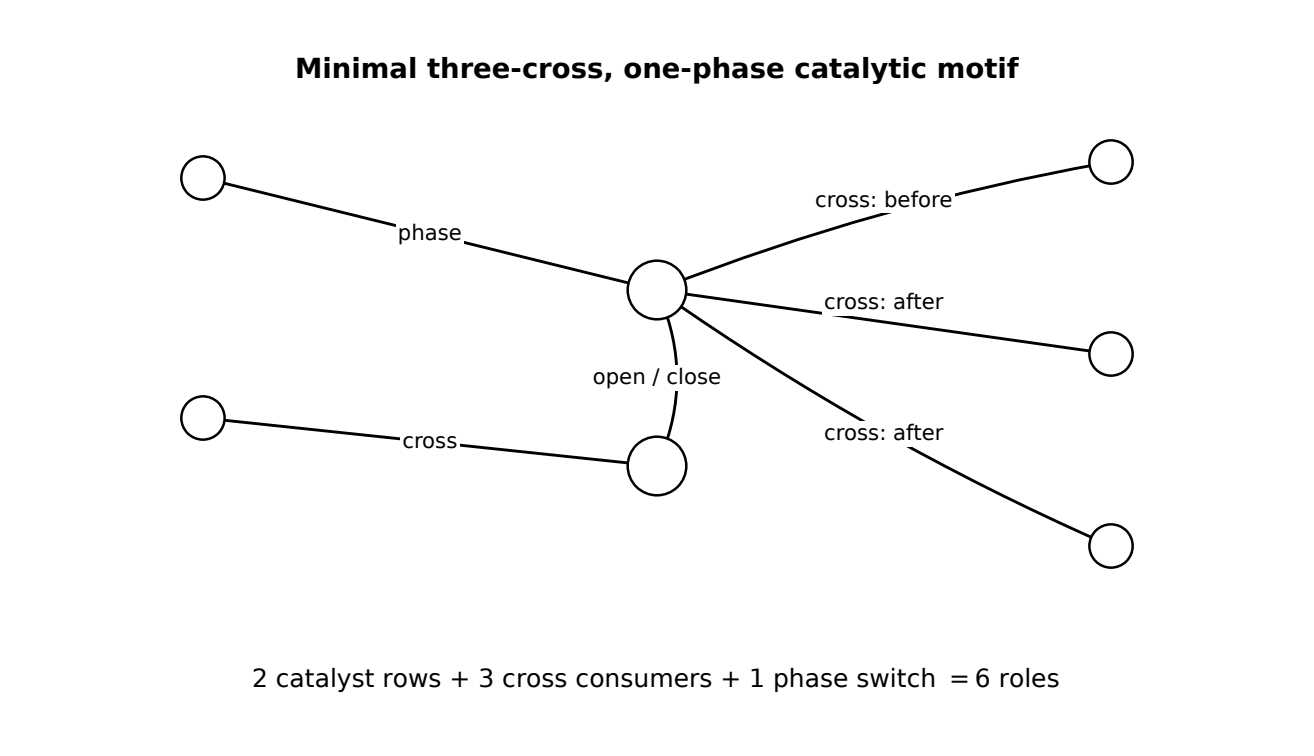
Three consumers are therefore the first possible point at which the cost two of opening and closing can be amortized.
9.4.2 Why an all-cross word is insufficient
On this page · Permalink · Source line 1499
Within the distinct-leaf normal form, cross count alone is not enough.
Lemma 9.25: All-cross mirror
Suppose a simple one-catalyst word contains only cross interactions, with left inputs \(X\) and right outputs \(Y\). Then its target has a lower-directed realization with the same number of gates.
Proof
Write the opening coefficient as \(a\in{\mathbb F}^\times\), the left-update coefficients as \(b_x\), and the right-read coefficients as \(c_y\). Since the all-cross middle gates commute past one another, the ambient gate list may be written
Put \(B=\sum_{x\in X}b_xe_x\). Its final nontrivial rows are
The following lower-directed gate list produces the same rows:
Indeed, after the first gate \(R_q=e_q+a^{-1}e_p\), so the output gates create exactly \(c_ye_p+ac_ye_q\). The source updates then leave \(R_p=e_p-aB\), and the final gate changes \(R_q\) to \(e_q+B\). Both words have \(|X|+|Y|+2\) gates.
Thus a minimal strict shortcut needs both positive catalytic excess and a phase switch that makes temporal order matter.
Proposition 9.26: Six-role threshold in the simple model
A strict shortcut in the distinct-leaf simple one-catalyst model requires at least six row roles:
The bound is attained by the matrix \(C\).
Proof
By Proposition 9.24, at least three cross interactions are required. By Lemma 9.25, at least one phase interaction is required. With distinct leaves these use four auxiliary rows in addition to the two catalyst rows. The word of Proposition 9.17 has exactly this form.
9.4.3 Enumeration of the minimal motifs
On this page · Permalink · Source line 1565
Fix six ordered rows. The catalyst pair must be adjacent in a minimal six-role word. Write
let \(L\) be the set of rows left of \(p\), and let \(R\) be the set of rows right of \(q\). Then
There are two orientations.
Left phase.
On this page · Permalink · Source line 1579
Choose a phase leaf \(x\in L\). The remaining \(|L|-1\) left leaves interact by \(u\to q\). Every right leaf is a cross read \(p\to y\). To make the phase effective, the right leaves are divided into a nonempty set read before \(x\to p\) and a nonempty set read after it. The number of targets is
Right phase.
On this page · Permalink · Source line 1585
Choose a phase leaf \(y\in R\). Every other right leaf is a cross read. The left updates into \(q\) are divided nontrivially before and after the phase gate \(q\to y\). The number is
Proposition 9.27: Motif count
For a split \((L,R)=(|L|,|R|)\) with \(L+R=4\), the number of minimal phase-separated targets is
For the three possible splits,
Hence there are twenty targets.
Proof
The preceding left-phase and right-phase constructions are disjoint because the phase row lies on opposite sides of the catalyst. Within each orientation, the final support records the phase leaf and the before/after subset, so distinct choices give distinct targets. Summing gives the formula and the stated values.
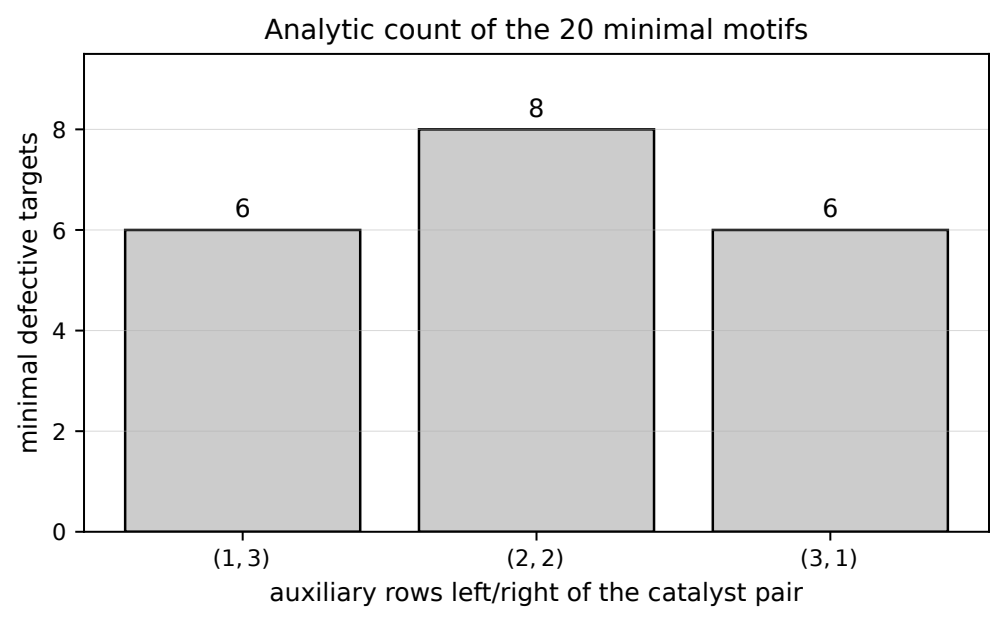
Every target counted by Proposition 9.27 has an explicit six-gate ambient word and a seven-gate lower word obtained by eliminating the three cross interactions. The nontrivial statement is that there are no other defects in dimension six and that none of these targets has a lower word of length six. That is the exact classification established in Section 9.5.