
Quantum and reversible gate families
On this page · Permalink · Source line 3214
10.1 Qudit SUM gates and ring-valued linear logic
On this page · Permalink · Source line 3215
10.1.1 From transvections to quantum gates
On this page · Permalink · Source line 3221
Let \(d\ge2\). On \(n\) qudits with computational basis labeled by \({\mathbb Z}_d^n\), define the scaled SUM gate
It is a permutation unitary. Its action on basis labels is the row transvection
For \(d=2\) and \(a=1\), it is CNOT. For prime \(d\), these gates lie in the standard qudit Clifford group. For composite \(d\), they remain exact reversible modular-addition gates.
Proved statement
The universal six-row atom in the core chapter is valid over every nonzero commutative ring with identity. Taking \(R={\mathbb Z}_d\) gives a six-qudit target with restricted directed-SUM length seven and ambient all-direction SUM length six for every \(d\ge2\).
10.1.2 The universal six-qudit circuit
On this page · Permalink · Source line 3240
Use the coordinate names
The target acts on basis labels by
with \(x\) and \(q\) unchanged. An ambient word is
The first gate adds the dirty \(q\) component to \(p\). The middle gates export two different carrier states. The final inverse gate restores \(p\).
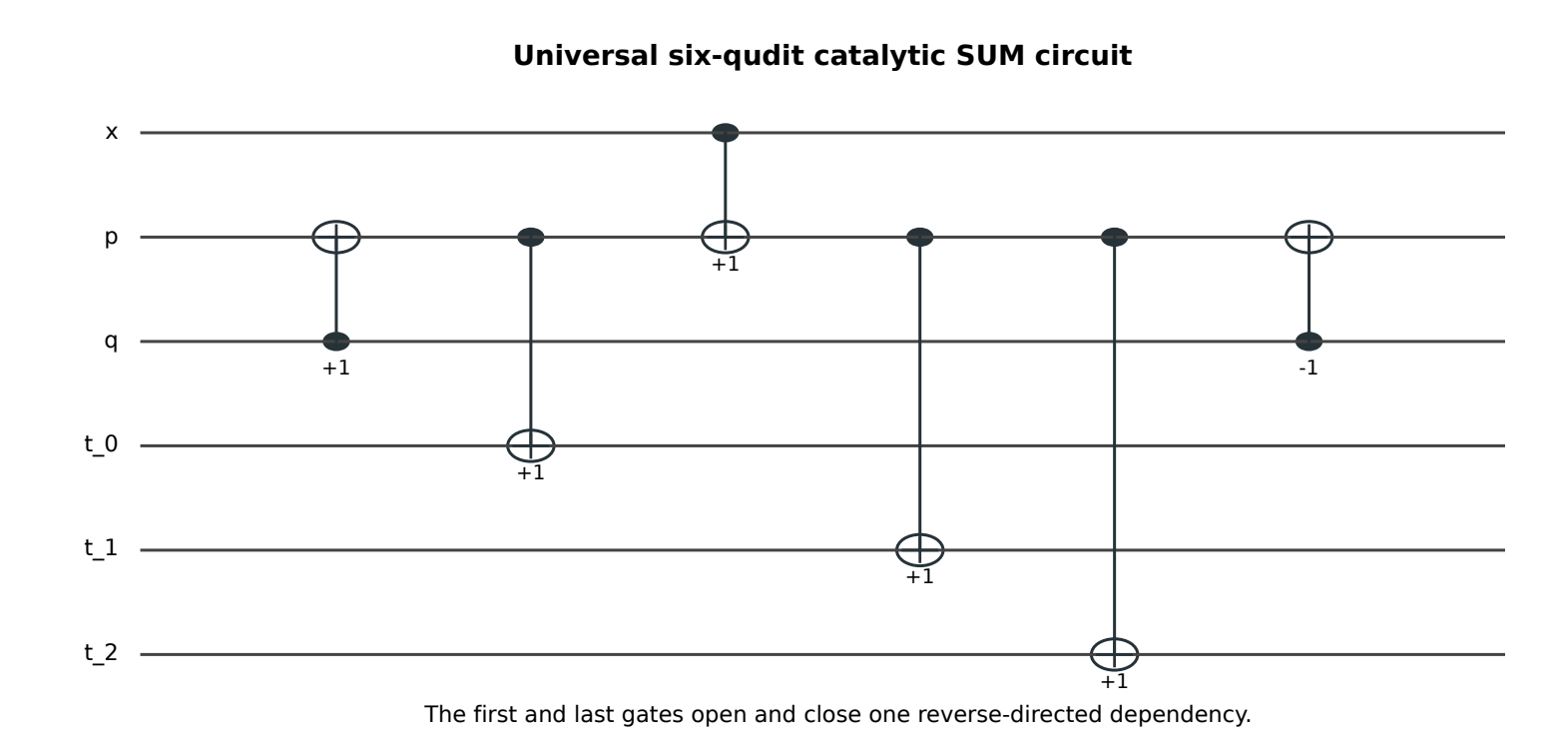
A lower-only word needs seven gates. The exact proof is coefficient-domain independent because it uses pivot support and the number of distinct carrier states rather than division.
10.1.3 Connected higher-dimensional qudit families
On this page · Permalink · Source line 3277
The snapshot target \(A(u;s_1,\ldots,s_v)\) from the core chapter is defined over any coefficient ring for which the displayed additions make sense. Over \({\mathbb Z}_d\), it becomes a modular SUM circuit. Its explicit ambient word uses exactly two reverse-directed SUM gates and has length
The interval-tree proof of exact restricted length is most transparent over fields, but the displayed upper-bound and resource-amortization mechanism remain valid over every \({\mathbb Z}_d\).
For a field \({\mathbb F}_q\), the exact formula is
so
The connected family has asymptotic ratio approaching \(3/2\).
10.1.4 Weighted physical costs
On this page · Permalink · Source line 3296
Suppose forward SUM gates cost one and reverse-directed SUM gates cost \(\lambda\). The displayed word has weighted cost
while the restricted construction costs \(u+2v\). Hence the gain is at least
This formula can be combined with hardware calibration. If reverse orientation requires echo pulses or routing, the catalyst remains useful when the number of exported snapshots exceeds twice the effective penalty.
Scope boundary
A gate-count saving does not imply a lower physical error or depth. Device-specific conclusions require a cost vector containing duration, infidelity, crosstalk, and routing. The algebraic theorem identifies candidate rewrites and the exact break-even inequality.
10.1.5 Pauli action for prime qudits
On this page · Permalink · Source line 3311
For odd prime \(d\), let \(X\) and \(Z\) denote generalized Pauli operators. The SUM gate acts by
Thus the modular linear action embeds into a symplectic transformation. The catalytic row excursion has a dual Pauli interpretation: a temporary reverse dependency changes both \(X\) propagation and the contragredient \(Z\) propagation, then restores them.
This makes the SUM family a bridge between the transvection paper and the Clifford chapter. It is the only quantum extension in this monograph that follows directly from the ring-universal theorem without a new finite search.
10.1.6 Continuous-variable shear analogue
On this page · Permalink · Source line 3325
On continuous variables, a linear coordinate map \(A\) embeds symplectically as
A row shear therefore gives a Gaussian SUM transformation. The six-row word identity remains a matrix identity in the corresponding shear subgroup.
Research template
To claim an advantage in a full Gaussian gate library, one must compare against rotations, squeezers, beam splitters, and general symplectic decompositions. The current theorem proves a defect only inside the directed-shear versus all-shear comparison.
10.1.7 Compiler primitive
On this page · Permalink · Source line 3340
A compiler can search for a carrier row \(p\), a temporary source \(q\), and output rows requiring several successive states of \(p\). The symbolic pattern is:
add \(q\) into \(p\) in the disallowed direction,
update \(p\) through a sequence of allowed additions,
copy selected intermediate states of \(p\) into outputs,
subtract \(q\) from \(p\),
verify that the outputs contain the intended modular combinations.
The Python function snapshot_target constructs the target and snapshot_ambient_word emits the word.
Constructing a modular snapshot family.
On this page · Permalink · Source line 3351
from catalytic_gate_atlas.linear import (
    snapshot_target,
    snapshot_ambient_word,
    apply_row_word,
)

u = 4
phases = [0, 2, 4]
modulus = 5
A = snapshot_target(u, phases, modulus)
word = snapshot_ambient_word(u, phases, modulus)
assert apply_row_word(len(A), word, modulus) == A10.1.8 Open qudit questions
On this page · Permalink · Source line 3366
Question 10.1
Does the first defective dimension remain six for every finite field and every modular ring \({\mathbb Z}_d\) under the directed-SUM metric?
Question 10.2
Can qudit Clifford gates outside the SUM subgroup produce a larger defect for a SUM target under total, entangling, or depth cost?
Question 10.3
Do composite dimensions admit characteristic-dependent catalytic motifs unavailable over fields?