
Algorithms and open directions
On this page · Permalink · Source line 2015
7.1 Architecture of a symmetry-collapse compiler
On this page · Permalink · Source line 2016
7.1.1 The five-stage pipeline
On this page · Permalink · Source line 2020
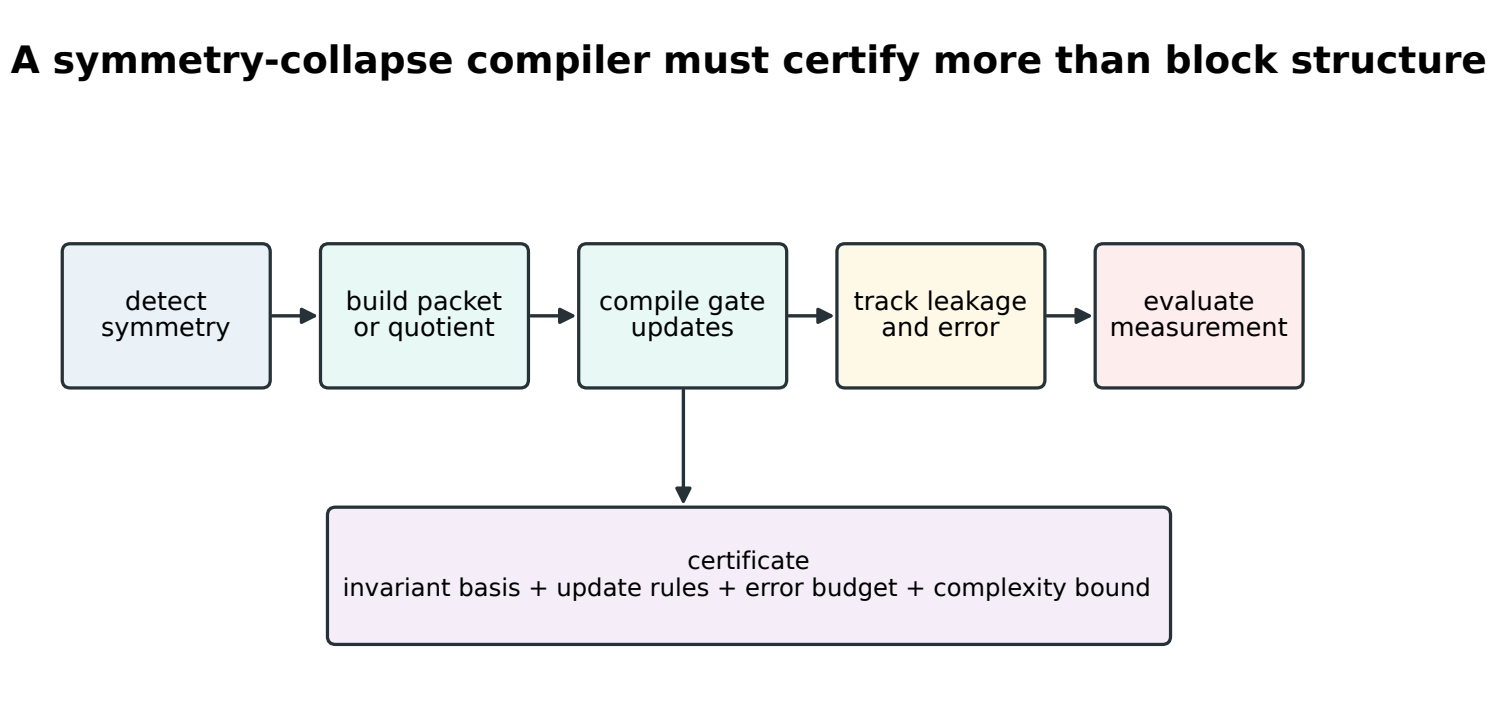
A practical compiler must perform more than symbolic block diagonalization.
Detect exact or approximate symmetries.
Construct an invariant basis, orbit quotient, or compact internal representation.
Compile each gate into that representation.
Track leakage, truncation, and numerical error.
Evaluate the requested measurement and emit a complexity certificate.
7.1.2 Symmetry detection
On this page · Permalink · Source line 2037
Detection may use declared conserved quantities, commutators, finite-group generators, graph automorphisms, stabilizer relations, occupation conservation, or numerical approximate symmetries. Exact symbolic detection is preferable when available. Numerical detection must specify tolerances and how they propagate.
7.1.3 Basis construction
On this page · Permalink · Source line 2040
Examples include:
subset indexing for fixed weight,
occupation vectors for bosons,
Dicke states for full permutation symmetry,
Schur coordinates for broader permutation symmetry,
orbit states for graph walks,
stabilizer tableaux,
fermionic or bosonic covariance matrices,
matrix-product states for bounded entanglement.
The compiler should avoid materializing an exponentially large change-of-basis matrix. It needs direct indexing and update formulas.
7.1.4 Gate plan caching
On this page · Permalink · Source line 2056
For a repeated circuit family, compile a packet plan containing affected index pairs, sparse matrix blocks, phase tables, and quotient couplings. The plan can be reused across parameter values when the sparsity pattern is fixed.
7.1.5 Fallback and adaptive enlargement
On this page · Permalink · Source line 2059
If a gate leaks from the current representation, the compiler can reject the reduction, merge packets, add neighboring sectors, or switch internal representations. The choice must preserve a certified error budget.
7.1.6 Output certificate
On this page · Permalink · Source line 2062
A useful machine-readable certificate should include:
the symmetry or invariant-subspace proof,
active dimensions or representation sizes,
gate update complexity,
leakage or approximation bounds,
measurement complexity,
benchmark and hardware metadata,
the final complexity conclusion and its scope.