Quantum and CircuitsReading edition

Degree bounds must retain shared register products

Reading tools
Reading libraryFind statementsInspect Lean
Switch work

Saved reading

Read side by side

Start reading

Resources & source

Original TeX with line links · Download TeX

The wording and mathematics follow the retained manuscript. This reading format does not add a proof review or extend Lean coverage.

Skip contents and start reading

Degree bounds must retain shared register products

Take four independent input bits. Compute

\[ q_1=x_1x_2,\qquad q_2=x_3x_4,\qquad q_3=q_1q_2. \]

After two ANDs, each nonlinear register has degree two, but their product has degree four. After the third AND, a coordinate of degree four appears.
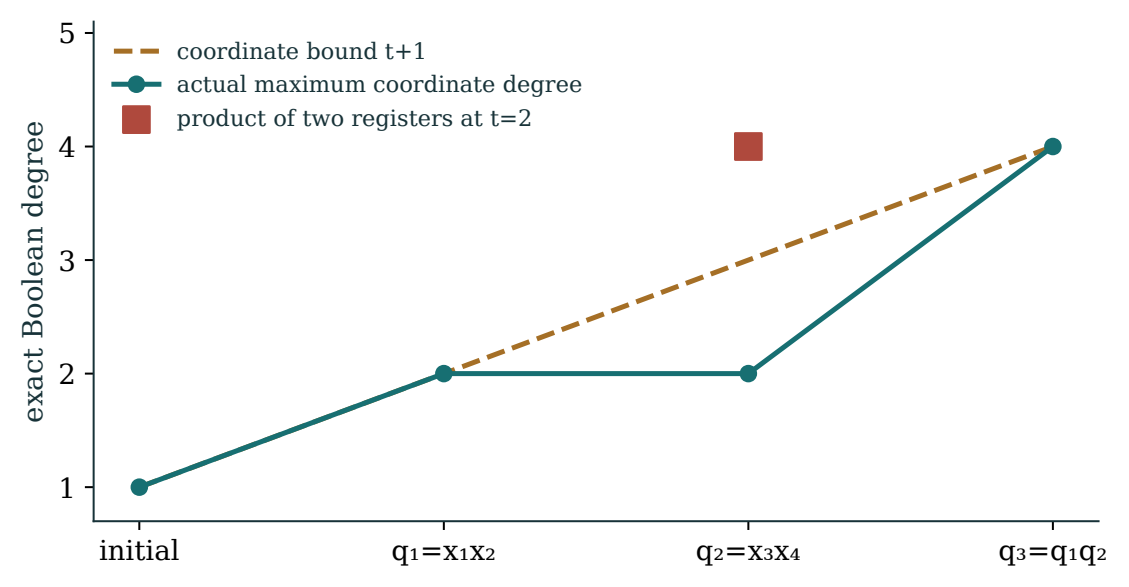
Exact degrees from the complete four-input truth tables. The square marker is a two-register product, not a coordinate.

View full-size figure (new tab)

The correct invariant tracks a product of \(r\) current registers after \(t\) Toffolis:

\[ \deg\!\left(\prod_{i\in L}s_i(x)\right)\le t+|L|=t+r. \]

At \(t=2\), the product \(q_1q_2\) has \(r=2\) and saturates \(t+r=4\). At \(t=3\), the resulting coordinate has \(r=1\) and saturates \(t+1=4\).

This explains why tracking only individual register degrees and then adding their separate histories can lose the shared accounting. The invariant applies to the actual evolving state. It does not unfold a reused register into a new copy of the entire computation.

Exact finite fixture plus the general register-product invariant; the source proves workspaceDegree_run for arbitrary gate lists.

Source and conversion record

Source SHA-256: 488075fae27e7db2e4bcee68c08f93b659a12536c807e5e419d6e8e166317763

Unsupported prose commands stop the build. The mathematical expression sequence is checked against the source, with manuscript macros expanded for display.

Conversion records

Notation in Quantum and Circuits

Look up a symbol without leaving this chapter. Select text before opening help to search for it.

Search this work’s notation.

    Symbols can have different meanings in different passages. Read each result in its own context.

    Open the full notation index