Quantum and CircuitsReading edition

Witness indicators are orthogonal idempotents

Reading tools
Reading libraryFind statementsInspect Lean
Switch work

Saved reading

Read side by side

Start reading

Resources & source

Original TeX with line links · Download TeX

The wording and mathematics follow the retained manuscript. This reading format does not add a proof review or extend Lean coverage.

Skip contents and start reading

Witness indicators are orthogonal idempotents

Let \(K\) be a field and \(W=\{0,1\}^m\). The full witness algebra is \(B=K^W\) with pointwise addition and multiplication. For each witness \(v\), the indicator \(\delta_v\) is one at \(v\) and zero elsewhere. Then
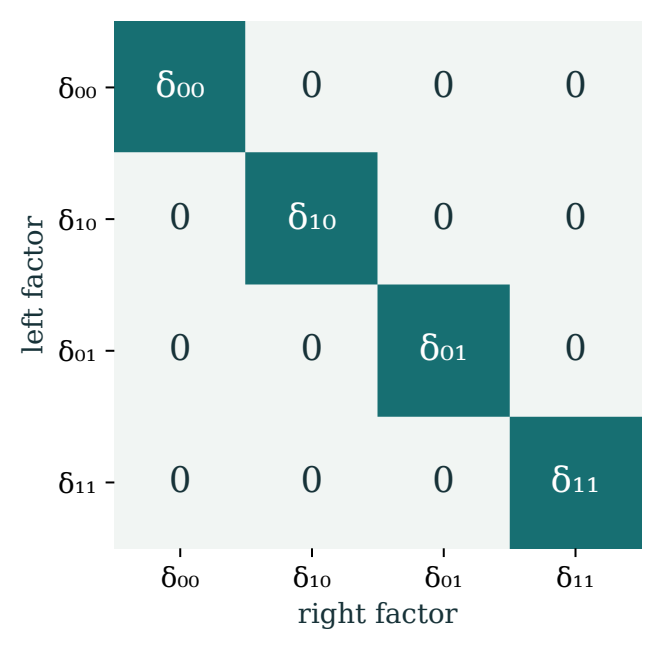
\[ \delta_v^2=\delta_v,\qquad \delta_u\delta_v=0\ (u\ne v), \qquad \sum_v\delta_v=1. \]
The four-witness multiplication table at m=2. Each nonzero diagonal entry is its own point indicator.
The four-witness multiplication table at \(m=2\). Each nonzero diagonal entry is its own point indicator.

View full-size figure (new tab)

The four indicator functions form a basis of \(K^4\). General \(m\) has \(2^m\) such basis elements. A verifier is the sum of the indicators of its accepted witnesses, and pointwise multiplication models intersection of accepting sets.

This algebra retains exact witness compatibility: disjoint singleton predicates multiply to zero. A summary that preserves that product operation while retaining every singleton must preserve the same orthogonal structure. The following dimension theorem says exactly how much fixed linear space that requires.

Exact \(m=2\) multiplication table; general product-algebra identities hold over any field. No characteristic-two assumption is needed for the dimension proof.

Source and conversion record

Source SHA-256: 488075fae27e7db2e4bcee68c08f93b659a12536c807e5e419d6e8e166317763

Unsupported prose commands stop the build. The mathematical expression sequence is checked against the source, with manuscript macros expanded for display.

Conversion records

Notation in Quantum and Circuits

Look up a symbol without leaving this chapter. Select text before opening help to search for it.

Search this work’s notation.

    Symbols can have different meanings in different passages. Read each result in its own context.

    Open the full notation index