
7.3 Atlas of candidate symmetry collapses
On this page · Permalink · Source line 2122
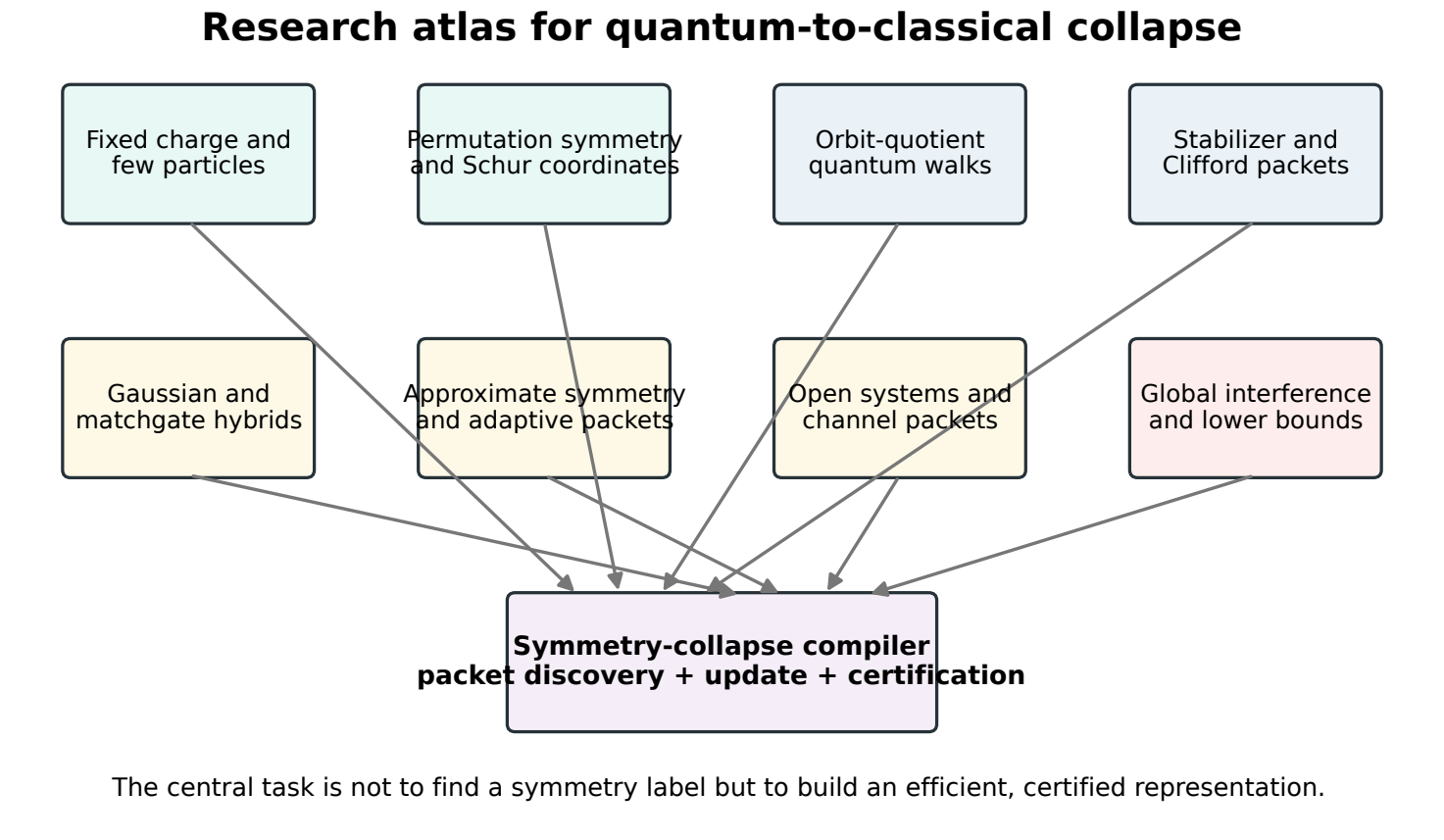
7.3.1 High-confidence theorem families
On this page · Permalink · Source line 2131
| Family | Compression mechanism | Decisive condition |
|---|---|---|
| Fixed charge \(k=O(1)\) | Explicit subset basis of size \(\binom nk\) | Number-preserving gates and efficient measurement |
| Permutation-symmetric qubits | Dicke basis of size \(n+1\) | Collective or permutation-invariant dynamics |
| Symmetric qudits, fixed \(d\) | Occupation basis \(\binom{n+d-1}{d-1}\) | Efficient occupation-space updates |
| Polynomial-orbit walks | Quotient Hamiltonian on orbit states | Succinct quotient entries and orbit-invariant input/output |
| Few bosons or fermions | Fixed-particle occupation basis | Fixed particle number and efficient few-body updates |
| Stabilizer circuits | Tableau representation | Clifford closure and efficient Pauli measurement |
| Gaussian circuits | Covariance representation | Gaussian closure and efficient observable evaluation |
7.3.2 Hybrid theorem targets
On this page · Permalink · Source line 2152
The strongest new classes may combine several resources:
charge packets plus Gaussian covariance,
permutation packets plus bounded-bond tensor networks,
stabilizer tableaux plus a small syndrome transfer graph,
orbit quotients plus Fourier diagonalization,
adaptive approximate packets plus rigorous leakage accounting.
7.3.3 Negative controls
On this page · Permalink · Source line 2163
A research atlas should preserve cases that do not collapse:
parity alone,
weight modulo a fixed constant,
half filling with generic internal states,
a syndrome label with exponentially many logical qubits,
a block encoding without classical access,
global phase interference without a compact representation.
7.3.4 Priority order
On this page · Permalink · Source line 2175
The recommended sequence is:
implement the Dicke and orbit-quotient simulators;
combine fixed charge with Gaussian and stabilizer encodings;
develop adaptive leakage-certified packet growth;
build open-system four-index packet compilers;
search for broader representations of global interference;
separate simulator-specific lower bounds from decision-problem lower bounds.