
Packets, types, holonomy, and restricted realization
On this page · Permalink · Source line 4512
11.1 Packets, types, holonomy, and restricted realization
On this page · Permalink · Source line 4513
11.1.1 Why coarse spectra are not enough
On this page · Permalink · Source line 4522
A finite symmetry problem often comes with a natural commuting operator algebra. Its joint spectrum is attractive because it is canonical, compact, and computationally cheap. Yet the joint eigenvalues and their multiplicities can be identical across objects whose realization behavior is different.
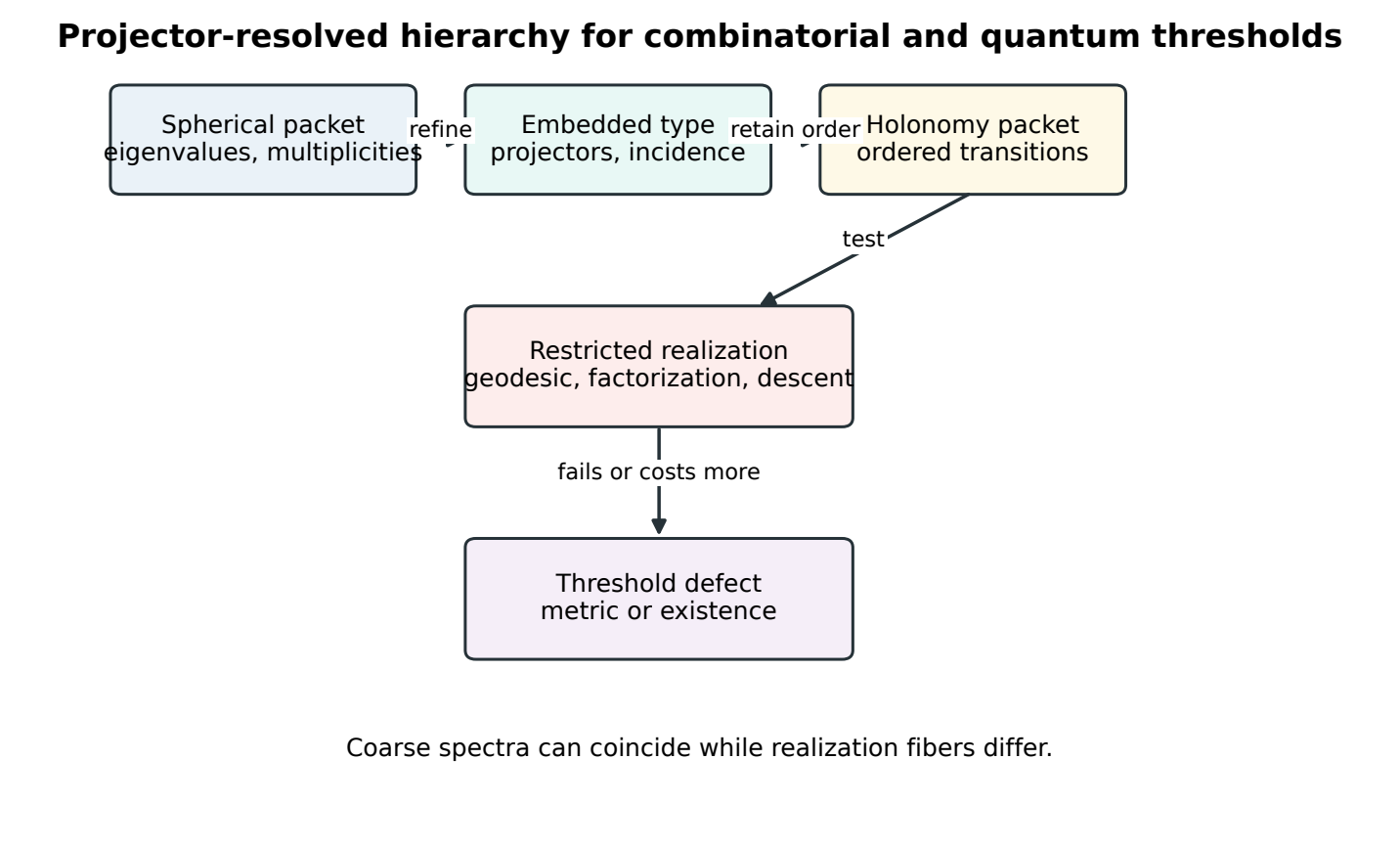
This chapter develops the hierarchy
The relation \(\prec\) means “retains strictly more potentially relevant information,” not that every refinement is complete.
11.1.2 Spherical packets
On this page · Permalink · Source line 4544
Let \(T_1,\ldots,T_m\) be commuting normal operators on a finite-dimensional Hilbert space. Their unique coarsest joint spectral resolution is
The tuple
is the spherical label. The abstract spectral packet records these labels and the ranks of \(B_\lambda\).
Two different embedded systems can have the same abstract packet. The actual matrices \(B_\lambda\), endpoint coefficients, and transition operators may still differ.
Principle 11.1: Spherical collapse
Passing from embedded operators to eigenvalues and multiplicities can erase exactly the incidence or transition data that controls restricted realization.
11.1.3 The Latin-square association algebra
On this page · Permalink · Source line 4563
A Latin square \(L\) of order \(n\) has \(n^2\) cells. Let \(R,C,S\) be adjacency matrices for equality of row, column, and symbol. The algebra generated by \(I,J,R,C,S\) is commutative and its abstract multiplication table depends only on \(n\), not on the paratopy class of \(L\).
Define
Then the five joint projectors are
Their multiplicities are
The Latin-square graph \(R+C+S\) has universal spectrum
At \(n=6\) this becomes
Thus the graph spectrum cannot distinguish the twelve main classes of order six.
Proved statement
The displayed projector formulas depend only on the Latin-square axioms and the order. They therefore prove that the abstract \(R,C,S\) joint eigenvalue packets cannot distinguish squares of the same order. This conclusion does not require an enumeration of the order-six main classes.
11.1.4 Transition fusion also collapses
On this page · Permalink · Source line 4610
Let \(\rho_i\) be the row permutations of a Latin square. The symmetrized aggregate of all pair transitions satisfies
Hence first-order fusion destroys the class information as well.
The lesson is general: summing typed transitions can be as destructive as discarding the embedded projectors. Order and labels matter.
11.1.5 Embedded type data
On this page · Permalink · Source line 4625
A type packet retains the actual projectors, support partitions, distinguished incidence sets, or local representation types. Examples include:
the row, column, and symbol partitions of a Latin square;
a projective-line closure system;
the flag stabilized by a circuit subgroup;
support patterns of unitary or quantum-Latin entries;
ramification or block data in a finite group action.
A projective-line closure procedure can supply additional type operators, such as adjacency operators of a line spread. Whether a particular added operator separates two classes is a further question. The present archive does not include the separate order-six projective computation, so it supplies no new finite certification of that comparison.
11.1.6 Holonomy packets
On this page · Permalink · Source line 4637
Let a family of local charts or rows be represented by permutations \(\rho_i\). Define normalized transitions
and the transition group
A holonomy packet may include:
the isomorphism type or order of \(H_r(L)\),
the cycle-type inventory of the distinguished \(h_{ij}\),
block systems and orbit partitions,
characters or matrix coefficients of words in the \(h_{ij}\),
noncommutative moments
\[ \operatorname{tr}(h_{i_1j_1}\cdots h_{i_kj_k}), \]the corresponding packets for row, column, and symbol roles.
Isotopy conjugates these transition groups; paratopy permutes the three roles. Therefore the unordered multiset of role signatures is a paratopy invariant.
Research template
For a specified collection of Latin squares, one can compute transition-group orders, pair-transition cycle inventories, and nontrivial block sizes, then test whether the resulting role signatures separate the collection. The separate order-six input tables and verifier are not included in this archive, so pairwise separation of all twelve main classes is an open verification obligation here.
Even a complete discrete classification would not prove orthonormal representability. Noncommutative transition data are candidate refinements of the information lost under spherical fusion.
11.1.7 Imprimitivity as hidden decomposition
On this page · Permalink · Source line 4666
A transitive permutation group is imprimitive when it preserves a nontrivial block system. In combinatorial designs, imprimitivity often signals a subsquare, product, congruence, or module decomposition.
For a Latin square of order \(2m\), normalize one row to the identity permutation on the symbols. An \(m\times m\) Latin subsquare determines a partition of the symbols into its \(m\) symbols and their complement. Rows meeting the subsquare preserve the two corresponding column blocks, and the remaining rows exchange them. Thus normalized row transitions preserve this two-block system. Conversely, if all normalized row transitions preserve a partition into two blocks of size \(m\), exactly \(m\) rows send a fixed column block into a fixed symbol block, producing an \(m\times m\) Latin subsquare. This is a structural criterion. Counting the order-six classes with this property requires separate input representatives.
Principle 11.2: Clifford-type decomposition
Combinatorial substructure can be detected as imprimitivity of a transition packet. The spherical packet sees aggregate multiplicities; the holonomy packet sees how those multiplicities are assembled into blocks.
11.1.8 Realization fibers
On this page · Permalink · Source line 4675
Let \(P\) denote packet data and let
be the space of restricted realizations compatible with \(P\). The packet may completely classify the discrete object while the realization fiber remains empty, positive dimensional, disconnected, or singular.
Examples of realization conditions include:
a flag-preserving geodesic with a declared length;
a product-state orthonormal representation;
a positive semidefinite Gram matrix with a zero pattern;
a tensor factorization;
a global descent object compatible with local packets;
a circuit satisfying ancilla restoration on every input.
Thus classification and realization are distinct layers.
11.1.9 Quantum Latin squares as an existence defect
On this page · Permalink · Source line 4694
A quantum Latin square is an array [11] of vectors whose rows and columns are orthonormal bases. Ball and Simoens prove that a pair of non-entangled mutually orthogonal quantum Latin squares of order six does not exist, while earlier work provides entangled order-six solutions and hence AME\((4,6)\) states [8], [12], [39].
This is naturally expressed as
It is an existence defect, not a gate-count defect.
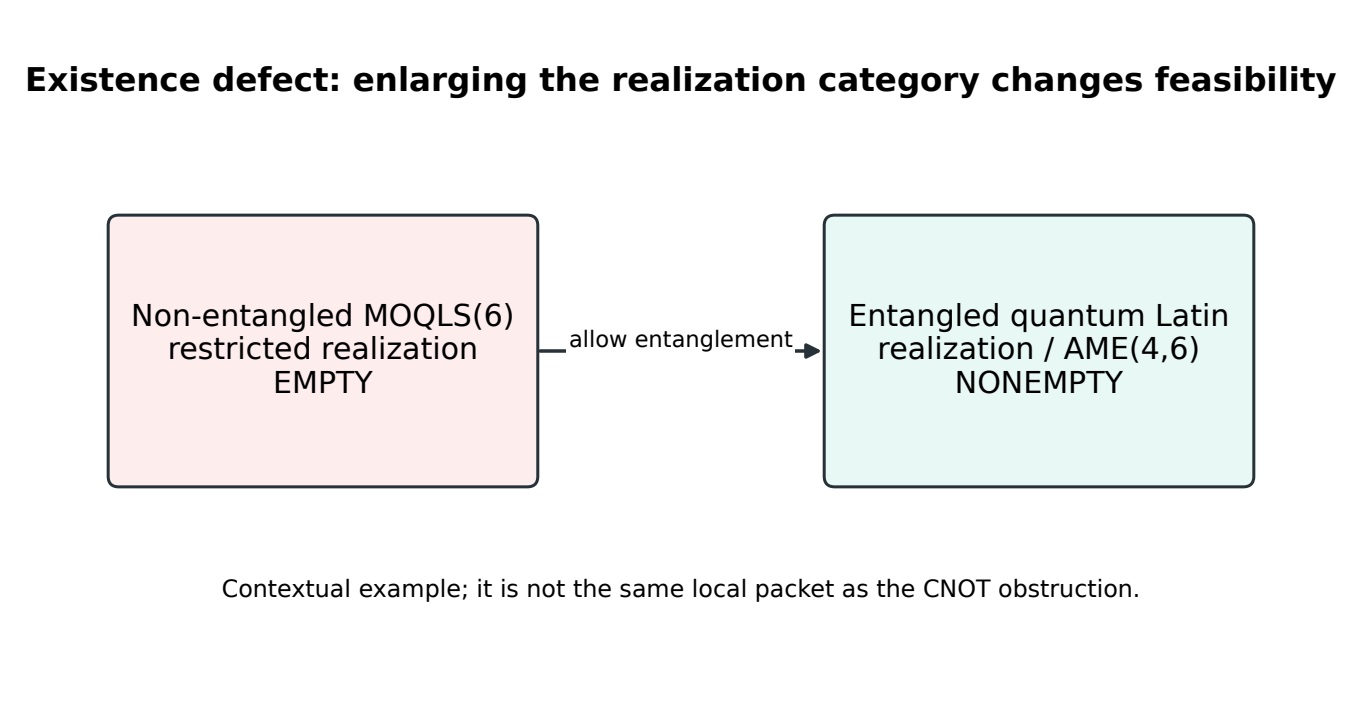
The source proof uses support patterns, a reduction to one classical square, orthonormal representations of complements of Latin-square graphs, projective-line closure, finite case analysis over twelve main classes, and a continuous argument for the two remaining subsquare cases. No theorem in the unitriangular or Clifford chapters is inferred from this result.
11.1.10 First-arrival packets
On this page · Permalink · Source line 4714
For a finite generator set \(S\), the endpoint Green kernel
contains more information than the spectrum of \(A_S\). Its first nonzero degree is the distance to \(g\).
If
then
The endpoint matrix coefficients of the embedded projectors determine cancellation between spectral components. This is the metric analogue of retaining a type rather than only an unramified eigencharacter.
11.1.11 Typed Green kernels
On this page · Permalink · Source line 4736
Let \(H\le G\) and let \(\mu_k(h)\) count ambient words of length \(k\) with holonomy \(h\in H\). For an irreducible representation \(\tau\) of \(H\), define
and
Fourier inversion recovers every \(\mu_k(h)\). The trivial representation records only total return to the subgroup; nontrivial types resolve the holonomy.
Proved statement
For finite \(H\), the full family of typed Green kernels over \(\widehat H\) determines every endpoint Green series and therefore every ambient word distance from the identity to an element of \(H\).
11.1.12 Operational Langlands analogy
On this page · Permalink · Source line 4755
The hierarchy resembles the local organization of representation theory:
The analogy is useful because it prevents coarse spectral data from being mistaken for a complete correspondence. It does not imply that global Langlands reciprocity predicts either the circuit threshold or the quantum-Latin result.
Scope boundary
The word “Langlands” in this monograph refers to an operational packet architecture: commuting local spectra, type refinement, noncommutative holonomy, tensor assembly, and descent obligations. No general automorphic or Galois correspondence is claimed or used.
11.1.13 A general finite threshold system
On this page · Permalink · Source line 4772
A packet-resolved threshold system consists of:
a finite group, groupoid, or association scheme;
a commutative spherical algebra with exact projectors;
embedded incidence or type data;
a transition group or monodromy representation;
restricted and ambient realization categories;
a metric, multiplicity, or descent obstruction.
The first threshold may then be defined as
The cost can be finite or infinite.
11.1.14 Open problems
On this page · Permalink · Source line 4790
Question 11.3
For which finite association schemes does the full embedded Bose–Mesner algebra determine the restricted realization fiber?
Question 11.4
What bounded degree of noncommutative transition moments separates all Latin squares of a fixed order?
Question 11.5
Can typed Green kernels yield new lower bounds without enumerating the full ambient group?
Question 11.6
When does imprimitivity of a transition packet characterize a tensor or subsquare decomposition in quantum combinatorial designs?