
An arbitrary cut compares two reversible computations
On this page · Permalink · Source line 40
Write the circuit as \(C=Q\circ P\). The prefix \(P\) runs forward; the inverse suffix \(Q^{-1}\) starts from the same zero-target boundary state. Define
The zero ancillas are suppressed here. The two executions generally arrive at different interior states, even though they start at matching boundaries.
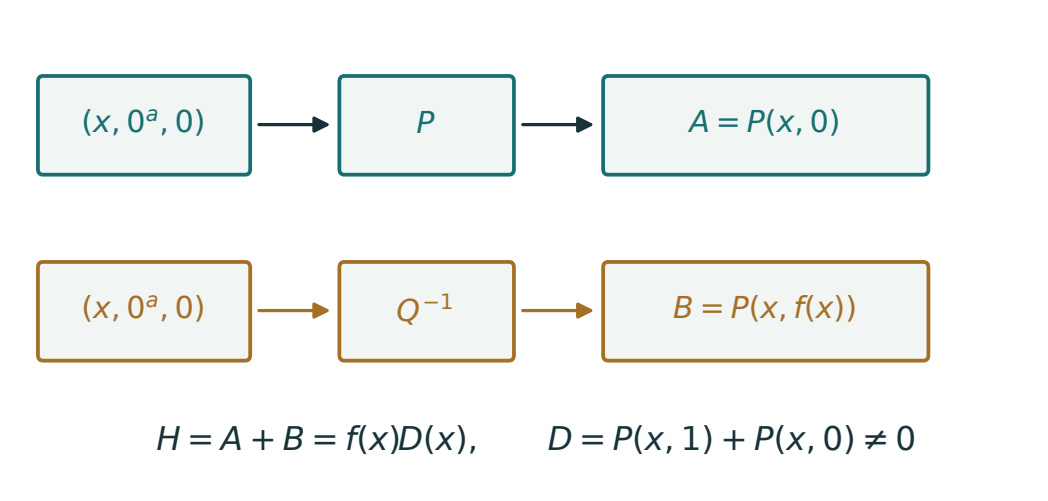
Correctness on both target branches gives
To derive it, apply \(C\) to \((x,b+f(x))\) and then apply \(Q^{-1}\) to the result. For \(b=0\), \(B=A\) when \(f(x)=0\), while \(B=P(x,1)\) when \(f(x)=1\). Thus
The two original states differ in their target. Since \(P\) is injective, \(D(x)\ne0\). Each coordinate discrepancy is supported on positives, and some coordinate discrepancy detects every positive input.
General written identity; archived formal declarations cut_transport_identity, direction_nonzero, and complete_safe_cover.