
Suppose all noise observations are independent and centered, with moment-generating bound \(\mathbb E e^{\lambda\eta}\le e^{\sigma^2\lambda^2/2}\). Averaging \(R\) observations at each of \(n+1\) sample sites replaces \(\sigma\) by \(\sigma/\sqrt R\). A sufficient recovery condition is
The probability of simultaneous recovery is then at least \(1-\delta\), subject to the same separated-jump sampling model.
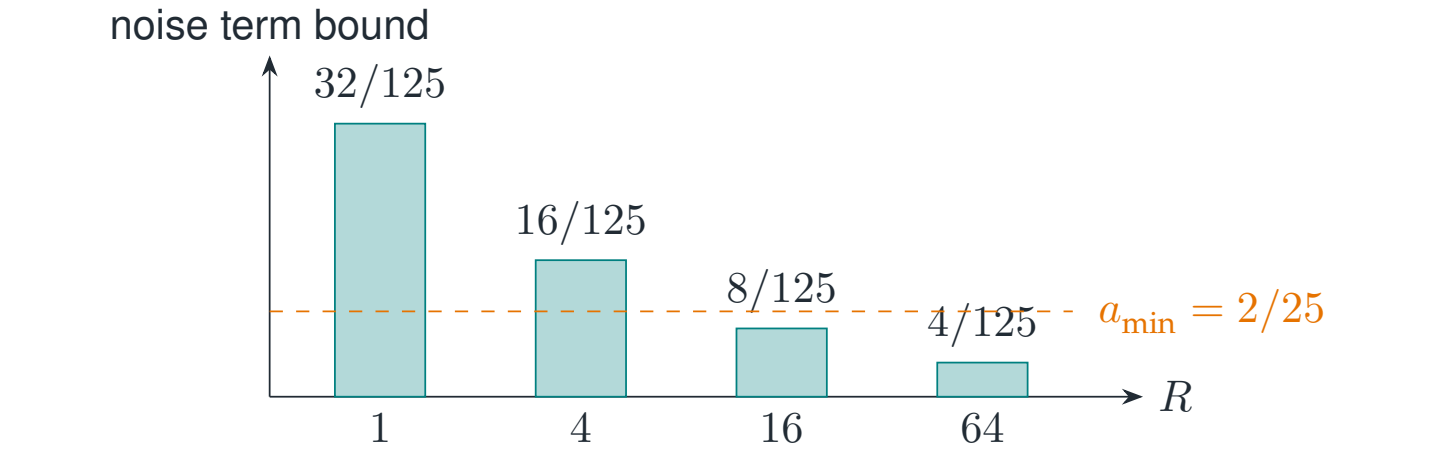
Reading the drawing
Bars show the noise contribution at the labeled repetition counts. A dashed comparison line marks the available contrast budget.
Drawing labels and data 11 labels
Read the original labels as selectable text. Tables preserve grid relationships; other short labels are grouped compactly.
- \(R\)
- noise term bound
- \( 32/125 \)
- \( 1 \)
- \( 16/125 \)
- \( 4 \)
- \( 8/125 \)
- \( 16 \)
- \( 4/125 \)
- \( 64 \)
- \(a_{\min}=2/25\)
One explicit conservative choice
Take \(n=256\), \(M=1/2\), \(\sigma=1/50\), \(\delta=1/20\), and \(a_{\min}=2/25\). Since \(\log(10240)<10<(16/5)^2\), choosing \(R=16\) makes the right-hand side strictly less than
Thus sixteen independent observations per sample site suffice for this bound. It is a sufficient budget, not a claim of optimal sample complexity. The exact checker certifies \(e^{10}>10240\) using a rational Taylor partial sum, so the displayed logarithm bound is not based on rounded numerical logarithms.
Dependence between adjacent contrasts is allowed
Neighboring differences share one sample. The proof does not require those differences to be independent: it bounds each tail and applies a union bound across all cells. Independence of the underlying sample noises supplies the stated subGaussian difference proxy. For a fixed separated signal model, a noise scale satisfying \(\sigma_n\sqrt{\log n}\to0\) gives the stated recovery consistency in probability. A fixed positive noise scale with one observation per site does not satisfy that condition.
Read this as
More grid points and more repeated observations affect different terms. Finer spacing reduces background variation; averaging reduces noise.