
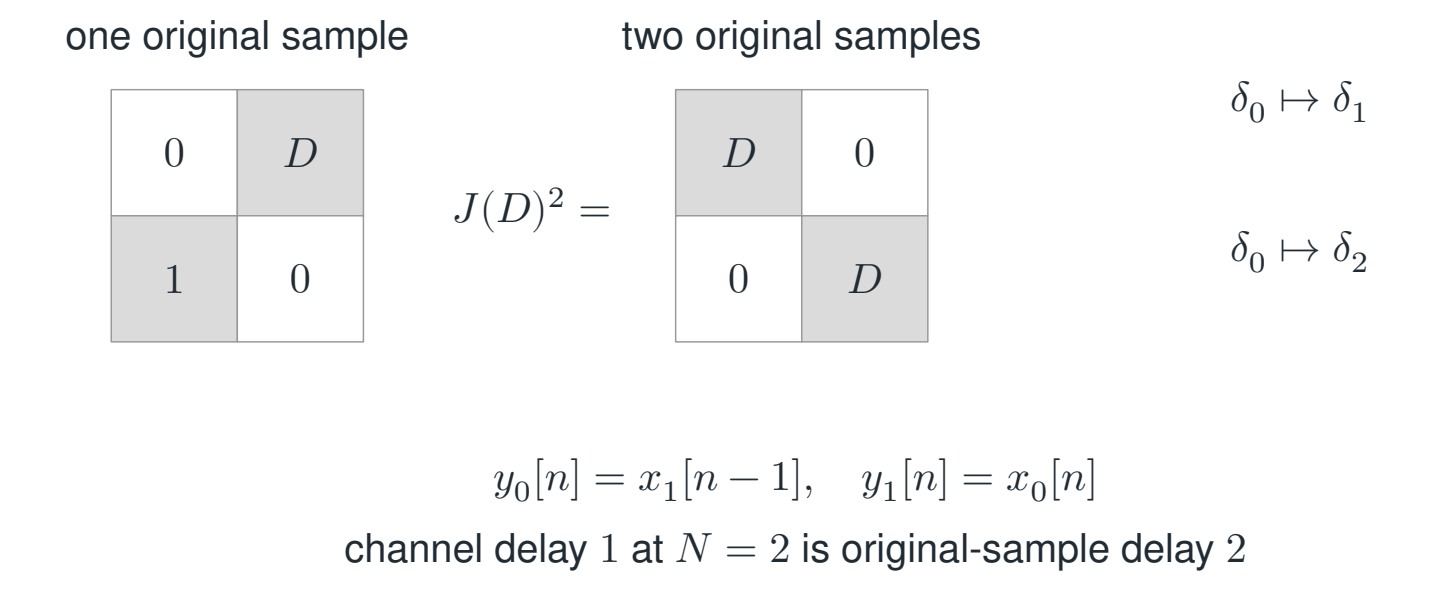
A one-sample delay swaps the two phases and wraps one of them into the preceding channel index. Its matrix is \(J(D)\), not \(DI_2\).
Reading the drawing
Two matrices and their impulse routes compare an original-sample delay with a channel-index delay. The two operations move the impulse to different original addresses.
Drawing labels and data 15 labels
Read the original labels as selectable text. Tables preserve grid relationships; other short labels are grouped compactly.
- one original sample
| Row / column | Column 1 | Column 2 |
|---|---|---|
| Row 1 | \(0\) | \(D\) |
| Row 2 | \(1\) | \(0\) |
- \(J(D)^2=\)
- two original samples
| Row / column | Column 1 | Column 2 |
|---|---|---|
| Row 1 | \(D\) | \(0\) |
| Row 2 | \(0\) | \(D\) |
- \(\delta_0\mapsto\delta_1\)
- \(\delta_0\mapsto\delta_2\)
- \(y_0[n]=x_1[n-1],\quad y_1[n]=x_0[n]\)
channel delay \(1\) at \(N=2\) is original-sample delay \(2\)
Trace one impulse
The input \(\delta_0\) has a single nonzero value in even channel address zero. Under \(J(D)\) it appears in odd channel address zero: this is the original sample \(\delta_1\). Under \(DI_2\) it stays even but moves to channel address one: this is \(\delta_2\). Thus
recovers the previous page's four-tap transfer matrix. The same delay algebra explains both the off-diagonal phase swap and the channel powers.
Signed delays need the same care
For an original-sample delay \(d\) at modulus \(N\),
This includes advances when \(d<0\). The finite verification checks the formula on signed sample addresses. A bank with product \(D^qI_N\) delays the original signal by \(Nq\) samples, not \(q\) samples.
Read this as
Always state the unit of a delay. A phase permutation and a channel delay together can represent one original sample.