
E9 Stable recovery of separated jumps
On this page · Permalink · Source line 2886
The detector needs a visible interval of thresholds
A smooth cell and bounded sample noise give one upper contrast bound. A jump cell gives a lower contrast bound after the same uncertainty is subtracted. Recovery is possible when the lower jump bound exceeds the upper smooth bound. The gap is a condition on the observation model, rather than an automatic consequence of packet coordinates.
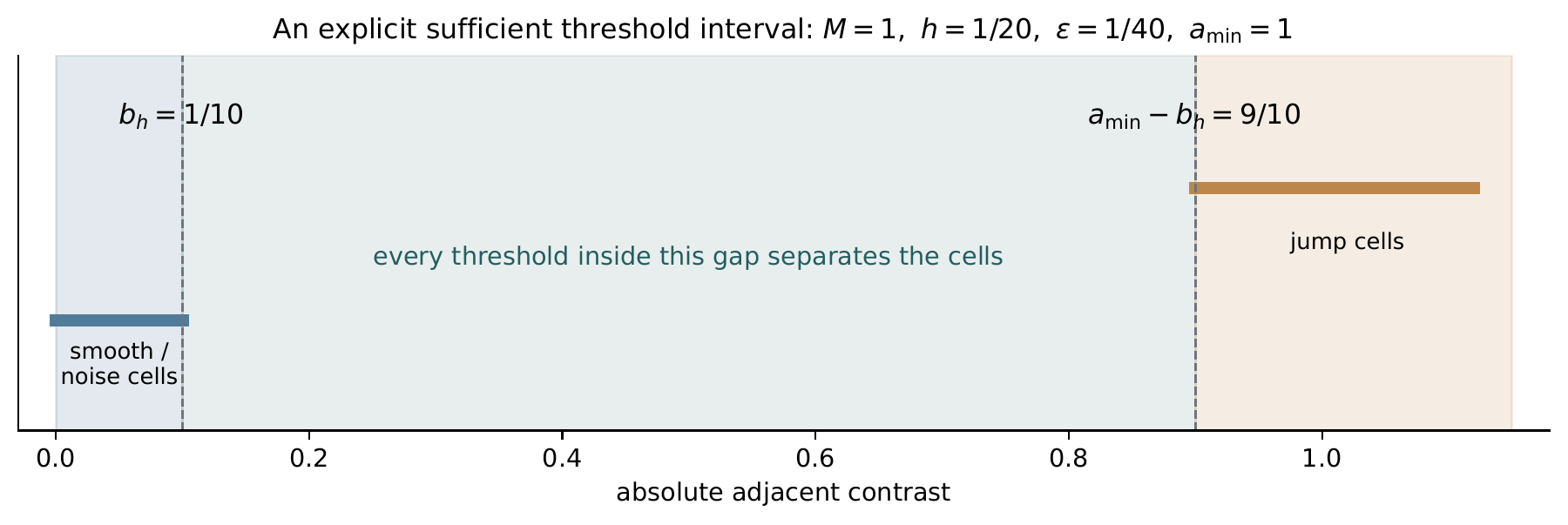
The previous sections describe the error after a packet has been estimated. We now give a direct recovery theorem for one dimensional separated jumps. The detector is intentionally simple because the aim is to expose the exact contrast gap.
Let
Assume
where \(s\) is Lipschitz with constant \(M\), and \(Q\geq1\) is finite with nonzero jump amplitudes. The zero-jump case requires no minimum-amplitude condition. Suppose no jump lies at a sample point and no grid cell contains more than one jump. Observe
Define the adjacent contrast
Lemma E9.1: Contrast gap
Assume \(|\eta_k|\leq\varepsilon\) and set
If the cell \((t_k,t_{k+1})\) contains no jump, then
If it contains one jump of amplitude \(a_q\), then
and therefore
Read proof · Visual guide: A strict contrast gap locates every separated jump cell · Read statement and proof side by side · Permalink · Source line 2924 · Claim record · Lean coverage · Code · Worked examples
Proof of Lemma E9.1
In a cell without a jump,
The Lipschitz and noise bounds give \(|D_k|\leq Mh+2\varepsilon\). In a cell with one jump, the same formula has the additional term \(a_q\), which proves the second estimate.
Back to statement · Read statement and proof side by side · Permalink · Source line 2943 · Claim record · Lean coverage · Code · Worked examples
Theorem E9.2: Deterministic jump cell recovery
Let
and assume
Choose a threshold \(\theta\) satisfying
Then
is exactly the set of grid cells containing jumps. If \(\widehat\tau_q\) is the midpoint of the detected cell and \(\widehat a_q=D_k\), then after matching by order,
and
Read proof · Visual guide: A strict contrast gap locates every separated jump cell · Read statement and proof side by side · Permalink · Source line 2951 · Claim record · Lean coverage · Code · Worked examples
Proof of Theorem E9.2
By Lemma E9.1, every cell without a jump has contrast at most \(b_h<\theta\). Every cell with a jump has contrast at least \(a_{\min}-b_h>\theta\). Hence the detected set is exact. The midpoint of a cell is within \(h/2\) of every point in that cell. The amplitude estimate is the second inequality in Lemma E9.1.
Back to statement · Read statement and proof side by side · Permalink · Source line 2984 · Claim record · Lean coverage · Code · Worked examples
Corollary E9.3: Jump count and sign recovery
Under the hypotheses of Theorem E9.2, the number of detected cells equals \(Q\), and
for every real valued jump.
Read proof · Read statement and proof side by side · Permalink · Source line 2988 · Claim record · Lean coverage · Code · Worked examples
Proof of Corollary E9.3
Exact cell recovery gives the jump count. Since
the amplitude estimate cannot cross zero.
Back to statement · Read statement and proof side by side · Permalink · Source line 2996 · Claim record · Lean coverage · Code · Worked examples
Corollary E9.4: Packet reconstruction after detection
Let
Under the hypotheses of Theorem E9.2, for \(1\leq p<\infty\),
If \(Q_m\) is bounded and linear and
then
Read proof · Read statement and proof side by side · Permalink · Source line 3004 · Claim record · Lean coverage · Code · Worked examples
Proof of Corollary E9.4
Write
The first sum has norm at most \(\sum_q|a_q-\widehat a_q|\leq Qb_h\). The location error interval for the \(q\)th jump is contained in its detected grid cell and has length at most \(h/2\). Distinct detected cells are disjoint, so the location errors have disjoint supports. Their \(p\)th powers therefore add exactly, which gives the displayed location term. The reconstruction estimate follows from Theorem E7.8.
Back to statement · Read statement and proof side by side · Permalink · Source line 3042 · Claim record · Lean coverage · Code · Worked examples
Remark E9.5: Why finite \(L^p\) matters
A shifted step does not converge in the supremum norm until the location is exact. The finite \(L^p\) error does converge because the disagreement is confined to an interval whose length tends to zero.
Corollary E9.6: Deterministic consistency
Assume \(h\to0\) along grids satisfying the preceding sampling assumptions, \(\varepsilon_h\to0\), the number of jumps is fixed, and the nonzero jump amplitudes and positive minimum separation remain fixed. Then the detected packet converges to the true packet in every finite \(L^p\) norm. If \(Q_m\) has a vanishing smooth approximation error and uniformly bounded norm, the complete reconstruction also converges in \(L^p\).
Read proof · Read statement and proof side by side · Permalink · Source line 3058 · Claim record · Lean coverage · Code · Worked examples
Proof of Corollary E9.6
The gap condition holds for sufficiently small \(h\). Then \(b_h\to0\), and the bound in Corollary E9.4 tends to zero.
Back to statement · Read statement and proof side by side · Permalink · Source line 3062 · Claim record · Lean coverage · Code · Worked examples
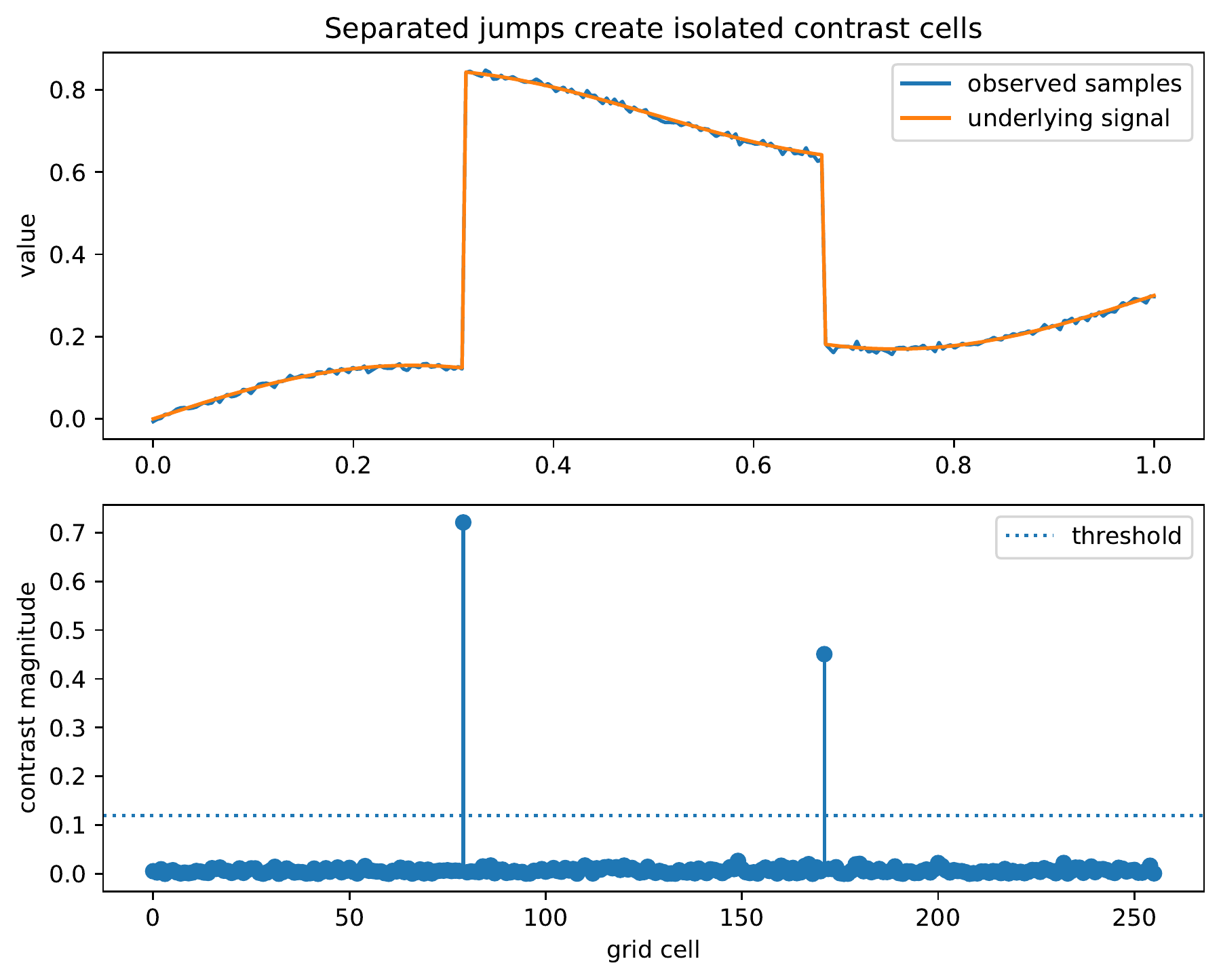
Example E9.7: A numerical threshold certificate
Take \(h=1/256\), \(M=0.5\), and \(\varepsilon=0.002\). Then
If every jump has magnitude at least \(0.08\), then \(0.08>2b_h\). Any threshold between \(0.00596\) and \(0.07404\) recovers the exact jump cells. The location error is at most
and every amplitude error is less than \(0.00596\).
Visual guide: A strict contrast gap locates every separated jump cell · Permalink · Source line 3073
E9.1 Sub Gaussian noise
On this page · Permalink · Source line 3087
Assume the noise variables are independent, centered, and \(\sigma\) sub Gaussian:
Theorem E9.8: Probability recovery bound
Fix \(0<\delta<1\) and define
and
With probability at least \(1-\delta\), every contrast satisfies the conclusions of Lemma E9.1 with \(b_h\) replaced by \(b_{h,\delta}\).
If
then thresholding between \(b_{h,\delta}\) and \(a_{\min}-b_{h,\delta}\) recovers every jump cell with probability at least \(1-\delta\). The same location and amplitude bounds hold with \(b_{h,\delta}\).
Read proof · Visual guide: Repeated observations shrink the noise side of the gap · Read statement and proof side by side · Permalink · Source line 3096 · Claim record · Lean coverage · Code · Worked examples
Proof of Theorem E9.8
If \(\sigma=0\), every centered zero-sub-Gaussian noise variable vanishes almost surely, and the noise-free deterministic conclusion applies. For \(\sigma>0\), the difference \(\eta_{k+1}-\eta_k\) is sub Gaussian with variance proxy \(2\sigma^2\), so
A union bound over the \(n\) cells gives
On the complementary event, repeat the deterministic proof.
Back to statement · Read statement and proof side by side · Permalink · Source line 3117 · Claim record · Lean coverage · Code · Worked examples
Corollary E9.9: Repeated measurements
Suppose \(R\) observations are averaged at every sample location, with all noise variables independent across sites and repetitions and each centered and \(\sigma\) sub Gaussian. Then Theorem E9.8 holds with \(\sigma\) replaced by \(\sigma/\sqrt R\). In particular, a sufficient recovery condition is
Read proof · Visual guide: Repeated observations shrink the noise side of the gap · Read statement and proof side by side · Permalink · Source line 3135 · Claim record · Lean coverage · Code · Worked examples
Proof of Corollary E9.9
The average of \(R\) independent \(\sigma\) sub Gaussian variables is \(\sigma/\sqrt R\) sub Gaussian. Substitute this parameter in Theorem E9.8.
Back to statement · Read statement and proof side by side · Permalink · Source line 3146 · Claim record · Lean coverage · Code · Worked examples
Remark E9.10
The displayed uniform noise certificate scales as \(\sigma\sqrt{\log n}\). At fixed positive \(\sigma\), it does not imply consistency of this detector. Decreasing the noise scale or averaging repeated measurements gives sufficient regimes; other averaging schemes require their own analysis.
Corollary E9.11: Probability consistency
Let \(\sigma_n\sqrt{\log n}\to0\) and \(h=1/n\). For every fixed \(0<\delta<1\), along grids satisfying the preceding sampling assumptions, all jump cells are recovered with probability at least \(1-\delta\) for sufficiently large \(n\). For the fixed finite jump model above, along grids satisfying the preceding sampling assumptions, the packet error converges to zero in probability in every finite \(L^p\) norm.
Read proof · Visual guide: Repeated observations shrink the noise side of the gap · Read statement and proof side by side · Permalink · Source line 3154 · Claim record · Lean coverage · Code · Worked examples
Proof of Corollary E9.11
For each fixed \(\delta>0\), \(b_{h,\delta}\to0\). Apply Theorem E9.8 and Corollary E9.4. For any error tolerance \(\epsilon>0\), the high-probability bound is eventually smaller than \(\epsilon\), so the limit superior of the probability that the packet error exceeds \(\epsilon\) is at most \(\delta\). Since \(\delta\) is arbitrary, convergence is in probability.
Back to statement · Read statement and proof side by side · Permalink · Source line 3158 · Claim record · Lean coverage · Code · Worked examples
E9.2 Signals with values in a normed space
On this page · Permalink · Source line 3162
The recovery proof does not depend on an ordering of the signal values.
Proposition E9.12: Vector jump recovery
Let the values lie in a normed space \(V\). Assume
and let the jump vectors satisfy \(\|a_q\|_V\geq a_{\min}\). Thresholding \(\|D_k\|_V\) gives the same recovery theorem under the condition
Read proof · Read statement and proof side by side · Permalink · Source line 3166 · Claim record · Lean coverage · Code · Worked examples
Proof of Proposition E9.12
Only the triangle inequality was used in Lemma E9.1 and Theorem E9.2.
Back to statement · Read statement and proof side by side · Permalink · Source line 3179 · Claim record · Lean coverage · Code · Worked examples