
Apply Haar analysis to both children. A binary address records the chronological low/detail choices, with \(0\) for low and \(1\) for detail. Each depth-two channel contains four coefficients.
Reading the drawing
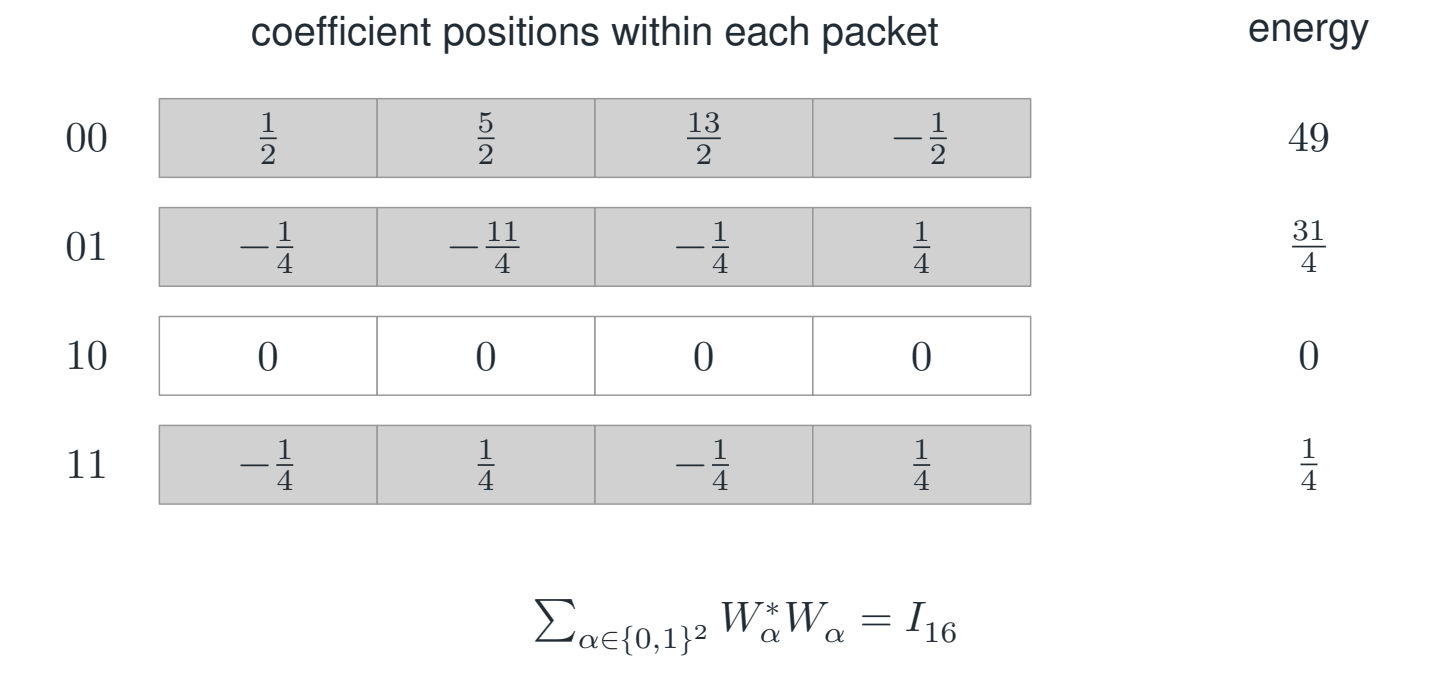
Rows display the four depth-two channel coefficient vectors and their energies. The identity beneath them reconstructs the original signal from the packet projectors.
Drawing labels and data 27 labels
Read the original labels as selectable text. Tables preserve grid relationships; other short labels are grouped compactly.
| Row / column | Column 1 | Column 2 | Column 3 | Column 4 |
|---|---|---|---|---|
| \(00\) | \(\frac{1}{2}\) | \(\frac{5}{2}\) | \(\frac{13}{2}\) | \(- \frac{1}{2}\) |
| \(01\) | \(- \frac{1}{4}\) | \(- \frac{11}{4}\) | \(- \frac{1}{4}\) | \(\frac{1}{4}\) |
| \(10\) | \(0\) | \(0\) | \(0\) | \(0\) |
| \(11\) | \(- \frac{1}{4}\) | \(\frac{1}{4}\) | \(- \frac{1}{4}\) | \(\frac{1}{4}\) |
- \(49\)
\(\frac{31}{4}\)
- \(0\)
\(\frac{1}{4}\)
- coefficient positions within each packet
- energy
The edge that first-level detail missed
Packet \(01\) is the detail child of the first low channel. It contains \(-11/4\), the large change between neighboring pair averages. Packet \(10\) vanishes for this particular signal because the first-level differences alternate in cancelling pairs. Neither feature is a universal identity for all inputs. The packet energies are
which again sum to \(57\). Two factors of \(1/\sqrt2\) explain why the depth-two coefficients are rational halves and quarters.
Coefficients and projectors are different objects
\(W_\alpha f\) is the short coefficient vector. The original-space component is \(W_\alpha^*W_\alpha f\). Summing these synthesized components, not the short arrays entrywise, reconstructs \(f\):
The finite verification constructs the actual analysis matrices and checks their product with their adjoints. The paper's \(\ell^2\) statement additionally establishes boundedness and the existence of the literal Hilbert adjoints.
Read this as
A packet address specifies an operator word. To add different packets as signals, synthesize them back into the common signal space first.