
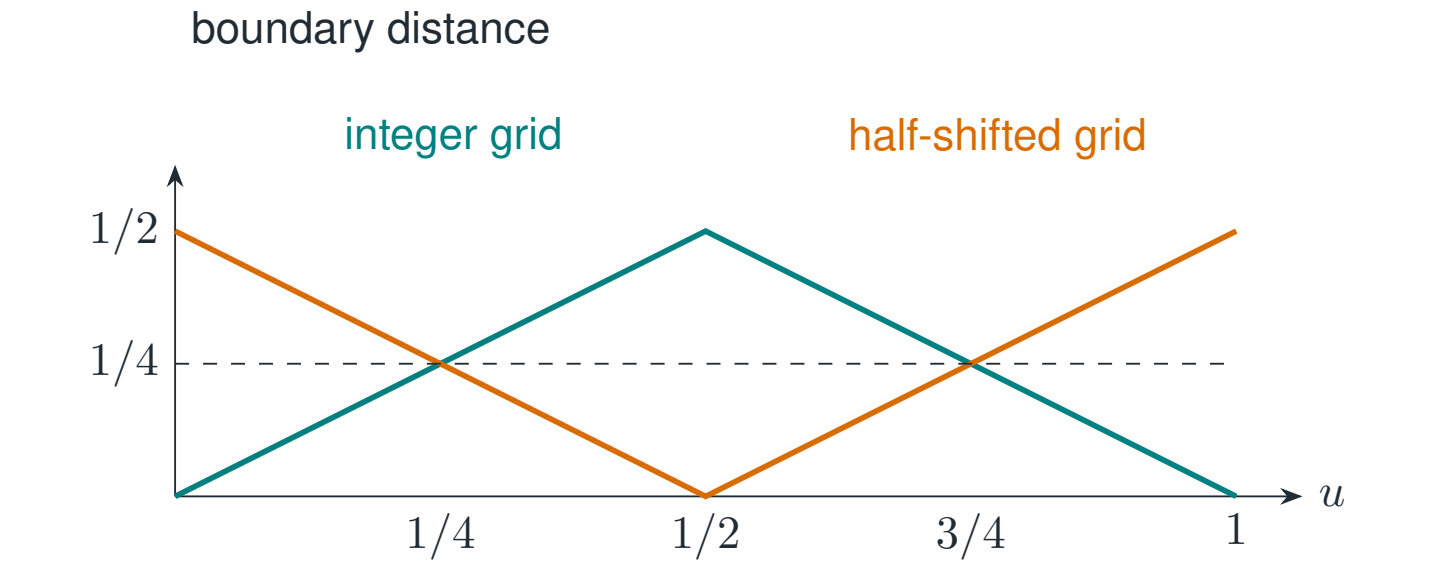
Normalize the support length to \(L=1\). The first grid has boundaries at integers; the second has boundaries at half-integers. For a point at position \(u\) modulo one, consider its distance to the nearest boundary of each grid.
Reading the drawing
Two triangular curves give the distance to the nearest boundary in the original and half-shifted grids. Their intersection levels show the quarter-cell guarantee.
Drawing labels and data 10 labels
Read the original labels as selectable text. Tables preserve grid relationships; other short labels are grouped compactly.
- \(u\)
- boundary distance
- \(1/4\)
- \(1/2\)
- \(1/4\)
- \(1/2\)
- \(3/4\)
- \(1\)
- integer grid
- half-shifted grid
At least one distance is one quarter or larger
If \(1/4\le u\le3/4\), the original cell works. Outside that range, a shifted cell works. At \(u=1/8\), the original margin is \(1/8\) but the shifted cell \([-1/2,1/2)\) gives margin \(3/8\). At \(u=1/4\), both margins equal \(1/4\), showing that the uniform constant cannot be increased for these two grids. Restoring \(L\), every jump has a support with boundary distance at least \(L/4\) in one grid. If \(L\) is smaller than the minimum jump separation, that support contains no other jump.
Insert the geometric guarantee into the analytic estimate
The alignment-independent gap condition is
For the numbers on V37, the right side is \(1/50+1/8=29/200\), strictly below \(1/4\). Hence one of the two grids supplies a detectable support for every jump, regardless of its position relative to the original grid. This certifies a useful support per jump. It does not by itself specify a unique rule for merging duplicate detections from two grids into exact breakpoint estimates.
Read this as
A second grid repairs a geometric blind spot. The contrast inequality and separation hypotheses still supply the recovery guarantee.