
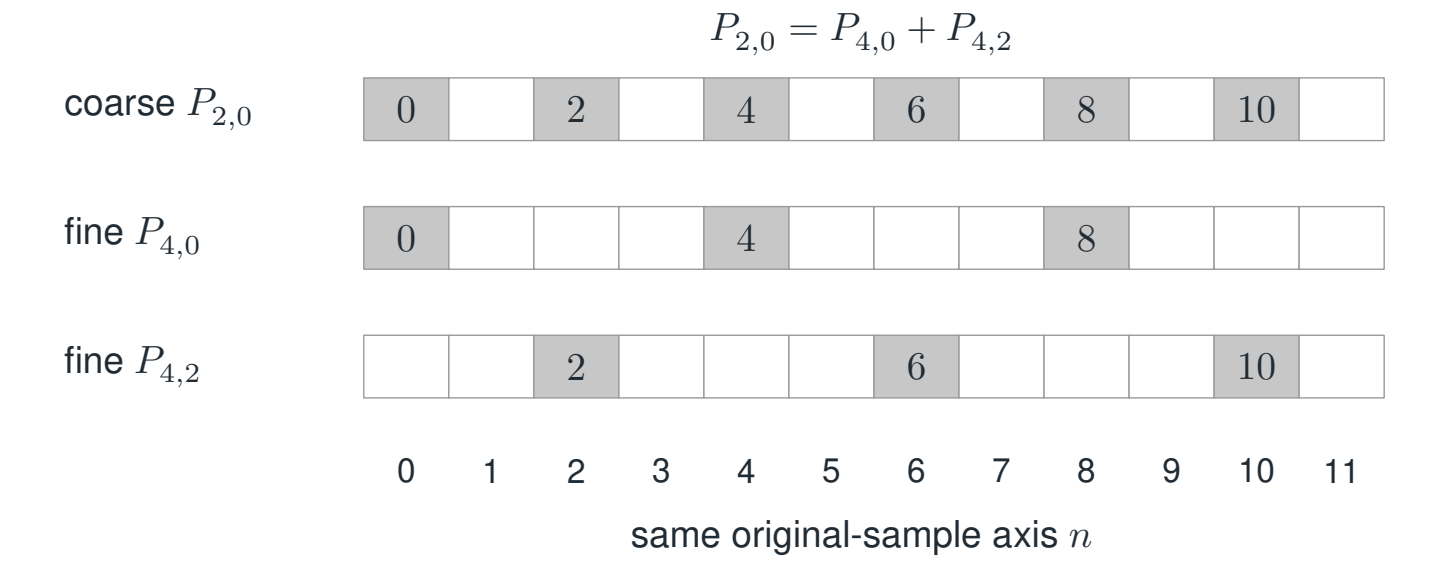
An even sample belongs to exactly one of residues \(0\) and \(2\) modulo four. Therefore the coarse even mask is the sum of two disjoint fine masks:
Reading the drawing
Three rows share the original sample axis. The even mask is partitioned into residues zero and two modulo four; blank cells are masked addresses.
Drawing labels and data 29 labels
Read the original labels as selectable text. Tables preserve grid relationships; other short labels are grouped compactly.
- coarse \(P_{2,0}\)
- \(0\)
- \(2\)
- \(4\)
- \(6\)
- \(8\)
- \(10\)
- fine \(P_{4,0}\)
- \(0\)
- \(4\)
- \(8\)
- fine \(P_{4,2}\)
- \(2\)
- \(6\)
- \(10\)
- 0
- 1
- 2
- 3
- 4
- 5
- 6
- 7
- 8
- 9
- 10
- 11
- \(P_{2,0}=P_{4,0}+P_{4,2}\)
- same original-sample axis \(n\)
Evidence note from the source edition
The common horizontal axis is the original sample index. Empty cells denote masked-out addresses. There are no interpolated samples between the displayed cells.
Why the coordinate convention matters
The decimated channel \(f_0[q]=f[2q]\) has its own index \(q\). At modulus four the descendants are \(f[4q]\) and \(f[4q+2]\). These shorter arrays must be interleaved to recover the coarse channel. Adding them entrywise instead produces sums of different original samples. For example, at the first descendant address the values \(f[0]=0\) and \(f[2]=1/2\) are two separate values. Their sum \(1/2\) cannot tell us both of them. Exact refinement is a disjoint partition, not an averaging rule or a new measurement.
The general formula
When \(N\) divides \(M\),
The divisibility hypothesis ensures that every fine residue class lies entirely inside one coarse class. Without it, this particular descendant relation is not the right refinement rule.
Read this as
Finer coordinates can preserve the object exactly. Compressing their values to averages is an additional operation, with an additional information-loss question.