
Take \(L=2{\mathbb Z}\times3{\mathbb Z}\) inside \({\mathbb Z}^2\), with representatives
Every address has a unique expression \((i,j)=(r_1,r_2)+(2q_1,3q_2)\). The six channels are \(x_r(2q_1,3q_2)=x(r_1+2q_1,r_2+3q_2)\).
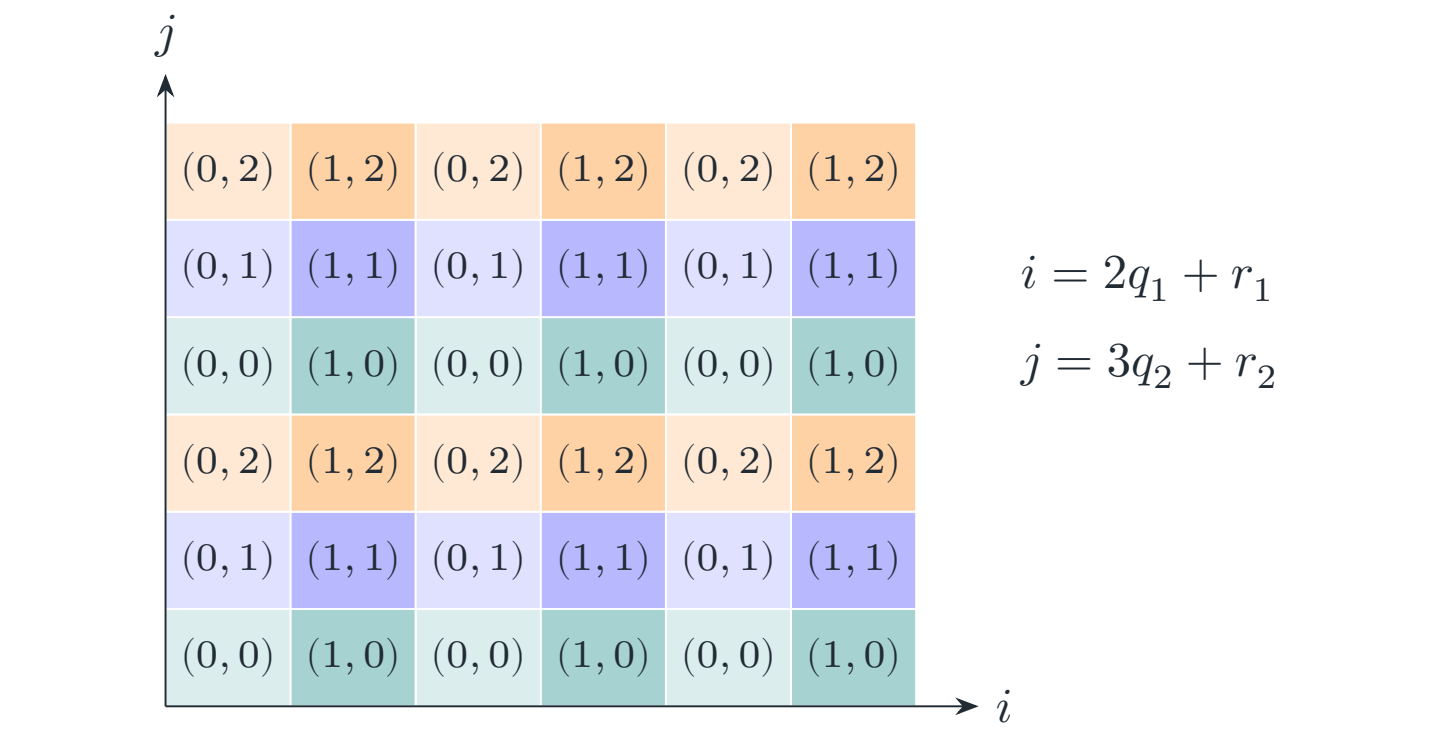
Reading the drawing
The colored lattice cells identify six address classes for a two-by-three sublattice. Labels retain the original horizontal and vertical index conventions.
Drawing labels and data 40 labels
Read the original labels as selectable text. Tables preserve grid relationships; other short labels are grouped compactly.
| Row / column | Column 1 | Column 2 | Column 3 | Column 4 | Column 5 | Column 6 |
|---|---|---|---|---|---|---|
| Row 1 | \((0,2)\) | \((1,2)\) | \((0,2)\) | \((1,2)\) | \((0,2)\) | \((1,2)\) |
| Row 2 | \((0,1)\) | \((1,1)\) | \((0,1)\) | \((1,1)\) | \((0,1)\) | \((1,1)\) |
| Row 3 | \((0,0)\) | \((1,0)\) | \((0,0)\) | \((1,0)\) | \((0,0)\) | \((1,0)\) |
| Row 4 | \((0,2)\) | \((1,2)\) | \((0,2)\) | \((1,2)\) | \((0,2)\) | \((1,2)\) |
| Row 5 | \((0,1)\) | \((1,1)\) | \((0,1)\) | \((1,1)\) | \((0,1)\) | \((1,1)\) |
| Row 6 | \((0,0)\) | \((1,0)\) | \((0,0)\) | \((1,0)\) | \((0,0)\) | \((1,0)\) |
- \(i\)
- \(j\)
- \(i=2q_1+r_1\)
- \(j=3q_2+r_2\)
Evidence note from the source edition
Each cell shows its residue label. Colors identify six disjoint classes; they do not average neighboring image pixels.
A negative address is still unique
The point \((-1,7)\) has representative \((1,1)\) and lattice displacement \((-2,6)\), hence channel index \((-1,2)\). Floor division gives the correct answer in both coordinates. For finite \(p\), the channel norm uses the sum of the \(p\)th powers. At \(p=\infty\), it uses their maximum. Both equal the norm on the original lattice because the cosets partition all addresses. In \(\ell^\infty\), this coordinate identity does not imply that translates of an impulse are dense: their closure is only \(c_0\).
Refinement partitions a class again
For \(L'=4{\mathbb Z}\times6{\mathbb Z}\subset L\), the coarse representative \((1,2)\) has fine representatives
Their original-lattice masks sum to the coarse mask. As on V4, decimated arrays are interleaved, not added entrywise.
Read this as
Dimension changes the address tuple. Unique coset decomposition still supplies exact synthesis and the correct norm identity.