
Represent impedance by a nonzero pair \([u:v]\), where \([cu:cv]=[u:v]\) for \(c\ne0\). A finite impedance is \([z:1]\); infinity is \([1:0]\). For a nonzero reflection multiplier \(w\), use
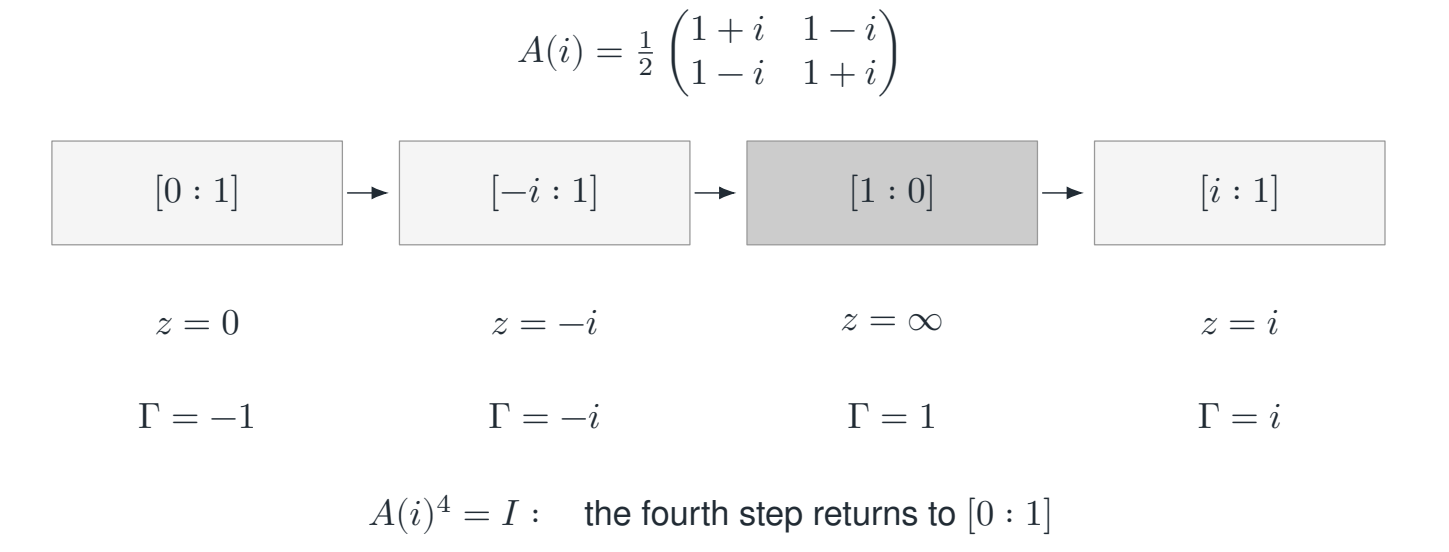
Reading the drawing
A sequence of homogeneous coordinate pairs follows the orbit through a chart pole. Affine coordinates below identify the infinite value without dividing by zero.
Drawing labels and data 14 labels
Read the original labels as selectable text. Tables preserve grid relationships; other short labels are grouped compactly.
- \([0:1]\)
- \(z=0\)
- \(\Gamma=-1\)
- \([-i:1]\)
- \(z=-i\)
- \(\Gamma=-i\)
- \([1:0]\)
- \(z=\infty\)
- \(\Gamma=1\)
- \([i:1]\)
- \(z=i\)
- \(\Gamma=i\)
\(A(i)^4=I:\quad\) the fourth step returns to \([0:1]\)
The action is defined before a ratio is taken
The determinant is \(w\), so the matrix cannot send a nonzero pair to zero. Direct multiplication gives
For \(w=i\), the orbit through zero is
The third point is a legitimate projective point, even though a finite impedance formula has a zero denominator there. The second iterate is \(A(-1)\), which swaps the two coordinates. Thus a half turn exchanges \(0\) and \(\infty\) and sends each finite nonzero \(z\) to \(1/z\). The matched point \(\Gamma=0\), equivalently \(z=1\), is fixed by every phase multiplier. It is not part of the boundary orbit above. The exact checks test homogeneous pairs and their rescaling equivalence, rather than introducing an artificial complex value for \(1/0\).
Read this as
Compute with homogeneous pairs first. A denominator becomes a chart-selection issue rather than an exception to the cyclic action.