
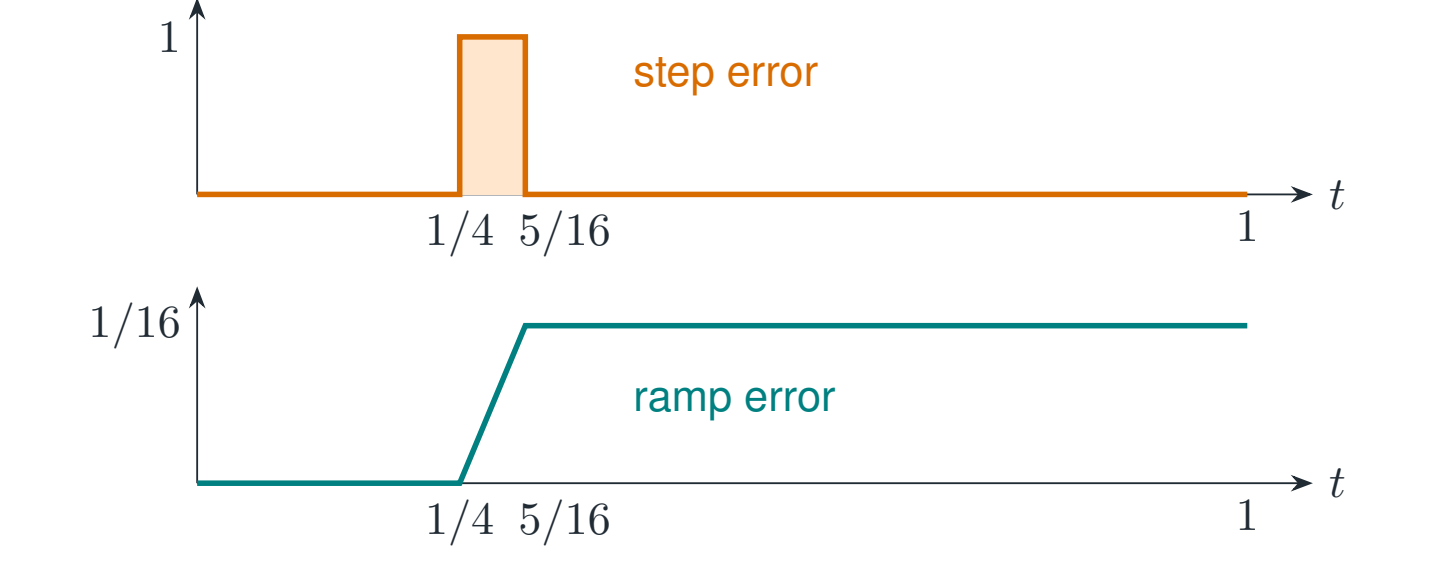
Set \(\tau=1/4\), \(\widehat\tau=5/16\), and \(\delta=1/16\). A unit step differs only on the interval between its two locations:
Reading the drawing
Two panels share the time variable but have different vertical scales. The upper step error has height one; the lower ramp error has height one sixteenth.
Drawing labels and data 12 labels
Read the original labels as selectable text. Tables preserve grid relationships; other short labels are grouped compactly.
- \(t\)
- \(1\)
- step error
- \(t\)
- \(1/16\)
- ramp error
- \(1/4\)
- \(5/16\)
- \(1\)
- \(1/4\)
- \(5/16\)
- \(1\)
For a ramp, the error height shrinks too
Write \(r_\tau(t)=(t-\tau)_+\). The difference grows linearly from zero to \(\delta\) on \([\tau,\widehat\tau]\) and stays at \(\delta\) on \([\widehat\tau,1]\). Direct integration gives
Thus the \(L^2\) ramp error is at most \(\delta\), and its supremum error is exactly \(\delta\). Positive-order truncated powers are Lipschitz in location, with the order-dependent constants supplied by the theorem.
The geometric analogue needs a tube hypothesis
If \(E\triangle F\subseteq N_\delta(\partial E)\) and the tube measure is bounded by \(C\delta\) for the stated range \(0<\delta<\delta_0\), then an equal-amplitude packet has finite-\(p\) error at most \(|a|(C\delta)^{1/p}\). A mere visual impression that two boundaries are close does not establish the inclusion or the tube estimate.
Read this as
A displaced value jump keeps its full height on a smaller set. A displaced derivative-jump packet also decreases in height.