
Assume a real signal is a Lipschitz background plus jumps. No jump occurs at a sample point, and each grid cell contains at most one jump. With spacing \(h\), background constant \(M\), and sample noise bounded by \(\varepsilon\), write
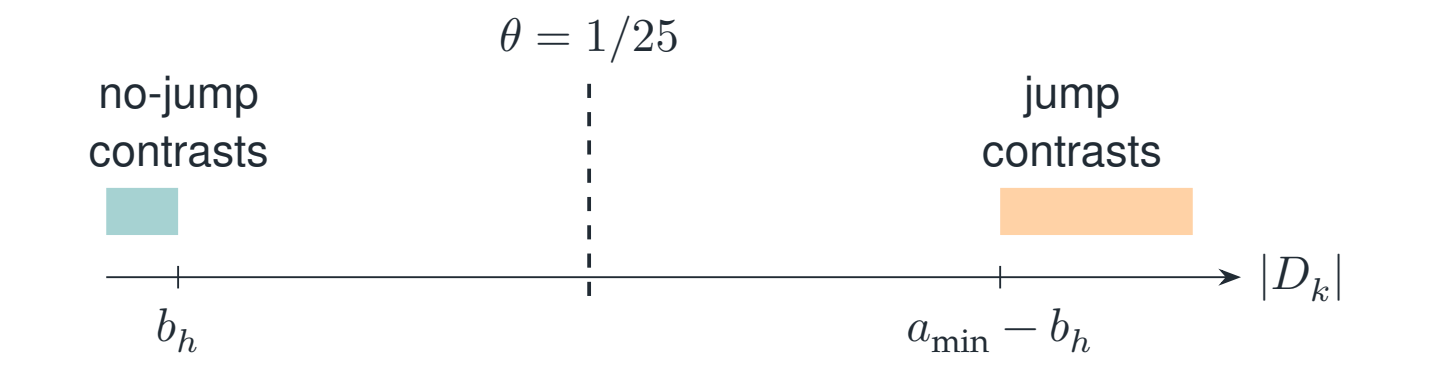
A no-jump contrast has magnitude at most \(b_h\). A jump contrast differs from its true amplitude by at most \(b_h\).
Reading the drawing
Separated horizontal ranges show no-jump and jump contrasts. A threshold lies strictly between their respective bounds.
Drawing labels and data 6 labels
Read the original labels as selectable text. Tables preserve grid relationships; other short labels are grouped compactly.
- \(|D_k|\)
- \(\theta=1/25\)
no-jump
contrasts
jump
contrasts
- \(b_h\)
- \(a_{\min}-b_h\)
Use the manuscript's exact numerical inputs
For \(h=1/256\), \(M=1/2\), \(\varepsilon=1/500\), and \(a_{\min}=2/25\),
The threshold \(\theta=1/25\) lies strictly between \(b_h\) and \(a_{\min}-b_h\). Thresholding \(|y_{k+1}-y_k|\) therefore identifies exactly the jump-containing cells. Their midpoints locate each jump within \(1/512\), and each estimated amplitude differs by at most \(381/64000\).
The recovered object is a cell, then an estimate
The theorem does not claim the exact real-valued breakpoint from a finite grid. It supplies the correct cell and a controlled representative of that cell. For real jumps, the amplitude error is too small to reverse the sign. Two opposite jumps in one cell could cancel in the contrast, which is why the separation assumption cannot be dropped. For \(Q\) jumps the finite-\(p\) packet bound contains both \(Qb_h\) and the location term \((\tfrac h2\sum_q|a_q|^p)^{1/p}\). A growing number of jumps or shrinking separation requires its own analysis.
Read this as
Exact detection means exact cell identification under a strict margin. Location and amplitude remain quantitative estimates with explicit errors.