
The complete depth-two transform is exact. Approximation begins only when we discard some of its sixteen coefficients. Order them by squared magnitude, with a deterministic address-and-position rule for ties.
Reading the drawing
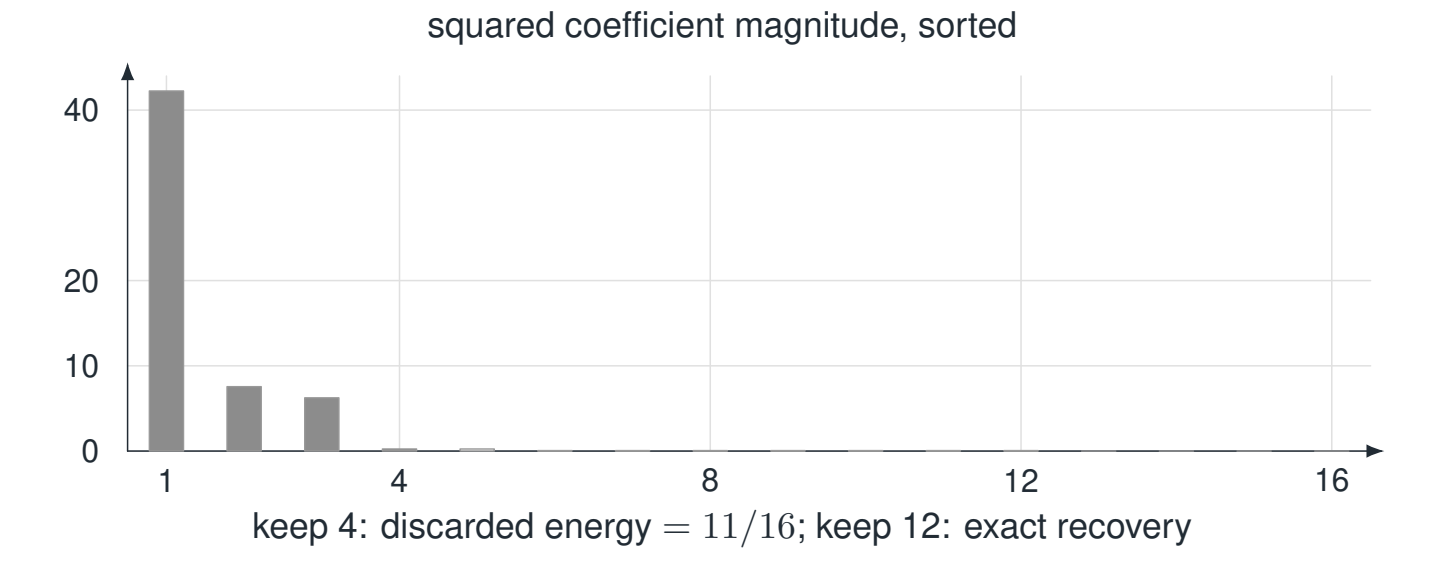
Bars show sorted scaled coefficient magnitudes. The annotation identifies the energy remaining after a finite number of retained coefficients.
Drawing labels and data 11 labels
Read the original labels as selectable text. Tables preserve grid relationships; other short labels are grouped compactly.
- 1
- 4
- 8
- 12
- 16
- 0
- 10
- 20
- 40
- squared coefficient magnitude, sorted
keep 4: discarded energy \(=11/16\); keep 12: exact recovery
Every discarded square has a meaning
In this fixed orthonormal basis, the squared reconstruction error equals the sum of the squared discarded coefficients. For our running signal:
| kept coefficients \(k\) | 1 | 2 | 4 | 8 | 12 | 16 |
|---|---|---|---|---|---|---|
| squared error | \(59/4\) | \(115/16\) | \(11/16\) | \(1/4\) | \(0\) | \(0\) |
The four zero coefficients belong to packet \(10\), so twelve coefficients suffice for exact reconstruction here. This is a property of the selected signal and basis, not a guarantee that all edge signals need only twelve coefficients.
Do not compare incompatible budgets
A cutoff \(m\) in a one-dimensional signed Fourier spectrum means \(2m+1\) bins, including zero. A budget of \(k\) largest coefficients is a different rule. Real Fourier synthesis may also require conjugate-pair closure. Neither count alone equals a bit-storage budget once amplitudes, phases, indices, or a selected tree must be encoded. The manuscript's Fourier-versus-Haar experiment is a finite comparison, not a proof that one basis dominates every signal class. Here we isolate the part that can be checked exactly: reconstruction error within one fixed finite basis.
Read this as
Changing coordinates creates no error. Throwing away coefficients does, and orthogonality makes that error exactly accountable.