
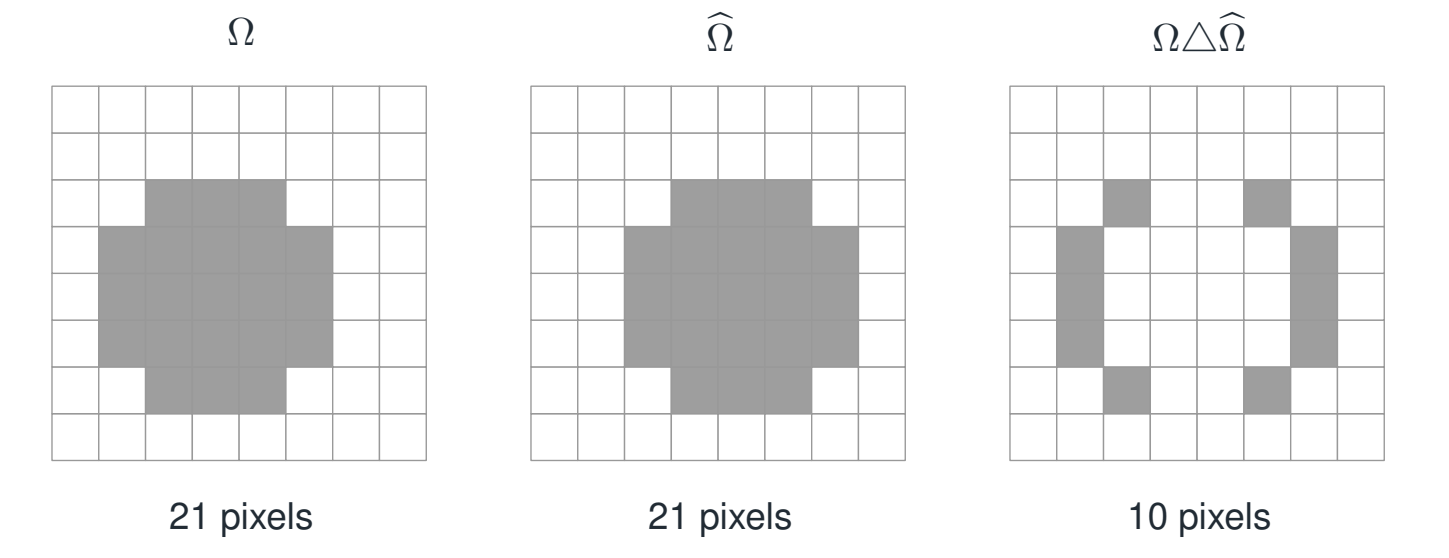
On the integer \(8\times8\) grid, choose the disk-shaped mask \(\Omega=\{(i,j):(i-3)^2+(j-3)^2\le5\}\) and translate it one pixel to the right. Each mask contains \(21\) pixels; their symmetric difference contains exactly \(10\).
Reading the drawing
Three pixel grids show the original mask, a shifted mask and their symmetric difference. Cell counts provide the finite geometric error measure.
Drawing labels and data 6 labels
Read the original labels as selectable text. Tables preserve grid relationships; other short labels are grouped compactly.
- \(\Omega\)
- 21 pixels
- \(\widehat\Omega\)
- 21 pixels
- \(\Omega\triangle\widehat\Omega\)
- 10 pixels
A geometric error calculation is not a segmentation algorithm
For a common amplitude \(a\), the squared counting-measure error is \(10a^2\), entirely on the disagreement pixels. The full-image mean squared error is \(10a^2/64\). Both are exact, but answer different normalization questions. Now consider the four-sample observation
It is consistent with either true signal
under deterministic sup-norm noise at most \(3/2\). Indeed \(y=(u+v)/2\), and both error norms equal \(3/2\). A rule receiving only \(y\) and that noise bound cannot be guaranteed to select both distinct true masks correctly.
What additional structure would have to do
A lower noise level, separation, contrast, geometry, or a specified prior can change the identification problem. The example rules out a guarantee at the stated noise radius and signal pair, not all recovery results. The manuscript's positive-contrast estimator is deliberately narrower than a universal segmentation method.
Read this as
Exact synthesis can preserve an identified boundary. It cannot decide between two boundaries that the observation model makes indistinguishable.