
Use a separate period-one example on \([-1/2,1/2)\):
This is the exact finite Fourier formula. The drawn curves sample it numerically; the endpoint calculation below is symbolic.
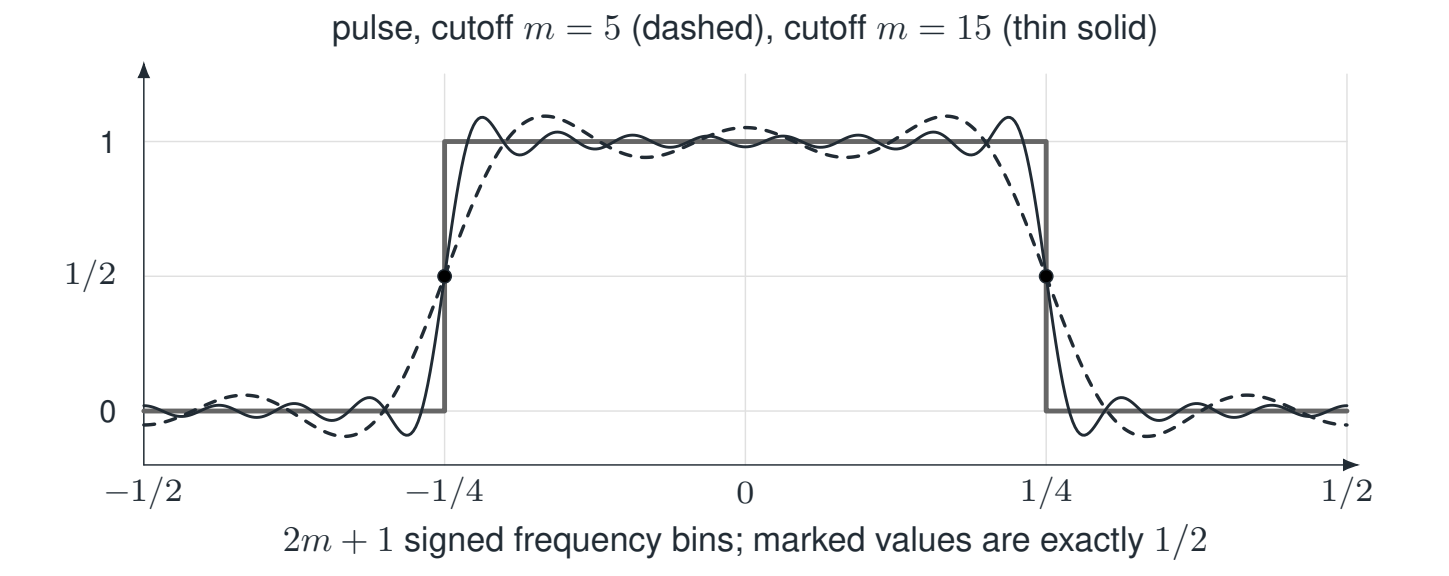
Reading the drawing
The pulse and two Fourier partial sums are plotted on the same interval. Endpoint marks and the caption distinguish midpoint convergence at jumps from uniform recovery.
Drawing labels and data 10 labels
Read the original labels as selectable text. Tables preserve grid relationships; other short labels are grouped compactly.
- \(-1/2\)
- \(-1/4\)
- \(0\)
- \(1/4\)
- \(1/2\)
- 0
- \(1/2\)
- 1
pulse, cutoff \(m=5\) (dashed), cutoff \(m=15\) (thin solid)
\(2m+1\) signed frequency bins; marked values are exactly \(1/2\)
One value is fixed at every cutoff
At \(t=\pm1/4\), every summand vanishes because \(\sin(\pi n/2)\cos(\pi n/2)=0\) for integer \(n\). Hence
A larger cutoff resolves a narrower transition, but it does not make the finite trigonometric polynomial discontinuous. The two displayed cutoffs retain \(11\) and \(31\) signed frequency bins, respectively, not five and fifteen coefficients.
An exact known-packet comparison
Take \(s(t)=\frac14\cos(2\pi t)+\frac1{10}\cos(6\pi t)\). For \(m\ge3\) this smooth packet is already in the retained Fourier span. Thus \(S_ms+j=s+j\) exactly in this special model, whereas \(S_m(s+j)\) still replaces the pulse by \(S_mj\). The values assigned at the two endpoints matter for pointwise error, but do not affect an \(L^p\) norm for finite \(p\). The illustrated ringing is not a root enclosure or an asymptotic error certificate.
Read this as
Increasing spectral resolution and retaining a known discontinuity are different operations, with different pointwise consequences.