
At phase order \(12=4\cdot3\), the map
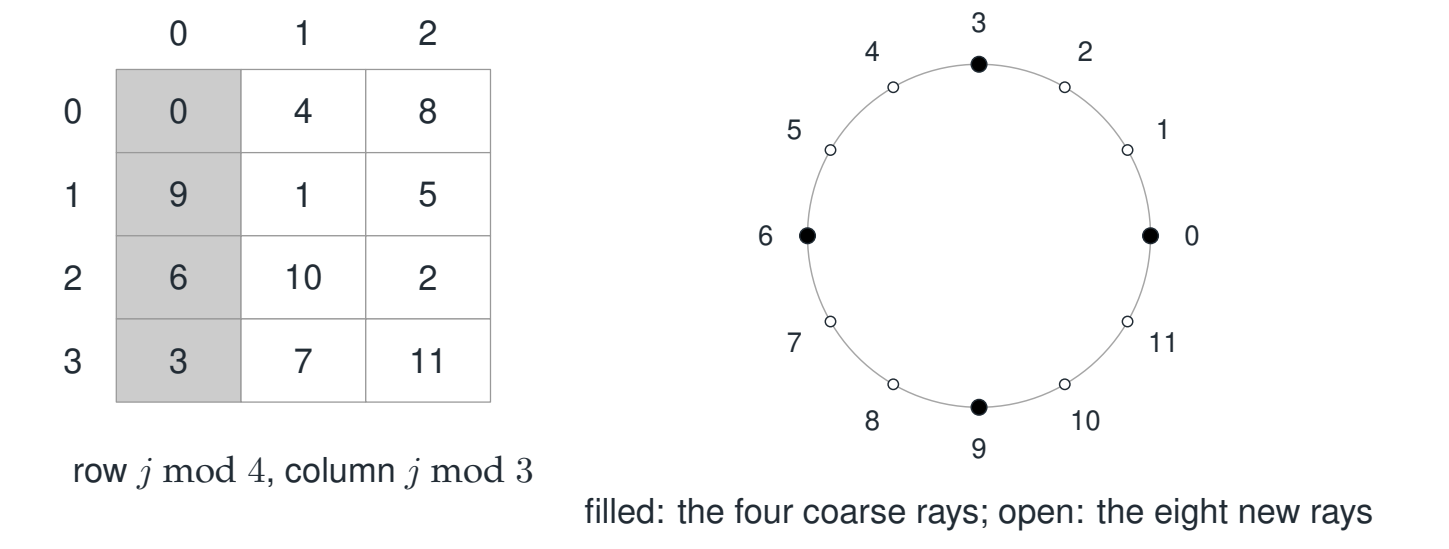
is a bijection from twelve residue addresses to the \(4\times3\) grid. Every cell below contains its unique original address.
Reading the drawing
A residue table and a twelve-point circle show dyadic–odd factorization. Labels identify exact addresses rather than averaging impedance values.
Drawing labels and data 33 labels
Read the original labels as selectable text. Tables preserve grid relationships; other short labels are grouped compactly.
| Row / column | 0 | 1 | 2 |
|---|---|---|---|
| 0 | 0 | 4 | 8 |
| 1 | 9 | 1 | 5 |
| 2 | 6 | 10 | 2 |
| 3 | 3 | 7 | 11 |
- row \(j\bmod4\), column \(j\bmod3\)
- 0
- 1
- 2
- 3
- 4
- 5
- 6
- 7
- 8
- 9
- 10
- 11
filled: the four coarse rays; open: the eight new rays
The factorization is an intersection of conditions
For integer sample addresses, including negative ones,
The product on the right is composition of two residue masks: both congruences must hold. Coprimality makes their intersection a single class modulo twelve. It is not a formula for multiplying or adding impedances.
Nested samples and nested projectors are different statements
The four coarse reflection rays occur at indices \(0,3,6,9\) of the twelve-ray grid. Thus the geometric sample set is nested. Separately, a coarse coefficient projector is the sum of its fine descendants in a common coefficient space. There is no corresponding rule saying that a coarse impedance is the average of its descendants. The inverse Cayley map is nonlinear. Even opposite reflection points have impedances \(3\) and \(1/3\) in the preceding example; their average \(5/3\) is not the impedance \(1\) of their averaged reflection coefficient zero.
Read this as
CRT factors addresses. Refinement conserves coefficient packets. Neither operation authorizes linear averaging through a nonlinear chart.