
Use a normalized Haar wavelet on an available interval of length \(L\) on the real line, positive on its left half and negative on its right half. Here \(H_\tau\) is the half-line step \(\mathbf1_{[\tau,\infty)}\), so there is no artificial second endpoint jump. If \(u\) is the relative jump position in the support, then
The coefficient vanishes when the jump lies exactly at a support boundary.
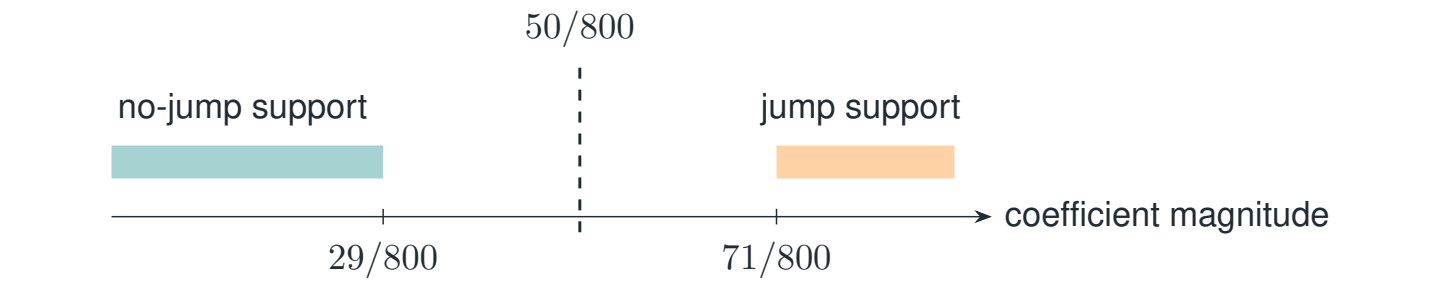
Reading the drawing
Separated ranges show the no-jump bound and the jump lower bound. A threshold between them uses the stated jump position within its Haar support.
Drawing labels and data 6 labels
Read the original labels as selectable text. Tables preserve grid relationships; other short labels are grouped compactly.
- coefficient magnitude
- \(50/800\)
- no-jump support
- jump support
- \(29/800\)
- \(71/800\)
A worked gap with all three contributions
Take \(L=1/4\), \(M=1\), noise bound \(\varepsilon=1/100\), jump size \(|a|=1\), and relative boundary distance at least \(\rho=1/4\). The smooth and noise contributions together are bounded by
The jump contributes at least \(|a|\rho\sqrt L=1/8\). The observed coefficient therefore has magnitude at least \(71/800\). The threshold \(1/16=50/800\) separates every such jump support from every support containing no jump.
The available support is part of the hypothesis
A fixed extension is needed if the observation domain ends inside a desired wavelet support. Also, the selected support must contain only the specified jump. An unmodeled second jump can reinforce or cancel the coefficient.
Read this as
Scale determines the smooth contribution, but alignment determines the jump contribution. A detection guarantee needs both.