
Consider the constant analysis bank
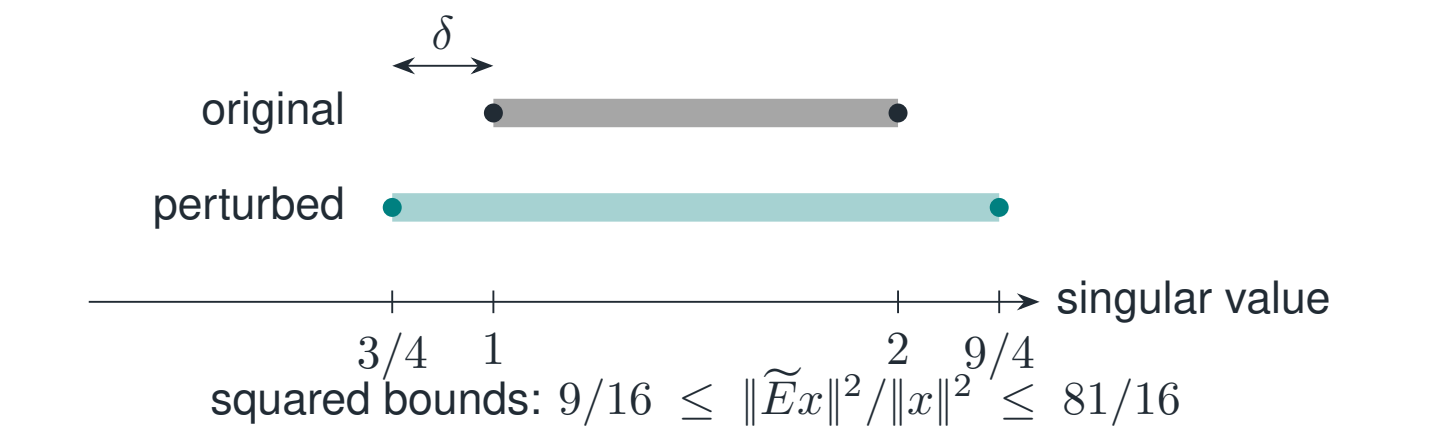
It has frame bounds \(A=1\), \(B=4\). For every perturbation with operator norm at most \(\delta=1/4\), the squared-norm bounds remain at least \((1-1/4)^2=9/16\) and at most \((2+1/4)^2=81/16\).
Reading the drawing
Two horizontal segments show the original and perturbed singular-value intervals on the same axis. The displacement and squared bounds are labeled.
Drawing labels and data 9 labels
Read the original labels as selectable text. Tables preserve grid relationships; other short labels are grouped compactly.
- singular value
- original
- perturbed
- \(3/4\)
- \(1\)
- \(2\)
- \(9/4\)
- \(\delta\)
squared bounds:
Both bounds can be attained
Choose \(\Delta E=\operatorname{diag}(-1/4,1/4)\). Then \(\widetilde E=\operatorname{diag}(3/4,9/4)\) has precisely those two frame bounds. Its inverse has operator norm \(4/3\). A coefficient error \(\nu=(3/4,0)\) therefore produces signal error \((1,0)\), attaining the noise bound. The strict condition \(\delta<\sqrt A\) prevents the lower bound from vanishing. At \(\delta=1\), the perturbation \(\operatorname{diag}(-1,0)\) destroys the first channel entirely.
An inverse and an approximate inverse answer different questions
If the original synthesis \(R=\operatorname{diag}(1,1/2)\) is retained after this perturbation, then
Its defect norm is \(1/4\). Every input has relative reconstruction error at most that value, with equality on the first coordinate. For frequency-dependent banks the theorem uses an essential supremum on the unit circle, not a few sampled frequencies.
Read this as
A lower singular-value gap quantifies stable recovery. A reconstruction defect quantifies the error of the actual synthesis bank being used.