
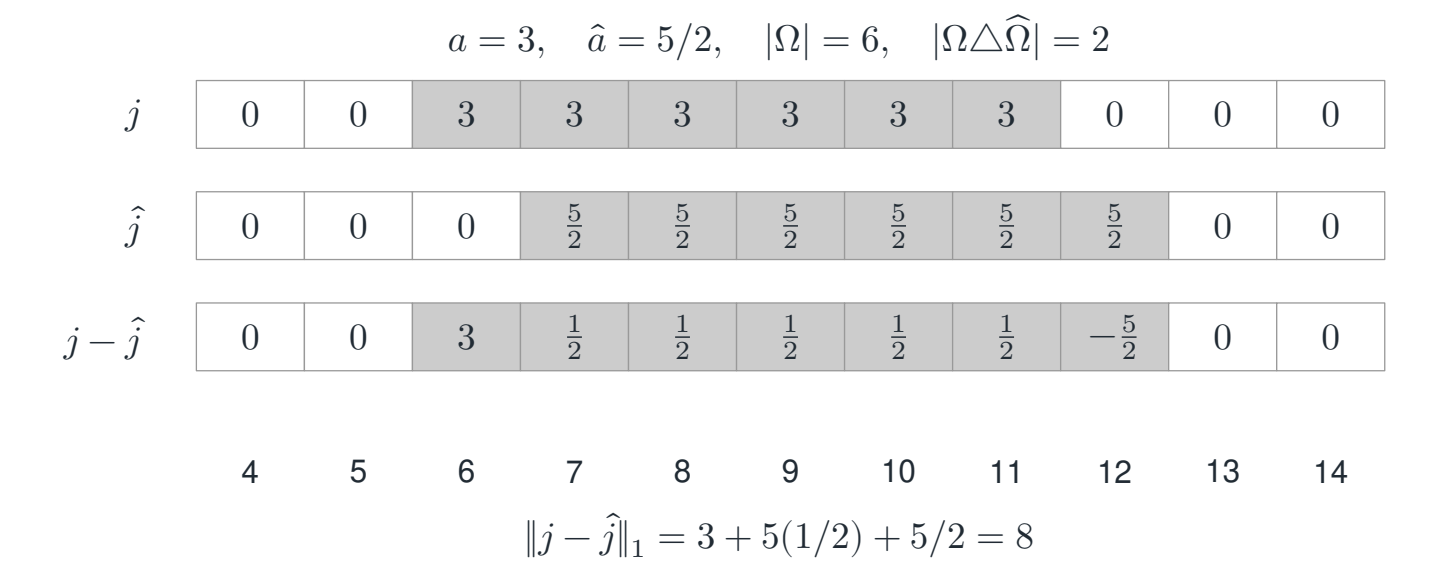
On the \(16\) sample addresses, let \(\Omega=\{6,\ldots,11\}\) and \(\widehat\Omega=\{7,\ldots,12\}\). Use true amplitude \(a=3\) and estimate \(\widehat a=5/2\). There are six true samples, five overlapping samples, and two disagreement samples.
Reading the drawing
Aligned sample rows display the target, estimate and difference on the original address grid. The labels separate error on shared support from error in mismatch cells.
Drawing labels and data 49 labels
Read the original labels as selectable text. Tables preserve grid relationships; other short labels are grouped compactly.
| Signal / sample address | 4 | 5 | 6 | 7 | 8 | 9 | 10 | 11 | 12 | 13 | 14 |
|---|---|---|---|---|---|---|---|---|---|---|---|
| \(j\) | \(0\) | \(0\) | \(3\) | \(3\) | \(3\) | \(3\) | \(3\) | \(3\) | \(0\) | \(0\) | \(0\) |
| \(\widehat j\) | \(0\) | \(0\) | \(0\) | \(\frac{5}{2}\) | \(\frac{5}{2}\) | \(\frac{5}{2}\) | \(\frac{5}{2}\) | \(\frac{5}{2}\) | \(\frac{5}{2}\) | \(0\) | \(0\) |
| \(j-\widehat j\) | \(0\) | \(0\) | \(3\) | \(\frac{1}{2}\) | \(\frac{1}{2}\) | \(\frac{1}{2}\) | \(\frac{1}{2}\) | \(\frac{1}{2}\) | \(- \frac{5}{2}\) | \(0\) | \(0\) |
- \(\|j-\widehat j\|_1=3+5(1/2)+5/2=8\)
The residual splits exactly as
The missed sample has error \(3\), the five shared samples have error \(1/2\), and the extra sample has error \(-5/2\). With counting measure,
Read the theorem as a budget, not an equality claim
Here the \(L^1\) bound is attained:
The \(L^2\) triangle bound is \(\frac12\sqrt6+\frac52\sqrt2\), and need not be sharp. A background estimate adds another term \(\|s-\widehat s\|_p\); cancellation between terms can make the total smaller than the bound. Normalized RMSE divides the \(L^2\) norm by \(\sqrt{16}\). A boundary-band RMSE uses the band size instead. Changing that denominator changes the reported quantity.
Read this as
Mask error, amplitude error, and background error are separate mathematical inputs. A single reconstruction score conceals that separation.