
Let two piecewise-constant signals have region values \(a=(0,2,5)\) and \(b=(0,2,5)\) on a counting-measure domain of twelve samples. Suppose their overlap counts are
The row totals \((4,3,5)\) are the true region sizes. The column totals are also \((4,3,5)\), although three samples are assigned to the wrong values.
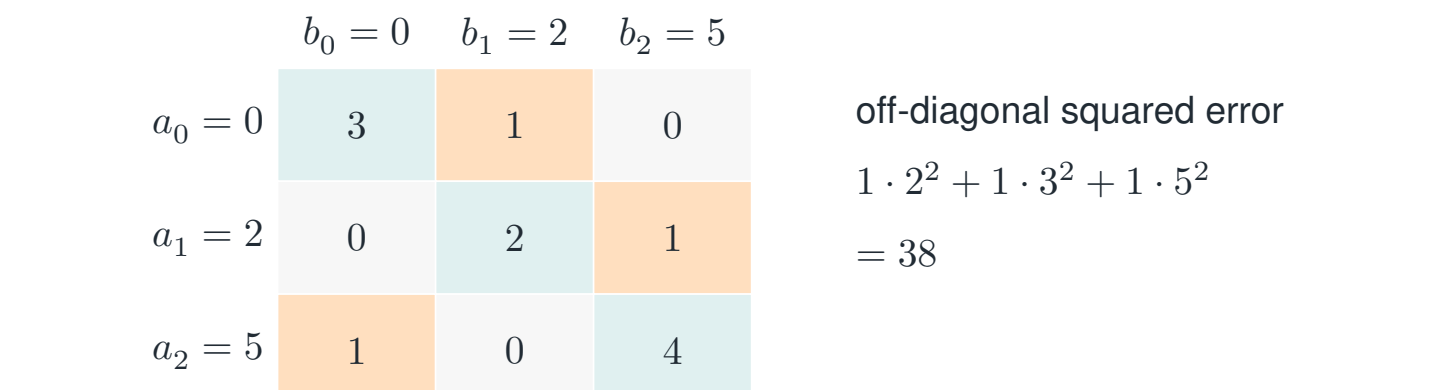
Reading the drawing
Rows are true regions and columns are estimated regions. Colored cells carry overlap weights; the annotation combines their squared amplitude discrepancies.
Drawing labels and data 16 labels
Read the original labels as selectable text. Tables preserve grid relationships; other short labels are grouped compactly.
| Row / column | Column 1 | Column 2 | Column 3 |
|---|---|---|---|
| Row 1 | \( 3 \) | \( 1 \) | \( 0 \) |
| Row 2 | \( 0 \) | \( 2 \) | \( 1 \) |
| Row 3 | \( 1 \) | \( 0 \) | \( 4 \) |
- \(a_0=0\)
- \(a_1=2\)
- \(a_2=5\)
- \(b_0=0\)
- \(b_1=2\)
- \(b_2=5\)
off-diagonal squared error
[6pt]\(1\cdot 2^2+1\cdot 3^2+1\cdot 5^2\)
[6pt]\(=38\)
Equal error counts need not mean equal reconstruction error
The three off-diagonal entries contribute one sample each. Their value differences have magnitudes \(2\), \(3\), and \(5\), so
The counting-measure supremum error is \(5\). The full-domain mean squared error is \(38/12=19/6\). A mismatch fraction of \(3/12\) reports a different statistic and omits all three amplitude weights.
The formula requires partitions
For measurable partitions \((E_i)\) and \((F_j)\), with \(M_{ij}=\mu(E_i\cap F_j)\),
Each location belongs to exactly one intersection. Overlapping indicator packets that are summed at the same location must first be converted to their actual combined value regions before this partition formula is applied.
Read this as
Geometry supplies the overlap counts. Signal values supply the weights. Their combination gives the norm relevant to reconstruction.