
For an even/odd pair \((e,o)\), form the prediction residual \(d=o-e\), then update \(s=e+d/2\). The inverse reads \(e=s-d/2\), followed by \(o=d+e\).
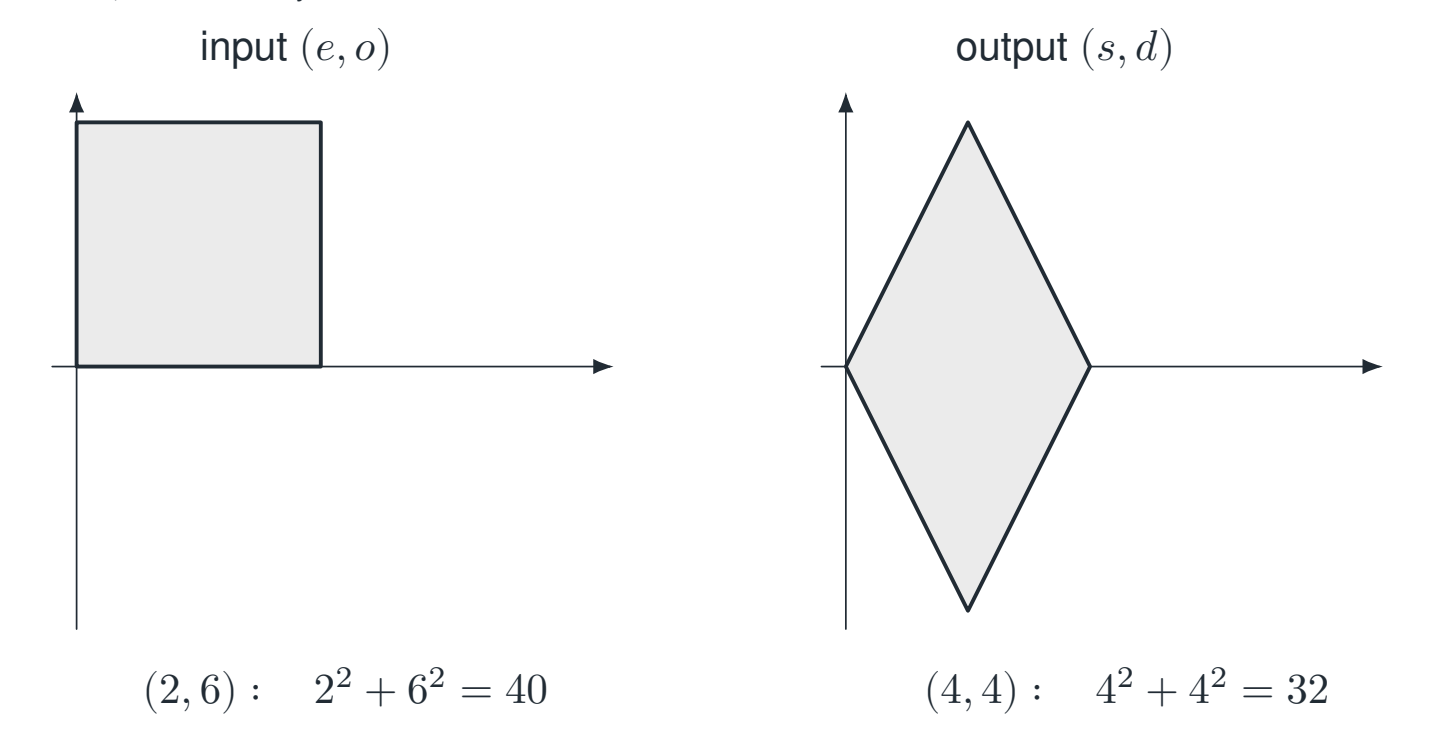
Reading the drawing
An input rectangle is sheared to a parallelogram in the output coordinates. The labeled example is invertible while its squared Euclidean norm changes.
Drawing labels and data 4 labels
Read the original labels as selectable text. Tables preserve grid relationships; other short labels are grouped compactly.
- input \((e,o)\)
- output \((s,d)\)
- \((2,6):\quad 2^2+6^2=40\)
- \((4,4):\quad 4^2+4^2=32\)
Evidence note from the source edition
The square \([0,4]^2\) and its exact image under the lifting matrix have the same area. The separate pair \((2,6)\) illustrates that Euclidean energy need not be preserved.
What determinant one does establish
The matrix is invertible, and in these real coordinates it preserves oriented area. The predict and update operations can be undone in reverse order. Applied to each pair, the construction gives exact finite-signal reconstruction.
What determinant one does not establish
The pair \((2,6)\) becomes \((4,4)\). Its squared Euclidean norm changes from \(40\) to \(32\). The lifting matrix is not unitary. Energy accounting must therefore use its actual coordinate metric or a separately normalized transform; invertibility alone cannot replace the Haar energy identity. All values in this example are rational. Integer-to-integer lifting with a rounding rule is a different algorithm. Its inverse and error conventions require their own specification and are not silently inferred from the displayed rational matrix.
Read this as
Perfect reconstruction, determinant one, and norm preservation are different properties. This transform has the first two, not the third.