
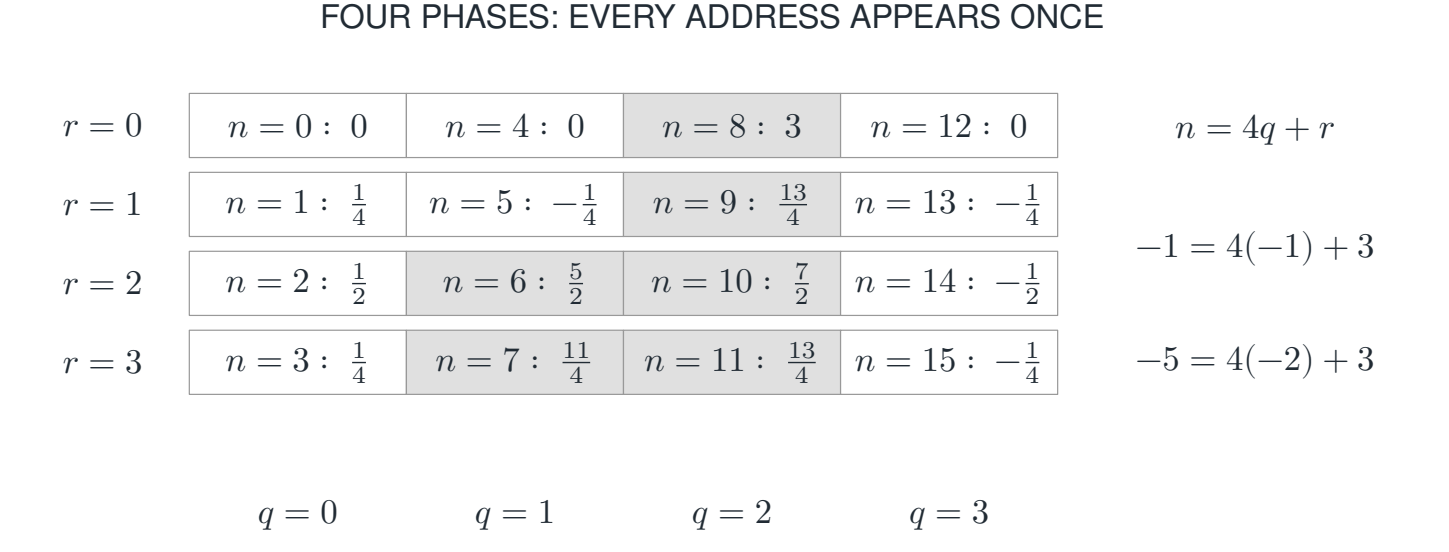
For four phases, write every sample address uniquely as \(n=4q+r\) with \(0\le r<4\). Analysis stores \(f[n]\) at channel address \((r,q)\). Synthesis puts that exact value back at \(4q+r\).
Reading the drawing
Each row is a residue class modulo four. Cells retain original sample addresses and values; shading marks the supplied jump packet.
Drawing labels and data 28 labels
Read the original labels as selectable text. Tables preserve grid relationships; other short labels are grouped compactly.
- FOUR PHASES: EVERY ADDRESS APPEARS ONCE
| Row / column | Column 1 | Column 2 | Column 3 | Column 4 |
|---|---|---|---|---|
| \(r=0\) | \(n=0:\ 0\) | \(n=4:\ 0\) | \(n=8:\ 3\) | \(n=12:\ 0\) |
| \(r=1\) | \(n=1:\ \frac{1}{4}\) | \(n=5:\ - \frac{1}{4}\) | \(n=9:\ \frac{13}{4}\) | \(n=13:\ - \frac{1}{4}\) |
| \(r=2\) | \(n=2:\ \frac{1}{2}\) | \(n=6:\ \frac{5}{2}\) | \(n=10:\ \frac{7}{2}\) | \(n=14:\ - \frac{1}{2}\) |
| \(r=3\) | \(n=3:\ \frac{1}{4}\) | \(n=7:\ \frac{11}{4}\) | \(n=11:\ \frac{13}{4}\) | \(n=15:\ - \frac{1}{4}\) |
- \(n=4q+r\)
- \(-1=4(-1)+3\)
- \(-5=4(-2)+3\)
- \(q=0\)
- \(q=1\)
- \(q=2\)
- \(q=3\)
Evidence note from the source edition
Every cell contains an original address and its rational sample value. Shading marks the known jump packet, not an estimated feature or a frequency band.
What has changed? Only where the values are stored
The complete tuple of channels contains sixteen values, just as the original vector does. A single decimated channel is shorter, but keeping all four loses no samples. The residue projector \(P_{4,r}f\) is different: it keeps the original lattice and writes zeros outside phase \(r\).
The norm on the channel tuple is the sum-of-squares Hilbert norm, not the maximum of the channel norms. This distinction matters in the infinite-dimensional statement.
Negative addresses are ordinary addresses
Euclidean division, rather than truncation toward zero, gives \(-1=4(-1)+3\) and \(-5=4(-2)+3\). The finite tests exercise both positive and negative sample addresses. The algebraic identity applies before any plotting window or finite buffer is chosen.
Read this as
Downsampling one channel discards information. Splitting into all residue channels is an invertible address change.