
Take the causal filter \(h=(1,2,-1,1)\), with taps at \(0,1,2,3\), acting by \(y[n]=\sum_qh[q]f[n-q]\). Resolve the input into even and odd channels. Let \(D\) denote one delay in the channel index.
Reading the drawing
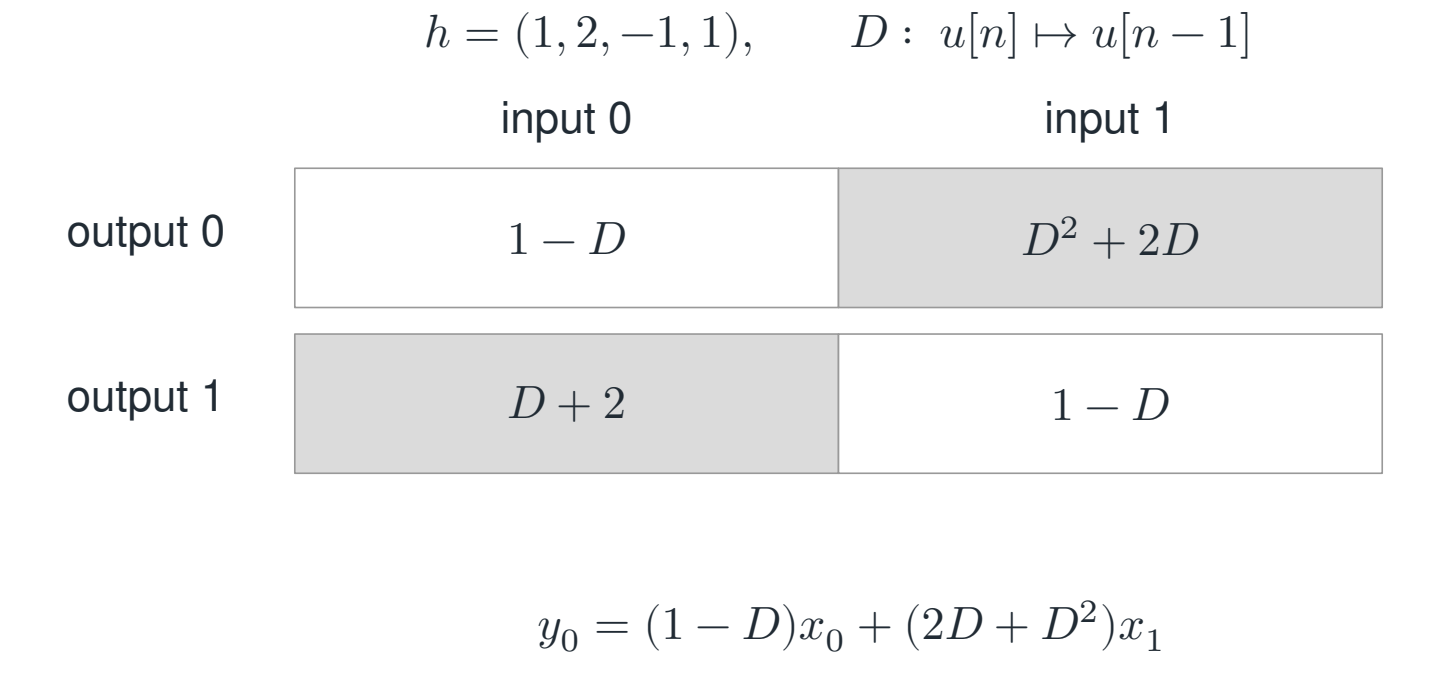
The two-by-two array has output phases as rows and input phases as columns. Each entry is an exact polynomial in channel delay.
Drawing labels and data 10 labels
Read the original labels as selectable text. Tables preserve grid relationships; other short labels are grouped compactly.
- \(h=(1,2,-1,1),\qquad D:\ u[n]\mapsto u[n-1]\)
| Row / column | input 0 | input 1 |
|---|---|---|
| output 0 | \(1 - D\) | \(D^{2} + 2 D\) |
| output 1 | \(D + 2\) | \(1 - D\) |
- \(y_0=(1-D)x_0+(2D+D^2)x_1\)
Reading one matrix entry
The odd-input contribution to the even output is \((2D+D^2)f_1\). The tap at original delay one reaches the preceding odd channel sample; the tap at delay three reaches the odd channel two positions back. These are different delays despite coming from the same input phase. The two channel equations are
Interleaving gives exactly the direct convolution, including its boundary samples under zero extension.
The general address calculation
For \(N\) phases, the block from input \(s\) to output \(k\) has kernel \(h_{ks}[m]=h[Nm+k-s]\). This comes from the exact identity \(Nn+k-q=N(n-m)+s\). It is a finite reindexing of taps, so no numerical transform of the input is needed. Evaluation of a bilateral transform is a separate step with the summability hypotheses stated in the manuscript.
Read this as
The matrix does not approximate the filter. Its entries record which input phase is used, how far back to read, and what coefficient to multiply.