
A complete pruning chooses nodes of a finite refinement tree so that every root-to-terminal path meets exactly one selected node. The horizontal positions below are terminal packet addresses, not time intervals in the original signal.
Reading the drawing
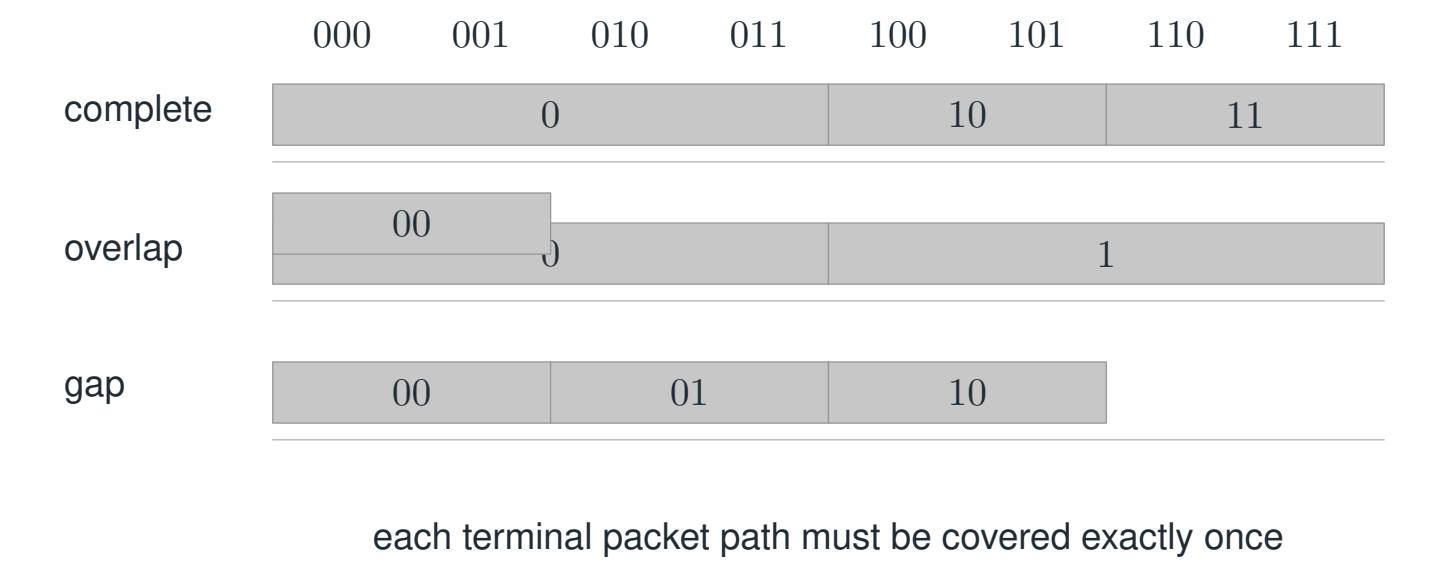
The three rows compare a complete covering antichain, overlapping nodes and a cut with a gap. The finest addresses provide a common coverage axis.
Drawing labels and data 21 labels
Read the original labels as selectable text. Tables preserve grid relationships; other short labels are grouped compactly.
- \(000\)
- \(001\)
- \(010\)
- \(011\)
- \(100\)
- \(101\)
- \(110\)
- \(111\)
- complete
- \(0\)
- \(10\)
- \(11\)
- overlap
- \(0\)
- \(00\)
- \(1\)
- gap
- \(00\)
- \(01\)
- \(10\)
each terminal packet path must be covered exactly once
Three candidate selections
The complete selection \(\{0,10,11\}\) covers every terminal branch once. The selection \(\{0,00,1\}\) covers the \(00\) branch twice: it is not an antichain. The selection \(\{00,01,10\}\) misses the \(11\) branch entirely. For actual Haar packets, set \(P_v=W_v^*W_v\). Parent-to-child conservation gives
Replacing unselected parents by their children until the complete pruning is reached proves \(\sum_{v\in\Lambda}P_v=I\). This is why the coefficients at different depths still form an exact coordinate system.
An exhaustive finite check
At depth three the pruning count obeys \(a_0=1\) and \(a_{d+1}=1+a_d^2\), giving \(1,2,5,26\). The supplied suite checks all \(26\) covering conditions and all \(26\) actual \(16\times16\) projector-sum identities. These finite checks illustrate, but do not replace, the universal tree theorem.
Read this as
Mixed depth is allowed. Missing a terminal path or selecting an ancestor and its descendant is not.