
Consider the finite Laurent bank
Its synthesis cancels the exact delayed cross-channel contribution introduced by analysis.
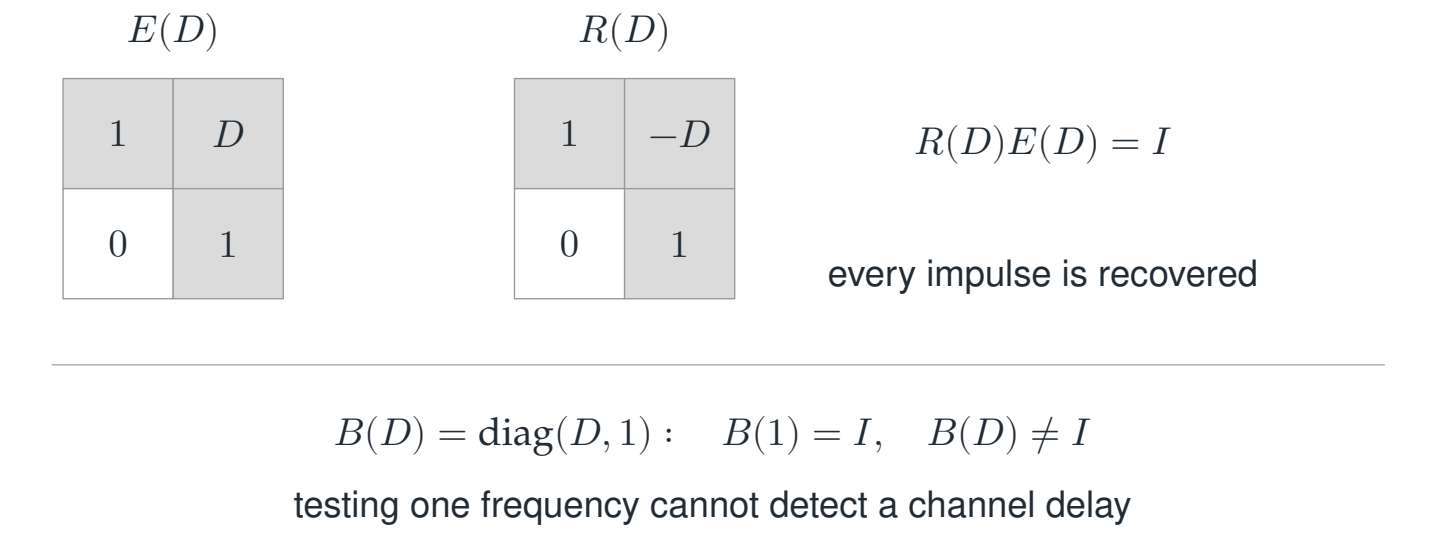
Reading the drawing
Analysis and synthesis matrices multiply to the identity. A separate diagonal delay below them agrees with the identity at one frequency but fails as an operator identity.
Drawing labels and data 14 labels
Read the original labels as selectable text. Tables preserve grid relationships; other short labels are grouped compactly.
- \(E(D)\)
| Row / column | Column 1 | Column 2 |
|---|---|---|
| Row 1 | \(1\) | \(D\) |
| Row 2 | \(0\) | \(1\) |
- \(R(D)\)
| Row / column | Column 1 | Column 2 |
|---|---|---|
| Row 1 | \(1\) | \(- D\) |
| Row 2 | \(0\) | \(1\) |
- \(R(D)E(D)=I\)
- every impulse is recovered
testing one frequency cannot detect a channel delay
Two inverses, all inputs
Direct polynomial multiplication gives \(RE=ER=I_2\). Since \(D\) acts as a shift, these identities imply perfect reconstruction on every bilateral channel sequence. With finite kernels, composition requires only finitely many operations at each address. The converse uses impulses. Insert an impulse in one input channel. Each output channel lists every coefficient of the corresponding transfer polynomial. If all such responses vanish for \(RE-I\), every coefficient is zero; hence the polynomial matrix itself is zero.
A deliberately misleading test
The matrix \(B(D)=\operatorname{diag}(D,1)\) satisfies \(B(1)=I_2\). At that one transform value it appears perfect. In the time domain, however, it delays only the first channel. An impulse in that channel immediately distinguishes it from the identity. This is why a small set of successful frequency evaluations is not automatically a proof of the full Laurent identity. A separate degree bound and a sufficient interpolation argument would be needed to turn finitely many evaluations into such a certificate.
Read this as
Exact reconstruction concerns every coefficient of the transfer operator, not just an attractive response curve or one evaluation point.