
In Lebesgue measure on the line, let
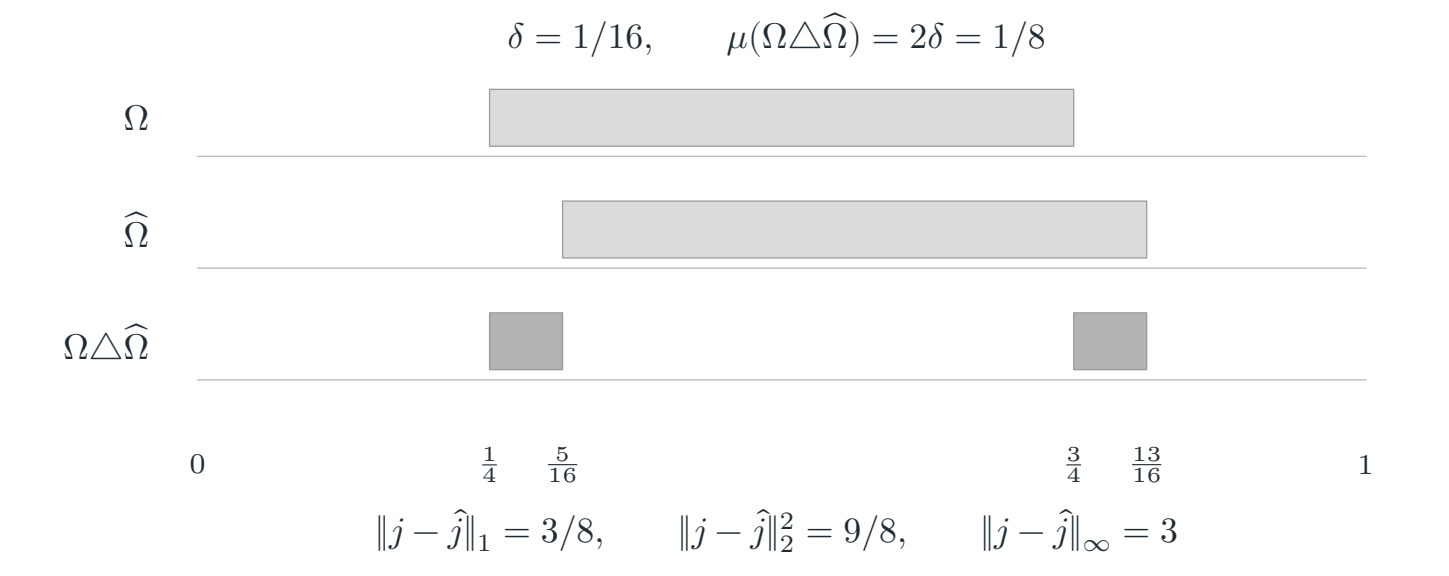
The two intervals have the same length. Their disagreement consists of one missed strip and one extra strip, each of width \(1/16\).
Reading the drawing
Three aligned rows show the true interval, its translated estimate and the two strips in their symmetric difference. The labels retain the distinct norm errors.
Drawing labels and data 11 labels
Read the original labels as selectable text. Tables preserve grid relationships; other short labels are grouped compactly.
- \(\Omega\)
- \(\widehat\Omega\)
- \(\Omega\triangle\widehat\Omega\)
- \(0\)
\(\frac{1}{4}\)
\(\frac{5}{16}\)
\(\frac{3}{4}\)
\(\frac{13}{16}\)
- \(1\)
| error measure | \(L^1\) norm | squared \(L^2\) norm | \(L^\infty\) norm |
|---|---|---|---|
| exact value | \(3/8\) | \(9/8\) | \(3\) |
Area shrinks while the missed jump keeps its height
For a translation by \(\delta\) with \(0<|\delta|<1/2\), the symmetric difference has measure \(2|\delta|\). At finite \(p\),
It tends to zero as the displacement tends to zero. The essential supremum stays \(3\) for every nonzero displacement, because the error reaches height \(3\) on a set of positive measure. At exactly zero displacement all norms vanish. A nonempty disagreement set of measure zero would be different: it can affect the pointwise supremum while leaving the essential norm unchanged. This is why the paper distinguishes the two statements.
Read this as
A shrinking boundary strip can give small integrated error and still contain a full-height jump error.