
For the periodic running signal define
This is nonlinear and not a convolution operator. Nevertheless its two-channel representation is exact, provided the neighbor comes from the correct channel and index.
Reading the drawing
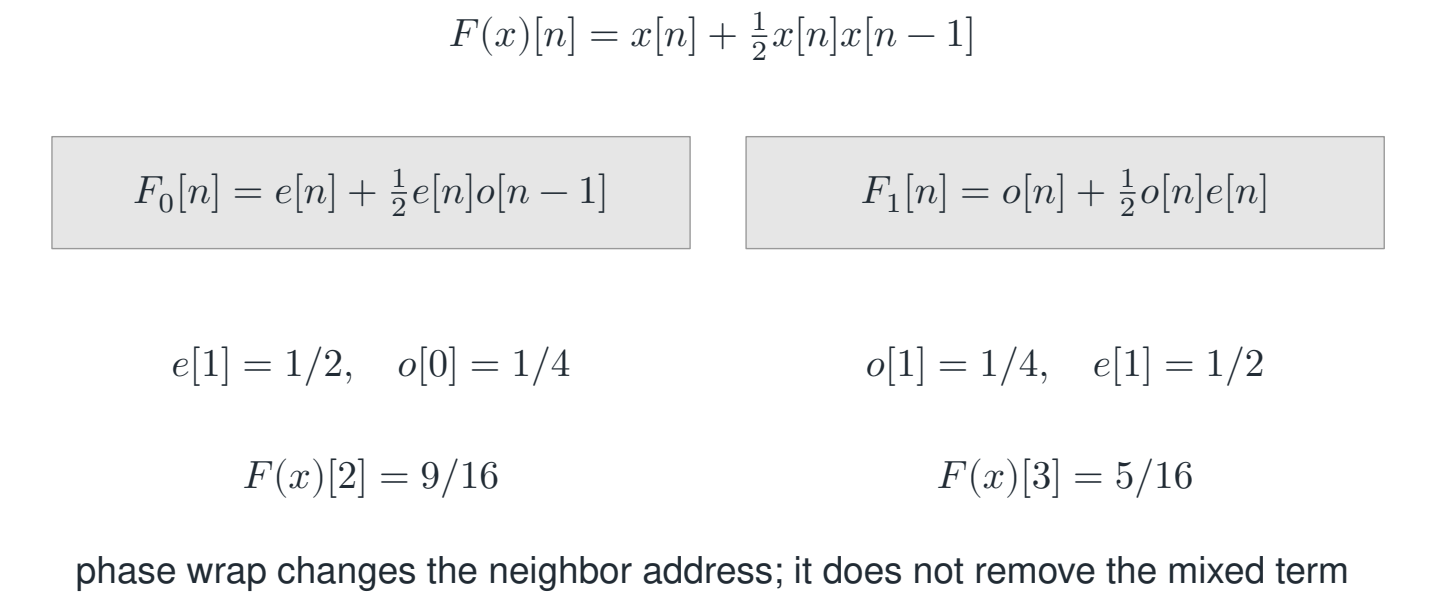
Two output blocks retain the input-channel dependence and channel shifts of a periodic neighbor product. The labeled sample values make the wrap explicit.
Drawing labels and data 8 labels
Read the original labels as selectable text. Tables preserve grid relationships; other short labels are grouped compactly.
- \(F(x)[n]=x[n]+\tfrac12x[n]x[n-1]\)
- \(F_0[n]=e[n]+\tfrac12e[n]o[n-1]\)
- \(F_1[n]=o[n]+\tfrac12o[n]e[n]\)
- \(e[1]=1/2,\quad o[0]=1/4\)
- \(o[1]=1/4,\quad e[1]=1/2\)
- \(F(x)[2]=9/16\)
- \(F(x)[3]=5/16\)
phase wrap changes the neighbor address; it does not remove the mixed term
Put \(e[q]=x[2q]\) and \(o[q]=x[2q+1]\), with channel indices taken modulo eight. Then
The even output needs the previous odd sample; the odd output needs the current even sample. This is the same carry in the address system that appeared in the one-sample delay matrix.
Check two actual outputs
The running values are \(x[1]=1/4\), \(x[2]=1/2\), and \(x[3]=1/4\), so
Applying the same formula independently within each decimated array would use the wrong neighbors. Keeping the full channel tuple avoids that loss of information. The supplied suite compares every output sample in the two implementations using exact rational arithmetic. No convergence, contraction, or approximation property follows merely from writing these exact coordinates. Those require hypotheses on the nonlinear map and the problem being solved.
Read this as
Exact packet coordinates remain available for nonlinear maps. They do not turn cross-channel interactions into independent channel problems.