
The word “product” must be typed. Multiplying two signal values at the same time address is not the same operation as multiplying generating series. The distinction changes which packets can interact.
Reading the drawing
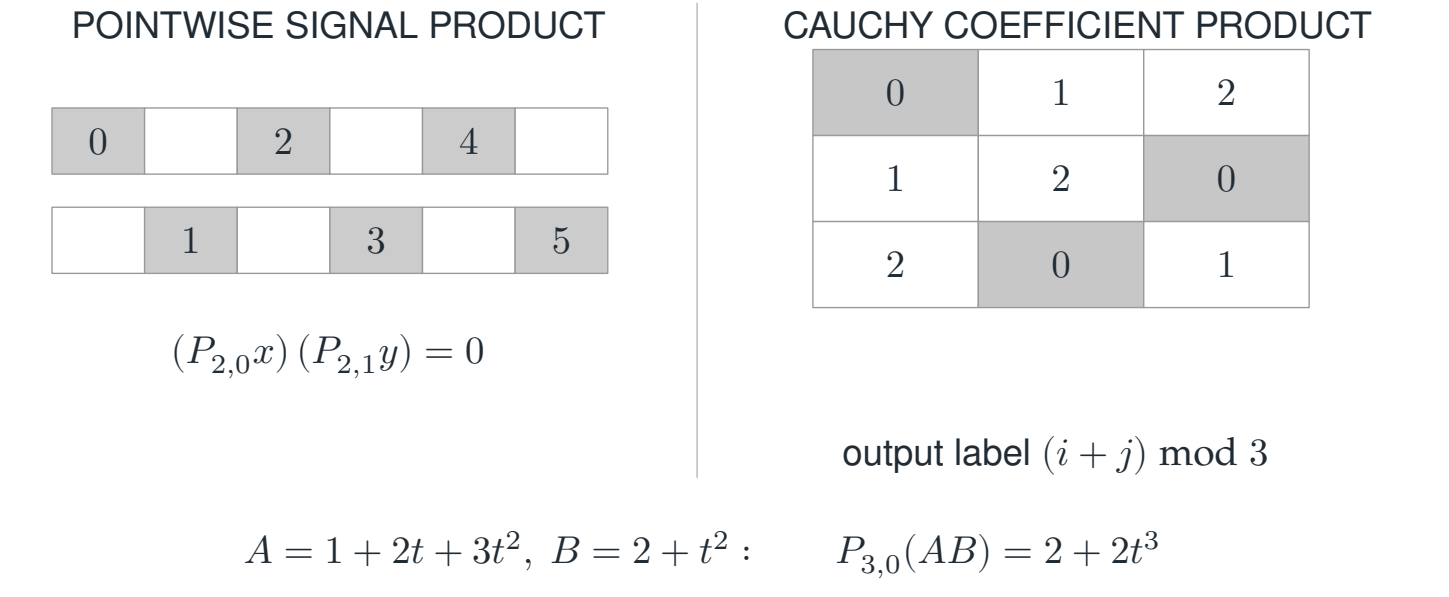
The left panel shows disjoint residue masks under pointwise multiplication. The right panel shows coefficient convolution with output residue given by the sum of input residues.
Drawing labels and data 20 labels
Read the original labels as selectable text. Tables preserve grid relationships; other short labels are grouped compactly.
- POINTWISE SIGNAL PRODUCT
- CAUCHY COEFFICIENT PRODUCT
- \(0\)
- \(2\)
- \(4\)
- \(1\)
- \(3\)
- \(5\)
- \((P_{2,0}x)\,(P_{2,1}y)=0\)
| Row / column | Column 1 | Column 2 | Column 3 |
|---|---|---|---|
| Row 1 | \(0\) | \(1\) | \(2\) |
| Row 2 | \(1\) | \(2\) | \(0\) |
| Row 3 | \(2\) | \(0\) | \(1\) |
- output label \((i+j)\bmod 3\)
Pointwise multiplication preserves the same address
For time-residue masks, \((P_{N,i}x)[n](P_{N,j}y)[n]=0\) when \(i\ne j\). Therefore
Here the dot means multiplication at the same sample, not convolution.
Cauchy multiplication adds degrees
For formal series \(A(t),B(t)\), the coefficient of \(t^n\) is a sum over \(a+b=n\). Consequently the output residue is \(i+j\pmod N\):
For \(N=3\), take \(A=1+2t+3t^2\) and \(B=2+t^2\). Direct multiplication gives
The \(2t^3\) term comes from residues \(1+2\), not \(0+0\). At power zero, the empty product contributes \(1\) only in residue zero. These are formal coefficient identities and require no convergence assumption.
Read this as
Before applying a packet multiplication rule, specify whether multiplication acts on sample values or on series coefficients.