
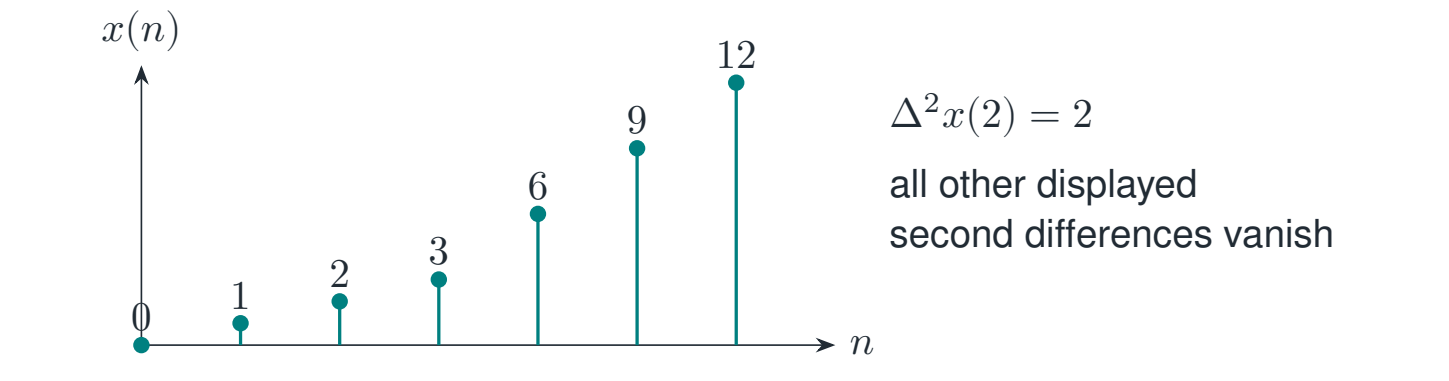
Let \(x(n)=n+2(n-3)_+\) on the integer line. Its slope changes from one to three at the breakpoint \(3\). The second forward difference is
Reading the drawing
Stems show the signal sample values and labeled second differences. The nonzero response is confined to a stencil crossing the slope change.
Drawing labels and data 10 labels
Read the original labels as selectable text. Tables preserve grid relationships; other short labels are grouped compactly.
- \(n\)
- \(x(n)\)
- \( 0 \)
- \( 1 \)
- \( 2 \)
- \( 3 \)
- \( 6 \)
- \( 9 \)
- \( 12 \)
\(\Delta^2x(2)=2\)
[5pt]all other displayed
second differences vanish
An exact small stencil calculation
The values at \(n=0,\ldots,6\) are \((0,1,2,3,6,9,12)\). The second differences at \(n=0,\ldots,4\) are \((0,0,2,0,0)\). The only nonzero stencil straddles the slope change. For a piecewise polynomial of degree at most \(d\), \(\Delta^{d+1}\) vanishes whenever its complete stencil lies inside one polynomial piece. Candidate responses are confined to at most \(d+1\) starting addresses before each breakpoint. They are boundary bands, not necessarily exact breakpoint locations.
Differencing also acts on noise
The absolute binomial coefficients of \(\Delta^m\) sum to \(2^m\). With \(\|\eta\|_\infty\le1/16\), second-difference noise is bounded by \(4/16=1/4\). The true response \(2\) remains at least \(7/4\), while all responses away from the breakpoint band remain at most \(1/4\). Threshold one separates them. The general robust-band statement assumes that each breakpoint has at least one sufficiently large true response. A breakpoint can fail that assumption through its amplitude or local configuration. Annihilation away from boundaries does not prove a lower bound at every boundary.
Read this as
A vanishing interior response is structural. Reliable detection also requires the boundary response to exceed the amplified noise.