
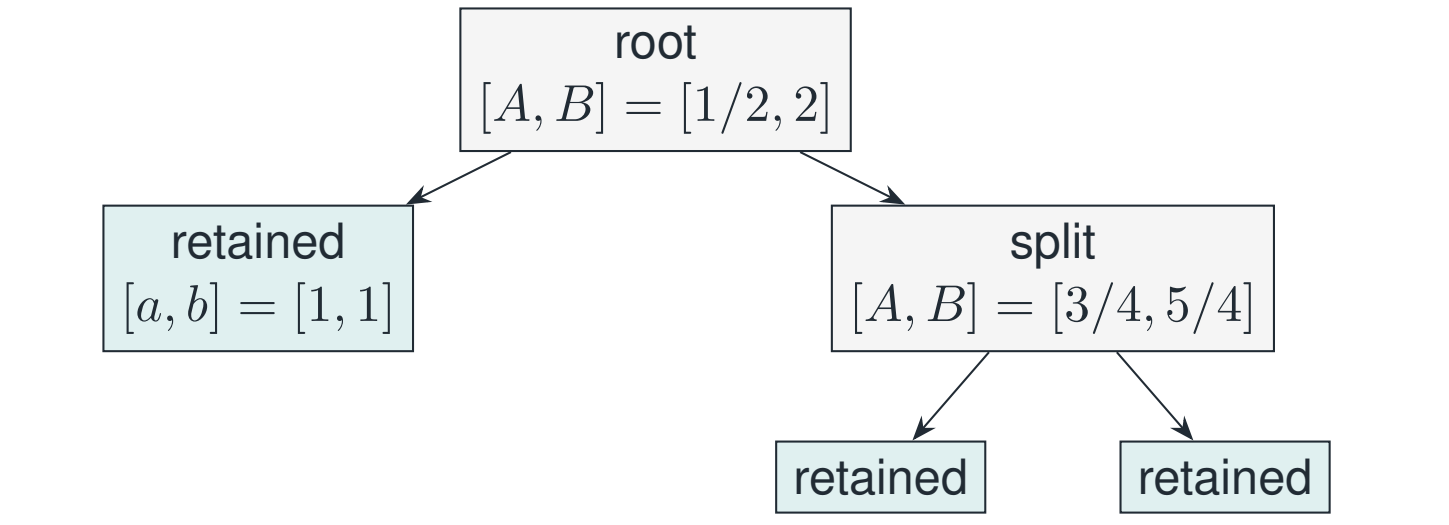
Suppose the root split has nonnegative squared-norm bounds \(A=1/2\) and \(B=2\). Retain the left child. Split the right child with bounds \(3/4\) and \(5/4\), then retain both grandchildren.
Reading the drawing
Boxes identify the retained root, a split branch and two descendants. Their local constants give the stated branchwise lower and upper bounds.
Drawing labels and data 5 labels
Read the original labels as selectable text. Tables preserve grid relationships; other short labels are grouped compactly.
root
\([A,B]=[1/2,2]\)
retained
\([a,b]=[1,1]\)
split
\([A,B]=[3/4,5/4]\)
- retained
- retained
Start with one at every retained node
The left subtree has bounds \(a_0=b_0=1\). The right subtree has \(a_1=3/4\) and \(b_1=5/4\). The recursive certificate gives
Consequently the total leaf coefficient energy lies between \(3/8\) and \(5/2\) times the root energy. These are guaranteed bounds; no assertion that every admissible collection of local maps attains both constants is needed.
Why a minimum and maximum appear
After the root split, its energy may distribute unevenly between the two children. The lower estimate must survive the least favorable child lower bound. The upper estimate must survive the largest child upper bound. Replacing these by an unweighted average would presume an energy distribution that the hypotheses do not supply. When all local maps are unitary, every factor is one and the recursion recovers exact energy conservation. For general local maps, a positive lower bound alone establishes injectivity and stable inversion on the range; it does not by itself assert surjectivity onto every possible leaf tuple.
Read this as
Exact tree coverage and good conditioning are separate inputs. The first chooses a coordinate route; the second bounds what that route does to norms.