
Use normalized impedance \(z\) and reflection coefficient \(\Gamma\):
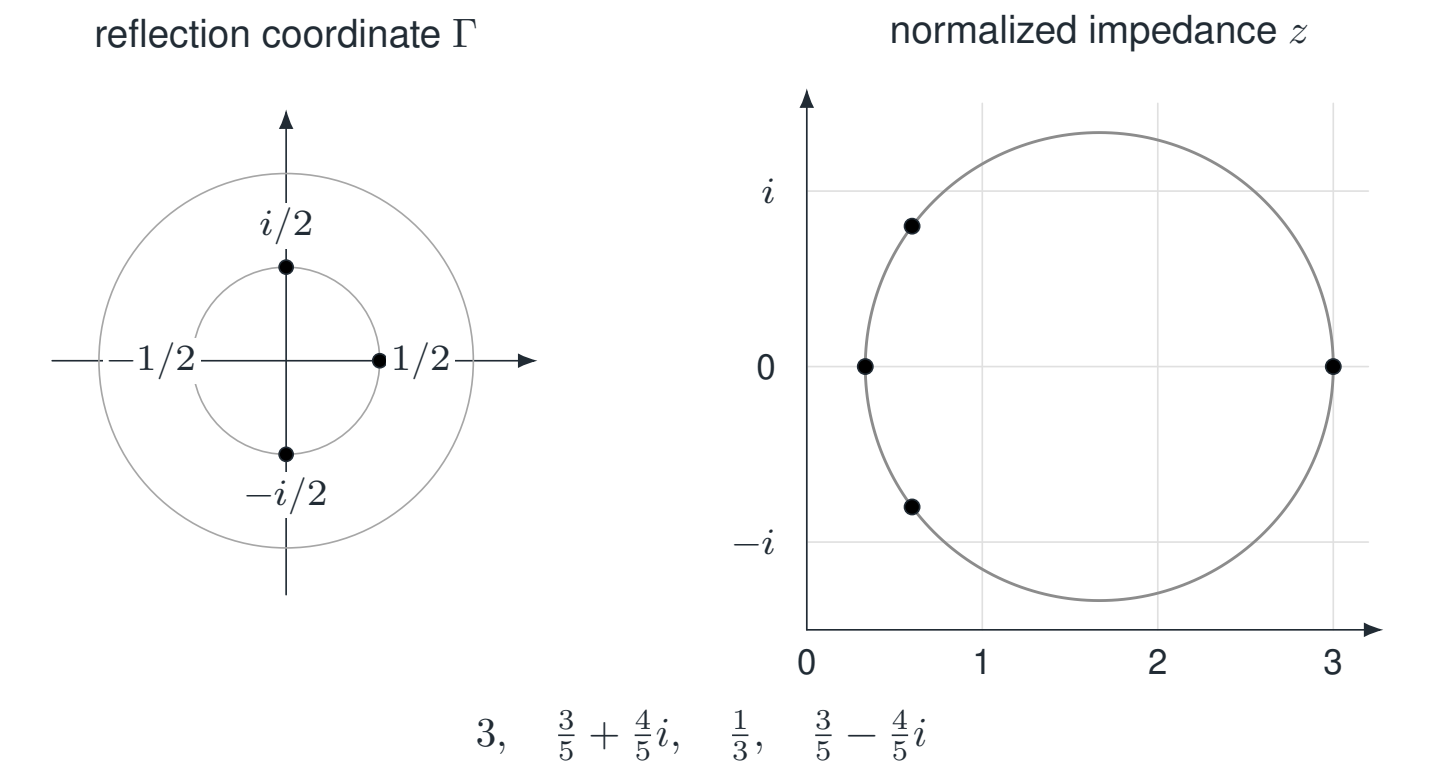
The circle \(|\Gamma|=1/2\) is a constant-mismatch orbit. Its four quarter-turn points map to the exact impedances shown below.
Reading the drawing
The left panel plots four reflection coefficients; the right plots their Cayley images. Coordinate labels identify the unequal impedances arising from quarter turns.
Drawing labels and data 14 labels
Read the original labels as selectable text. Tables preserve grid relationships; other short labels are grouped compactly.
- \(1/2\)
- \(i/2\)
- \(-1/2\)
- \(-i/2\)
- reflection coordinate \(\Gamma\)
- 0
- 1
- 2
- 3
- \(-i\)
- 0
- \(i\)
- normalized impedance \(z\)
| \(\Gamma\) | \(1/2\) | \(i/2\) | \(-1/2\) | \(-i/2\) |
|---|---|---|---|---|
| \(z\) | \(3\) | \(3/5+4i/5\) | \(1/3\) | \(3/5-4i/5\) |
The coordinates preserve structure, not Euclidean distances
A quarter turn is a rotation in the reflection disk. After pulling back, it is a Möbius map, not a Euclidean rotation of the impedance plane. Equal reflection magnitudes need not give equal impedance magnitudes. The opposite points \(1/2\) and \(-1/2\) become \(3\) and \(1/3\). The continuous impedance locus is the circle \((\operatorname{Re}z-5/3)^2+(\operatorname{Im}z)^2=16/9\), also drawn in the plate. Finite passive impedances with \(\operatorname{Re}z\ge0\) map to the closed disk except \(\Gamma=1\). That missing point is obtained only by adjoining impedance infinity. The interior maps to the open right half-plane. The classical Smith grid supplies the geometry; the cyclic labels specify exact rotations on it. Neither a new physical law nor a new optimal sampling theorem is implied by this coordinate description.
Read this as
A simple action in one chart can be nonlinear in another. Conjugacy preserves the action law, not the apparent shape of a displacement.