
E8 Exact error formulas for estimated packets
On this page · Permalink · Source line 2695
The error of an estimated packet is often described by a segmentation score. For approximation, an exact norm formula is more useful because it separates value errors from geometric disagreement.
Theorem E8.1: Exact scalar region formula
Let \(E,F\) be measurable subsets of a measure space, let \(a,b\in{\mathbb C}\), and let \(1\leq p<\infty\). Then
For equal amplitudes,
Read proof · Visual guide: An overlap matrix is an exact error ledger · Read statement and proof side by side · Permalink · Source line 2699 · Claim record · Lean coverage · Code · Worked examples
Proof of Theorem E8.1
The sets \(E\cap F\), \(E\setminus F\), and \(F\setminus E\) are disjoint. The difference takes the values \(a-b\), \(a\), and \(-b\) on these three sets and is zero elsewhere. Integrating its \(p\)th power gives the formula.
Back to statement · Read statement and proof side by side · Permalink · Source line 2718 · Claim record · Lean coverage · Code · Worked examples
Corollary E8.2: Location error for one step
Let \(0\leq\tau,\widehat\tau\leq1\) and \(H_\tau={\mathbf 1}_{[\tau,1]}\). For \(1\leq p<\infty\),
In the supremum norm, the error equals \(|a|\) whenever \(\tau\neq\widehat\tau\).
Read proof · Visual guide: A shifted step and a shifted ramp have different moduli · Read statement and proof side by side · Permalink · Source line 2722 · Claim record · Lean coverage · Code · Worked examples
Proof of Corollary E8.2
The symmetric difference of the two intervals has length \(|\tau-\widehat\tau|\). The supremum statement follows because the two steps differ by \(a\) on a nonempty interval.
Back to statement · Read statement and proof side by side · Permalink · Source line 2732 · Claim record · Lean coverage · Code · Worked examples
Theorem E8.3: Location stability for higher order packets
Let \(m\geq1\), \(1\leq p<\infty\), and \(0\leq\tau,\widehat\tau\leq1\). Then
For \(p=\infty\),
Thus location error is Lipschitz for every derivative jump packet of positive order, while a value jump has only the finite \(L^p\) modulus in Corollary E8.2.
Read proof · Visual guide: A shifted step and a shifted ramp have different moduli · Read statement and proof side by side · Permalink · Source line 2736 · Claim record · Lean coverage · Code · Worked examples
Proof of Theorem E8.3
Assume \(\tau<\widehat\tau\). Differentiation with respect to the location parameter gives
for almost every \(t\). Hence
Minkowski's inequality gives
The supremum is bounded by the norm of \(t^{m-1}/(m-1)!\) on \([0,1]\), which is the stated constant. The supremum norm argument is identical.
Back to statement · Read statement and proof side by side · Permalink · Source line 2753 · Claim record · Lean coverage · Code · Worked examples
E8.1 Several regions
On this page · Permalink · Source line 2775
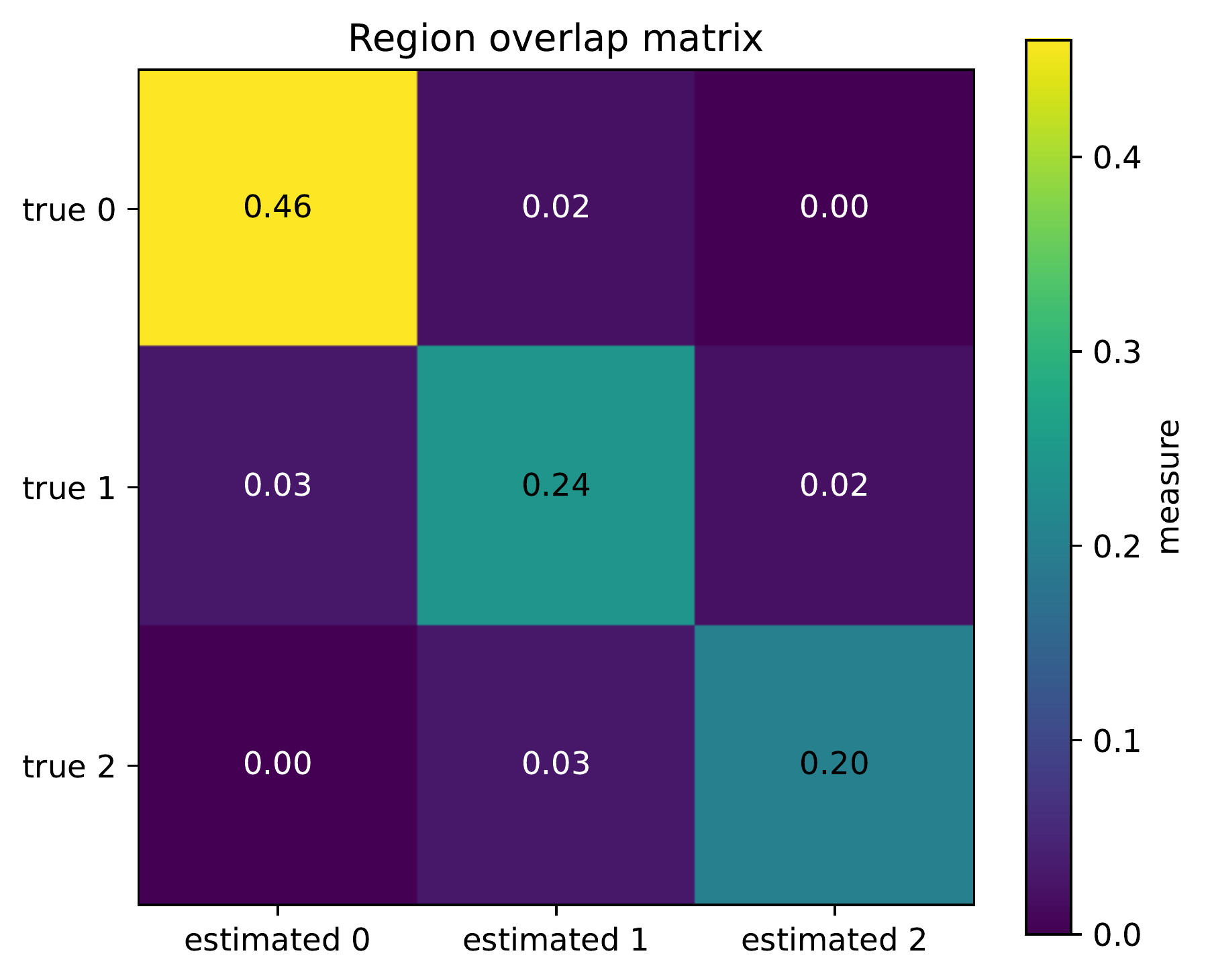
Let \((E_i)_{i=0}^{I}\) and \((F_j)_{j=0}^{J}\) be measurable partitions of the same domain, up to null sets. Let \(a_i\) and \(b_j\) be the corresponding values. The index zero may be used for a background region.
Theorem E8.4: Overlap matrix formula
Define
For \(1\leq p<\infty\),
The row sums of \(M\) are \(\mu(E_i)\), and the column sums are \(\mu(F_j)\).
Read proof · Visual guide: An overlap matrix is an exact error ledger · Read statement and proof side by side · Permalink · Source line 2779 · Claim record · Lean coverage · Code · Worked examples
Proof of Theorem E8.4
The intersections \(E_i\cap F_j\) form a measurable partition. On such an intersection, the two piecewise constant functions have values \(a_i\) and \(b_j\). Integrate the constant error over every intersection. The marginal identities follow by summing the partition pieces in a fixed row or column.
Back to statement · Read statement and proof side by side · Permalink · Source line 2797 · Claim record · Lean coverage · Code · Worked examples
Corollary E8.5: Background and packet error
Suppose the true and estimated packets use the same amplitude list \((a_i)_{i=0}^{I}\), but possibly different regions. Then
Only off diagonal overlaps contribute.
Read proof · Read statement and proof side by side · Permalink · Source line 2801 · Claim record · Lean coverage · Code · Worked examples
Proof of Corollary E8.5
Apply Theorem E8.4 with \(b_k=a_k\). The diagonal terms vanish.
Back to statement · Read statement and proof side by side · Permalink · Source line 2811 · Claim record · Lean coverage · Code · Worked examples
E8.2 Boundary tube control
On this page · Permalink · Source line 2822
For a closed set \(\Gamma\), write
Definition E8.6: Linear tube bound
A boundary \(\Gamma\) has a linear tube bound if there are constants \(C_\Gamma\) and \(\delta_0>0\) such that
for \(0<\delta<\delta_0\).
Permalink · Source line 2831 · Claim record · Lean coverage · Code · Worked examples
Bounded Lipschitz domains and many finite perimeter sets have estimates of this form, with constants controlled by geometric size. The next theorem only requires the displayed bound.
Theorem E8.7: Geometric packet bound
Let \(E\) be a region with boundary \(\Gamma\), and suppose
If \(\Gamma\) has a linear tube bound and \(0<\delta<\delta_0\) lies in its stated range, then for \(1\leq p<\infty\),
If amplitudes \(a\) and \(b\) differ, then
Read proof · Visual guide: A shifted step and a shifted ramp have different moduli · Read statement and proof side by side · Permalink · Source line 2843 · Claim record · Lean coverage · Code · Worked examples
Proof of Theorem E8.7
The equal amplitude case follows from Theorem E8.1 and the tube inclusion. For unequal amplitudes, split the error into its value mismatch on \(E\cap F\) and the two disagreement pieces. Apply the triangle inequality and the same tube estimate.
Back to statement · Read statement and proof side by side · Permalink · Source line 2866 · Claim record · Lean coverage · Code · Worked examples
Example E8.8: A perturbed disk
Let \(E\) and \(F\) be concentric disks of radii \(r\) and \(r+\delta\) in \({\mathbb R}^2\), with \(\delta>0\). Then
For equal amplitude \(a\), the exact \(L^2\) packet error is
This gives the expected square root dependence on boundary displacement.