
E5 Filter banks, frame bounds, and lifting
On this page · Permalink · Source line 2034
Throughout this section the banks act boundedly on the relevant polyphase \(\ell^2\) spaces. A finite channel analysis bank acts in Fourier coordinates by a matrix \(E(z)\). A synthesis bank acts by a matrix \(R(z)\). The matrices may be square or rectangular. Their entries are Laurent polynomials for finite filters and bounded measurable functions for general stable filters.
Theorem E5.1: Perfect reconstruction criterion
Let \(E(z)\) be an \(M\) by \(N\) analysis matrix and let \(R(z)\) be an \(N\) by \(M\) synthesis matrix. The bank reconstructs every input with a delay of \(d\) coarse channel samples, equivalent to \(Nd\) original samples in the one dimensional \(N\)-phase convention, exactly if and only if
for almost every point on the unit circle. A nonzero scalar factor gives exact reconstruction up to gain and delay.
Read proof · Read statement and proof side by side · Permalink · Source line 2038 · Claim record · Lean coverage · Code · Worked examples
Proof of Theorem E5.1
The channel Fourier transform turns analysis followed by synthesis into multiplication by \(R(z)E(z)\). If the matrix identity holds, inverse transformation gives the delayed input. Conversely, if every input is reconstructed with that delay, the difference matrix annihilates every vector valued Fourier datum and must vanish almost everywhere.
Back to statement · Read statement and proof side by side · Permalink · Source line 2046 · Claim record · Lean coverage · Code · Worked examples
Theorem E5.2: Quantitative imperfect reconstruction
Define the delay compensated defect
If
then the delay compensated reconstruction \(\widetilde x\) satisfies
The constant is sharp as an operator norm.
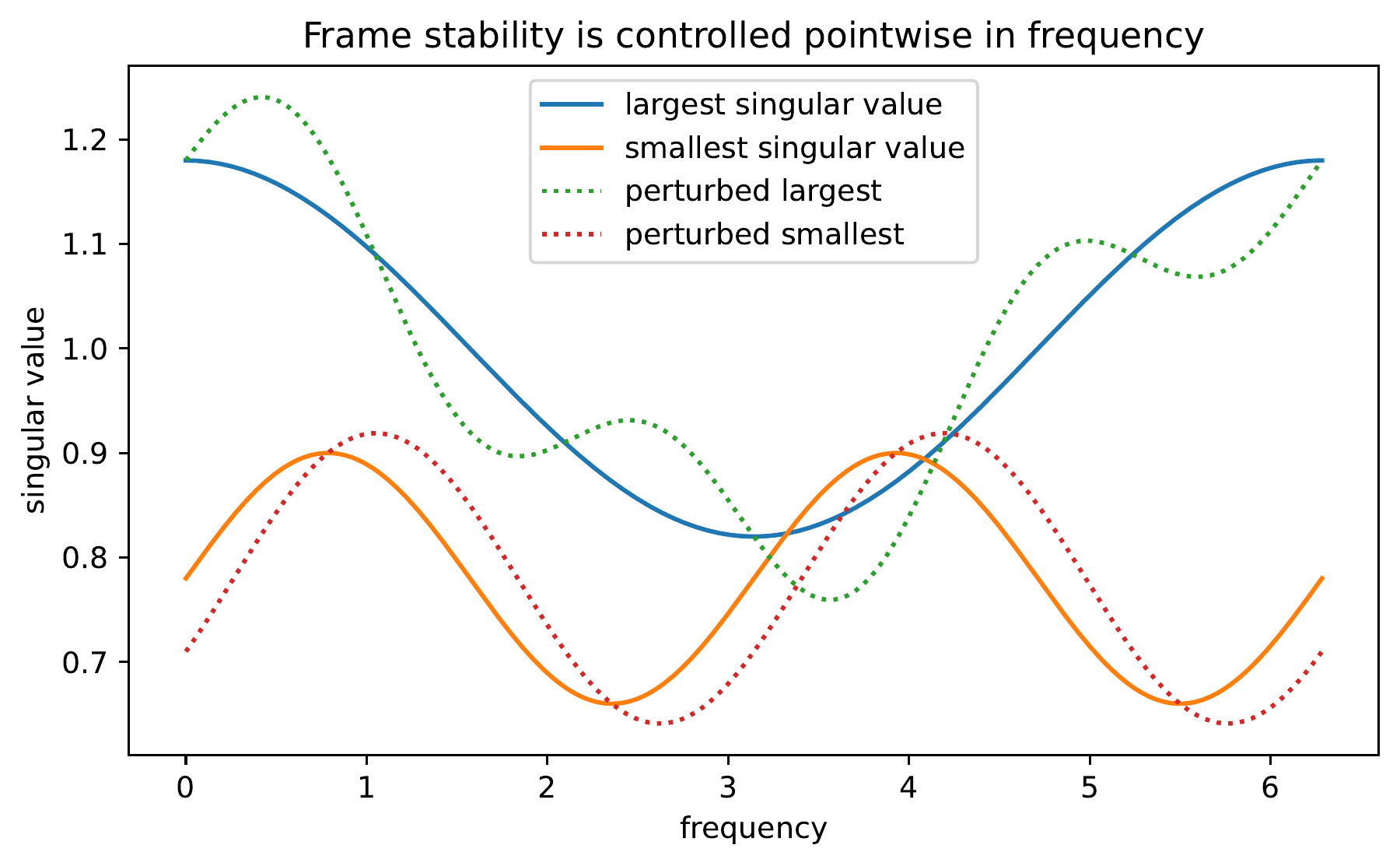
Read proof · Visual guide: A positive singular-value gap survives perturbation · Read statement and proof side by side · Permalink · Source line 2050 · Claim record · Lean coverage · Code · Worked examples
Proof of Theorem E5.2
In polyphase Fourier coordinates, the error is \(D({\mathrm e}^{{\mathrm i}\omega}){\boldsymbol{X}}({\mathrm e}^{{\mathrm i}\omega})\). Pointwise multiplication and Plancherel's theorem give the upper bound. The operator norm of a measurable matrix multiplier is its essential supremum, which proves sharpness.
Back to statement · Read statement and proof side by side · Permalink · Source line 2072 · Claim record · Lean coverage · Code · Worked examples
Example E5.3: A reconstruction certificate
Suppose a two channel bank has delay compensated defect
Then
Every input therefore has relative reconstruction error at most two percent in \(\ell^2\). The estimate is independent of the input length.
Theorem E5.4: Stability under filter perturbation
Assume \(RE=z^{-d}I_N\). Let
Set
Then the delay compensated reconstruction defect obeys
Read proof · Read statement and proof side by side · Permalink · Source line 2094 · Claim record · Lean coverage · Code · Worked examples
Proof of Theorem E5.4
Expand
Take pointwise operator norms, then the essential supremum. Multiplication by the delay factor has unit modulus.
Back to statement · Read statement and proof side by side · Permalink · Source line 2118 · Claim record · Lean coverage · Code · Worked examples
Theorem E5.5: Frame bounds from the polyphase symbol
Assume that
for almost every \(\omega\), where \(0<A\leq B<\infty\). Then the analysis bank satisfies
The pointwise matrix
is a bounded left inverse and gives the canonical dual synthesis bank.
Read proof · Read statement and proof side by side · Permalink · Source line 2128 · Claim record · Lean coverage · Code · Worked examples
Proof of Theorem E5.5
Apply the matrix inequality to the polyphase Fourier vector at every frequency and integrate. Plancherel's theorem gives the frame inequalities. The lower bound makes \(E^*E\) invertible almost everywhere, and direct multiplication gives \(R_{\rm can}E=I_N\). The same spectral bounds show that the canonical dual is bounded.
Back to statement · Read statement and proof side by side · Permalink · Source line 2154 · Claim record · Lean coverage · Code · Worked examples
Corollary E5.6: Coefficient noise under canonical synthesis
Under the hypotheses of Theorem E5.5, suppose the observed coefficient vector is
Canonical synthesis gives
and
Read proof · Visual guide: A positive singular-value gap survives perturbation · Read statement and proof side by side · Permalink · Source line 2158 · Claim record · Lean coverage · Code · Worked examples
Proof of Corollary E5.6
The smallest singular value of \(E\) is at least \(\sqrt A\), so the pointwise norm of its pseudoinverse is at most \(1/\sqrt A\). Apply Plancherel's theorem to \(R_{\mathrm{can}}\nu\).
Back to statement · Read statement and proof side by side · Permalink · Source line 2175 · Claim record · Lean coverage · Code · Worked examples
Theorem E5.7: Perturbation of frame bounds
Under the hypotheses of Theorem E5.5, let \(\widetilde E=E+\Delta E\) and suppose
Then \(\widetilde E\) is a frame analysis bank with bounds
Read proof · Visual guide: A positive singular-value gap survives perturbation · Read statement and proof side by side · Permalink · Source line 2179 · Claim record · Lean coverage · Code · Worked examples
Proof of Theorem E5.7
For every vector \(v\),
The upper bound follows from
Square the inequalities and integrate in frequency.
Back to statement · Read statement and proof side by side · Permalink · Source line 2192 · Claim record · Lean coverage · Code · Worked examples
Remark E5.8
Even when \(E\) is a Laurent polynomial matrix, the canonical dual need not have finite impulse response. Finite support of both analysis and synthesis is an additional algebraic condition.
Corollary E5.9: Paraunitary bank
If \(E(z)^*E(z)=I_N\) on the unit circle, then analysis is an isometry and synthesis may be chosen as \(R(z)=E(z)^*\).
Read proof · Read statement and proof side by side · Permalink · Source line 2214 · Claim record · Lean coverage · Code · Worked examples
Proof of Corollary E5.9
Use Theorem E5.5 with \(A=B=1\), then multiply the matrices.
Back to statement · Read statement and proof side by side · Permalink · Source line 2218 · Claim record · Lean coverage · Code · Worked examples
E5.1 Haar analysis
On this page · Permalink · Source line 2229
The Haar matrix is
For even and odd samples \(e(n)=x(2n)\) and \(o(n)=x(2n+1)\), the low and high coordinates are
Corollary E5.10: Haar reconstruction and energy
The Haar bank reconstructs exactly and
Read proof · Read statement and proof side by side · Permalink · Source line 2248 · Claim record · Lean coverage · Code · Worked examples
Proof of Corollary E5.10
The matrix \(E_H\) is unitary.
Back to statement · Read statement and proof side by side · Permalink · Source line 2255 · Claim record · Lean coverage · Code · Worked examples
E5.2 Lifting steps
On this page · Permalink · Source line 2259
Let \(P(z)\) and \(Q(z)\) be Laurent polynomials. Define
Theorem E5.11: Exact lifting update
The lifting matrices are invertible with
If \(R_0E_0=I\), then every finite product \(V\) of lifting matrices gives another exact bank by
Every lifting step has determinant one.
Read proof · Read statement and proof side by side · Permalink · Source line 2278 · Claim record · Lean coverage · Code · Worked examples
Proof of Theorem E5.11
Direct multiplication proves the inverse formulas and the determinant statement. The reconstructed product is
Back to statement · Read statement and proof side by side · Permalink · Source line 2294 · Claim record · Lean coverage · Code · Worked examples
Example E5.12: A two neighbor predict and update transform
Split a sequence into even and odd samples. Define
and
The inverse is obtained in reverse order:
then
Thus reconstruction is exact over every coefficient field in which two is invertible. This is a standard compactly supported biorthogonal lifting pattern [CohenDaubechiesFeauveau1992], [Sweldens1996], [DaubechiesSweldens1998].