
E3 Polyphase coordinates on finite index sublattices
On this page · Permalink · Source line 1756
Let \(L\leq{\mathbb Z}^d\) be a sublattice of finite index \(q\). Choose a set \(R\subset{\mathbb Z}^d\) containing one representative from every coset in \({\mathbb Z}^d/L\). Thus
For \(x:{\mathbb Z}^d\to{\mathbb C}\), its channel at \(r\) is the sequence on \(L\)
Definition E3.1: Lattice packet
For \(r\in R\), define the coordinate projector
The family \((P_r)_{r\in R}\) is called the packet system associated with \(L\) and \(R\).
Permalink · Source line 1767 · Claim record · Lean coverage · Code · Worked examples
For finite \(p\), equip \(\bigoplus_{r\in R}\ell^p(L)\) with
For \(p=\infty\), use the maximum norm.
Theorem E3.2: Exact lattice polyphase decomposition
For every \(1\leq p\leq\infty\), the analysis map
is an isometric isomorphism. Its inverse is the interleaving map
The projectors satisfy
Read proof · Visual guide: Six image phases are six exact address classes · Read statement and proof side by side · Permalink · Source line 1781 · Claim record · Lean coverage · Code · Worked examples
Proof of Theorem E3.2
Every address has a unique representation \(r+\ell\). For finite \(p\),
The corresponding supremum identity is immediate when \(p=\infty\). Unique address representation proves that analysis and interleaving are inverse maps. The projector identities follow from the disjoint coset partition.
Back to statement · Read statement and proof side by side · Permalink · Source line 1800 · Claim record · Lean coverage · Code · Worked examples
Corollary E3.3: One dimensional residue coordinates
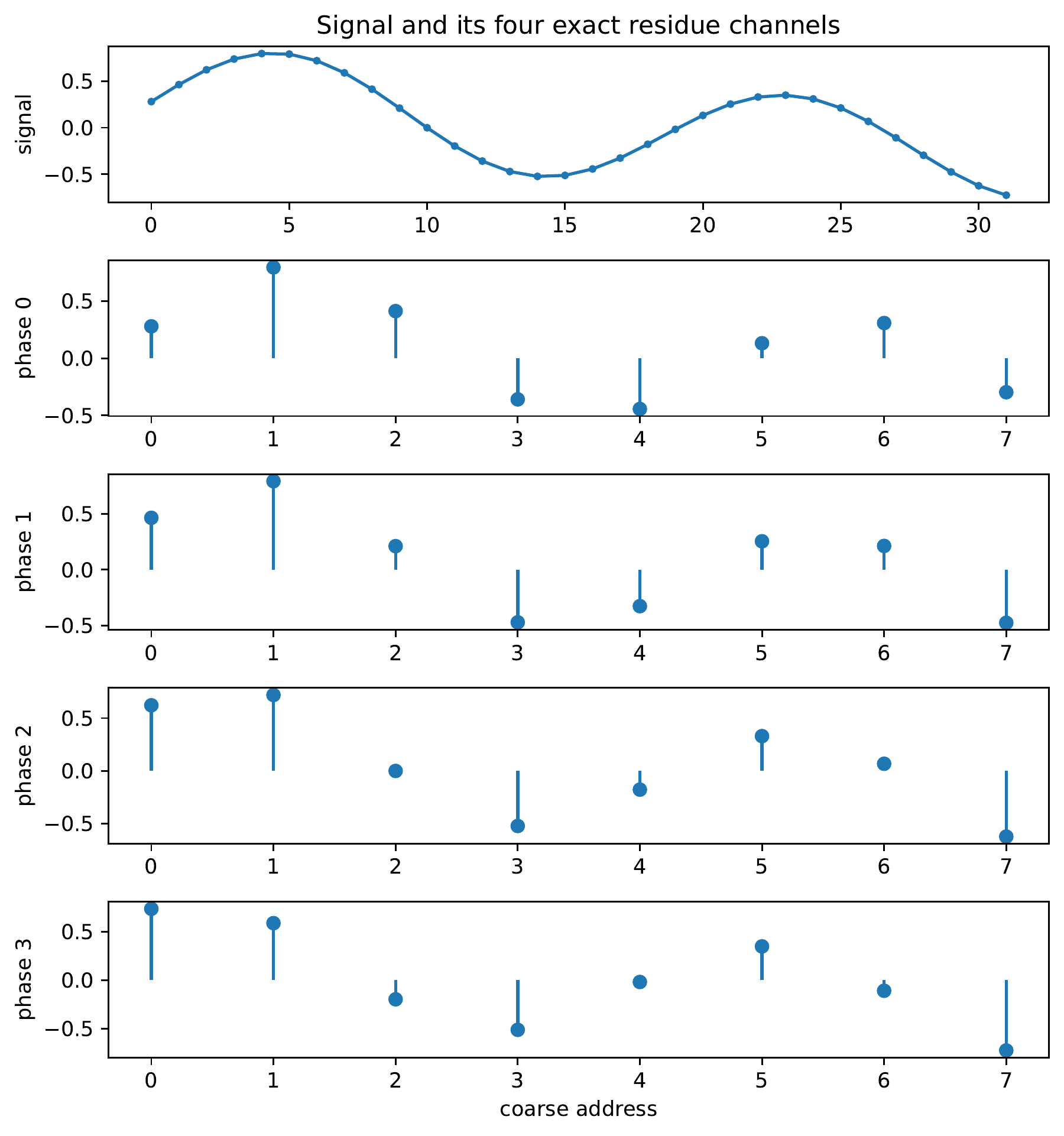
For \(L=N{\mathbb Z}\) and \(R=\{0,\ldots,N-1\}\),
and
isometrically.
Read proof · Read statement and proof side by side · Permalink · Source line 1812 · Claim record · Lean coverage · Code · Worked examples
Proof of Corollary E3.3
Apply Theorem E3.2 to the standard residue representatives.
Back to statement · Read statement and proof side by side · Permalink · Source line 1824 · Claim record · Lean coverage · Code · Worked examples
Proposition E3.4: Translation covariance
Fix \(a\in{\mathbb Z}^d\). For every \(r\in R\), write uniquely
Then
Thus a fine translation permutes the lattice packets and applies an internal translation on \(L\).
Read proof · Read statement and proof side by side · Permalink · Source line 1828 · Claim record · Lean coverage · Code · Worked examples
Proof of Proposition E3.4
Evaluate at \(r+\ell\):
This is the stated channel formula.
Back to statement · Read statement and proof side by side · Permalink · Source line 1846 · Claim record · Lean coverage · Code · Worked examples
E3.1 Refinement of sublattices
On this page · Permalink · Source line 1863
Let \(L'\leq L\leq{\mathbb Z}^d\), with both indices finite. Choose representative systems \(R\) for \({\mathbb Z}^d/L\) and \(R'\) for \({\mathbb Z}^d/L'\). For \(r\in R\), define
Theorem E3.5: Exact lattice refinement
For every coarse packet,
The fine packets in the sum are pairwise disjoint. Refinement through several nested sublattices is transitive.
Read proof · Visual guide: Six image phases are six exact address classes · Read statement and proof side by side · Permalink · Source line 1872 · Claim record · Lean coverage · Code · Worked examples
Proof of Theorem E3.5
The coset \(r+L\) is the disjoint union of the \(L'\) cosets contained in it. Multiplying by the corresponding indicator functions gives the projector identity. A nested partition of a coset is independent of whether the intermediate level is inserted, which proves transitivity.
Back to statement · Read statement and proof side by side · Permalink · Source line 1882 · Claim record · Lean coverage · Code · Worked examples
Example E3.6: Rectangular image phases
For
one may take
The analysis map separates an image into \(MN\) exact phases. Refining \((M,N)\) to \((M',N')\), where \(M\mid M'\) and \(N\mid N'\), splits every coarse phase into
fine phases.