
14 Dyadic–odd phase factorization and boundary weighting
On this page · Visual guide: Sensitivity grows before the pole is reached · Permalink · Source line 1219
Write
The cyclic index splits by the Chinese remainder theorem:
Proposition 14.1: Dyadic–odd packet factorization
After identifying the residue labels by the Chinese remainder map, the phase projector factors as
Read proof · Visual guide: Residue labels are not impedance averages · Read statement and proof side by side · Permalink · Source line 1233 · Claim record · Lean coverage · Code · Worked examples
Proof of Proposition 14.1
The two congruence conditions are independent because \(2^s\) and \(M\) are coprime. Their indicator functions multiply to the indicator of the unique residue class modulo \(N\) satisfying both.
Back to statement · Read statement and proof side by side · Permalink · Source line 1242 · Claim record · Lean coverage · Code · Worked examples
The first dyadic step is exceptional in Smith coordinates because it is the inversion \(z\mapsto z^{-1}\). Higher dyadic levels refine the open/short duality into quarter-, eighth-, and finer phase sectors.
Away from its pole \({\Gamma}=1\), the inverse Cayley map has derivative
while normalized admittance has derivative proportional to \((1+{\Gamma})^{-2}\). Away from \({\Gamma}=\pm1\), this motivates the symmetric sensitivity
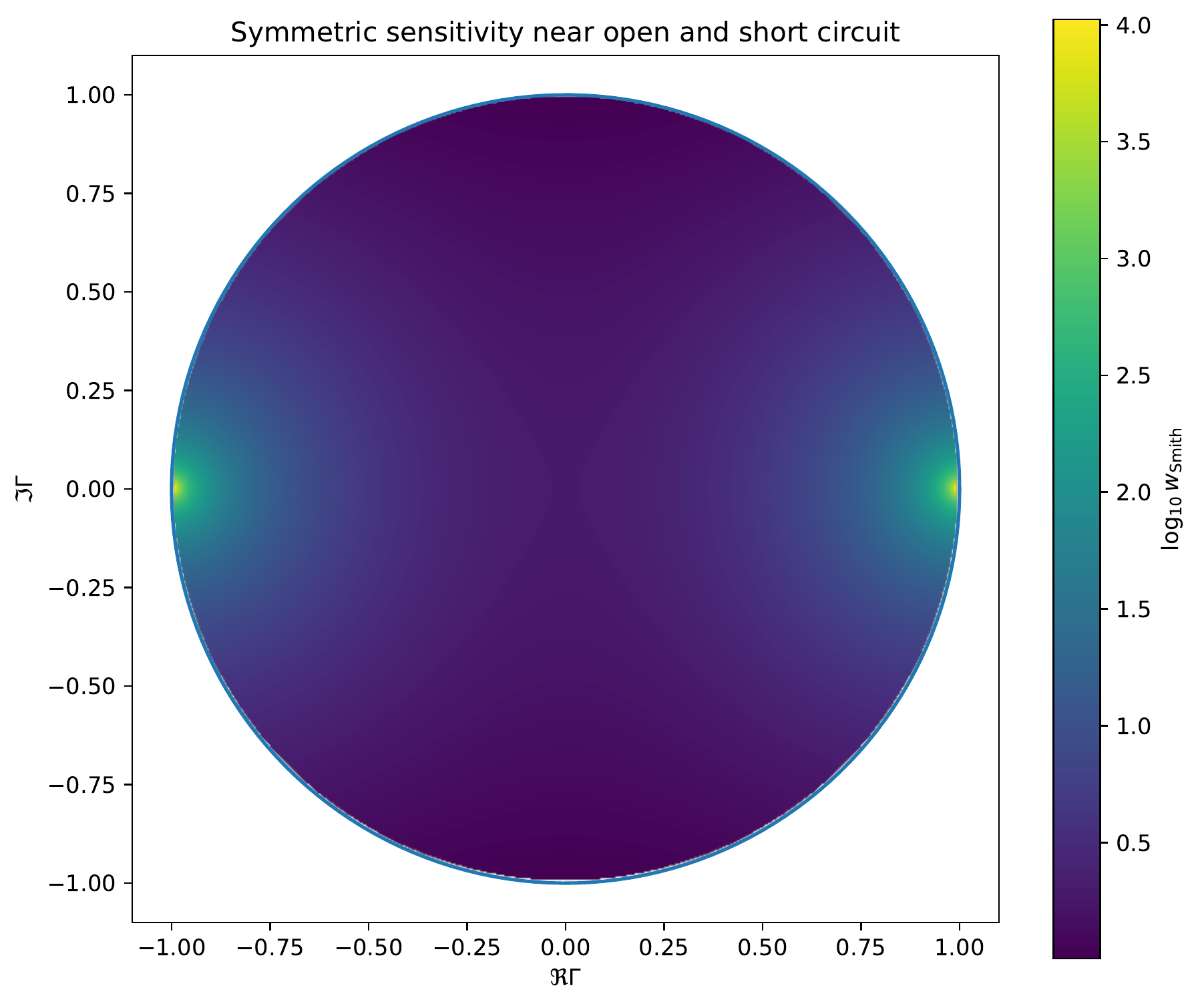
Boundary 14.2: Weighted refinement
The sensitivity formula follows directly from the exact coordinate derivatives. Using it to choose an optimal adaptive grid, interpolation rule, or measurement design is a separate numerical problem. The release visualizes the weight but does not prove optimality.
Permalink · Source line 1270 · Claim record · Lean coverage · Code · Worked examples