
12 Nonlinear signal packets
On this page · Visual guide: Nonlinear neighbors cross channel boundaries · Permalink · Source line 1056
Linear time invariance is not required for exact packet coordinates. Let \(A\) and \(B\) be formal power series over a commutative coefficient ring (in particular \({\mathbb C}\)). Set
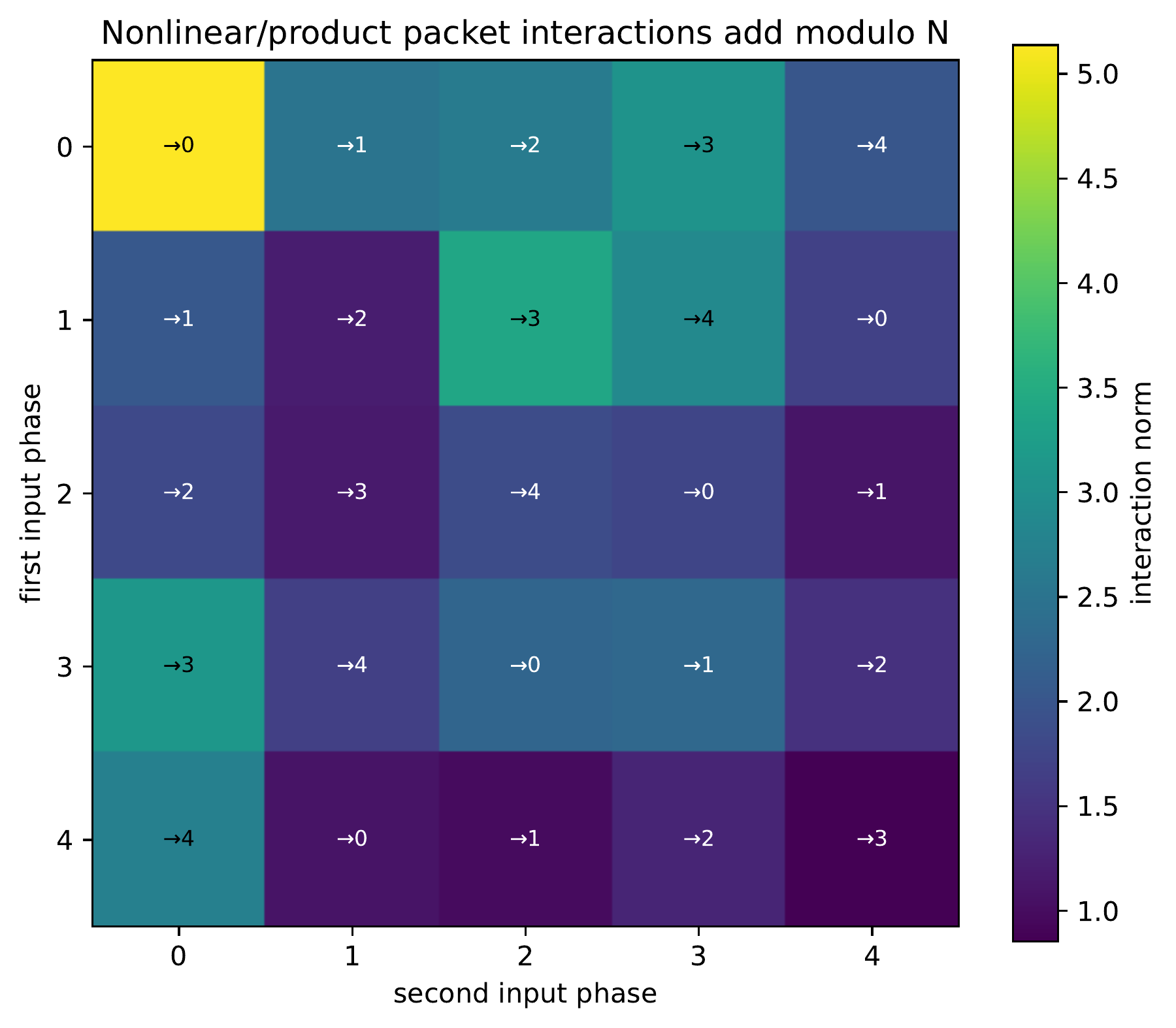
All phase indices range from \(0\) to \(N-1\). For another representation \(B(z)\), multiplication gives a nonlinear or bilinear interaction.
Theorem 12.1: Cyclic product law
For \(q\in{\mathbb N}\), the \(q\)th-power identity is
Read proof · Visual guide: Two products, two packet laws · Read statement and proof side by side · Permalink · Source line 1066 · Claim record · Lean coverage · Code · Worked examples
Proof of Theorem 12.1
Every coefficient in \(A_iB_j\) has degree congruent to \(i+j\) modulo \(N\). At any fixed degree \(n\), the Cauchy coefficient sum is finite. Sorting these terms by the residues of their two indices gives the first identity coefficient by coefficient. For the power identity, use induction on \(q\) and the finite product law. At \(q=0\), the index set contains the single empty tuple, its product is \(1\), and its residue sum is \(0\); hence the right side is \(1\) for \(k=0\) and \(0\) otherwise, as required. No convergence is needed for these formal identities. For analytic power series, the same identities hold wherever the series are absolutely convergent and their Cauchy products may be evaluated.
Back to statement · Read statement and proof side by side · Permalink · Source line 1083 · Claim record · Lean coverage · Code · Worked examples
For a finite nonlinear shift operator
the exact packet coordinates are simply
Analysis followed by this packet system and synthesis reproduces the direct nonlinear output exactly. The numerical residual in the companion implementation was zero to machine representation.