
9 Two-dimensional edge packets
On this page · Visual guide: Geometry localizes error while data may leave it ambiguous · Permalink · Source line 802
The first image consists of a smooth background and one sharp disk. The same three logical levels must remain separate:
the exact theorem using the known decomposition;
a limited estimator designed for a positive-contrast two-class packet;
the open problem of recovering arbitrary edge packets under noise and model ambiguity.
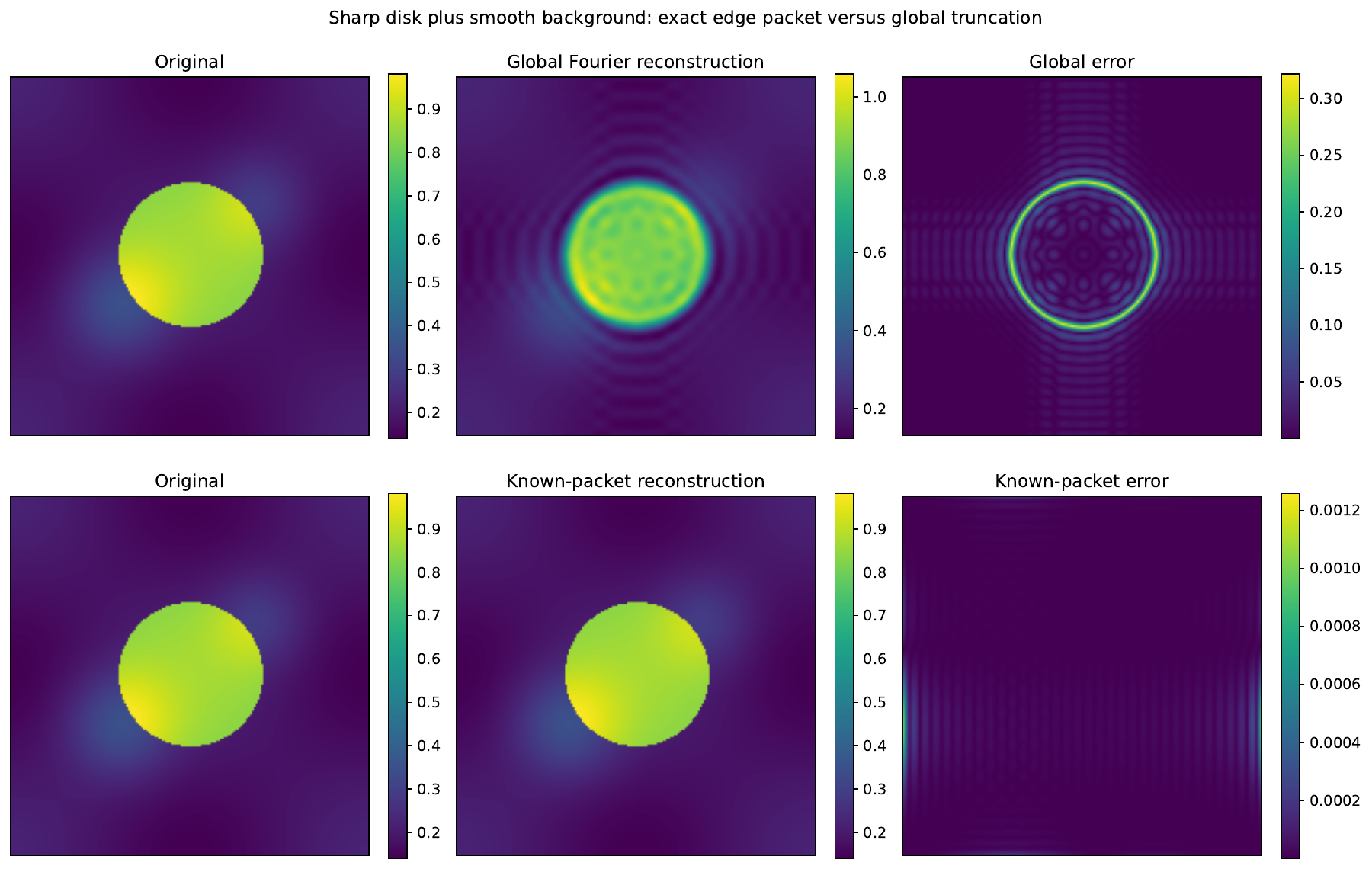
Numerical certificate 9.1: Two-dimensional errors
For the \(192\times192\) disk experiment, a square Fourier mask retains indices \(|k_x|,|k_y|\le16\), or \(33^2=1089\) bins. The reported errors are
The mask intersection-over-union was one in this positive-contrast synthetic case. The amplitude was estimated rather than inserted from the generating model.
Permalink · Source line 819 · Claim record · Lean coverage · Code · Worked examples
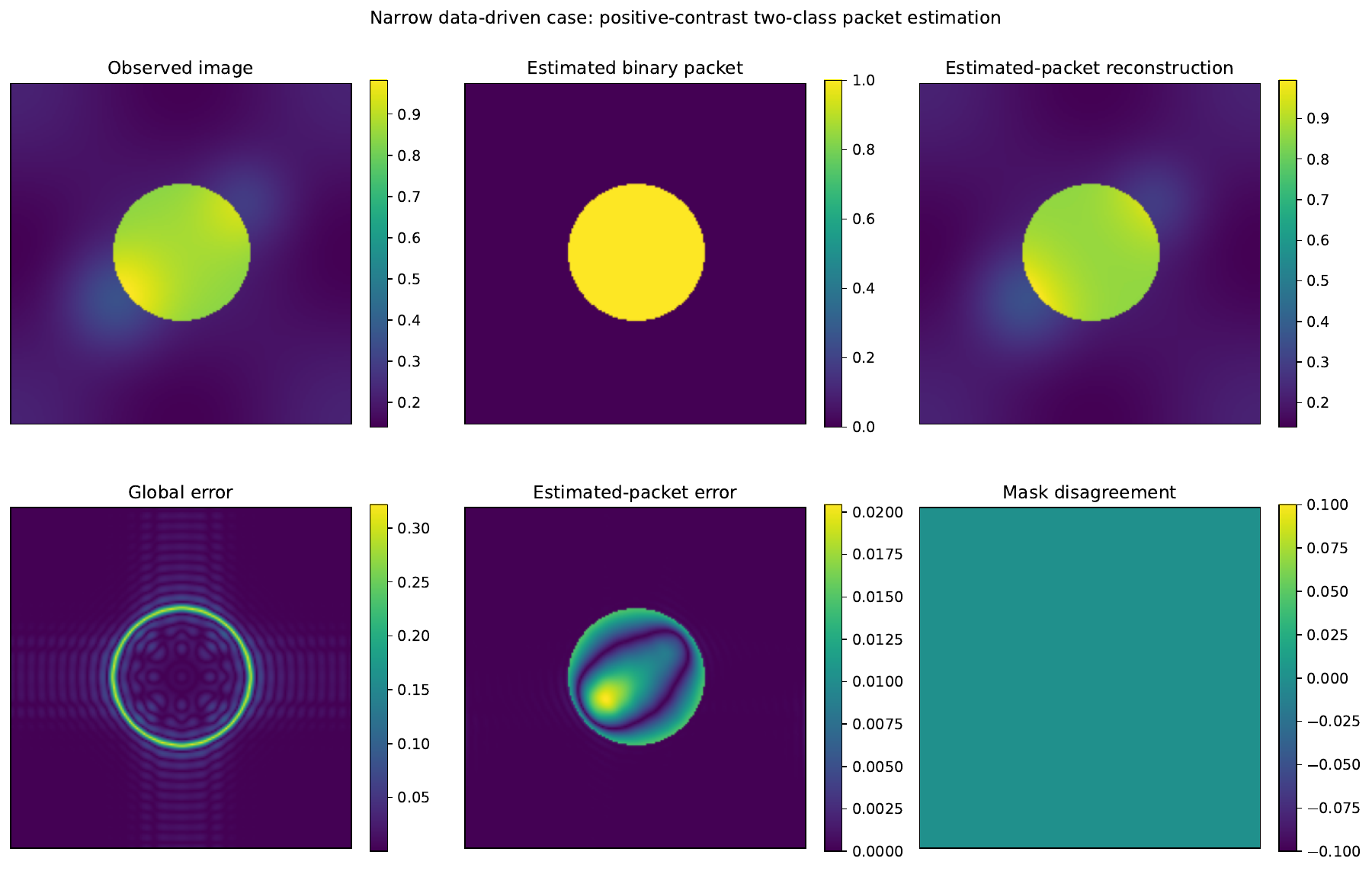
9.1 Curves, corners, and multiple amplitudes
On this page · Permalink · Source line 842
The exact theorem does not depend on the shape of the known edge packet. The next experiment contains a disk, a square, and a diamond with different jump amplitudes.
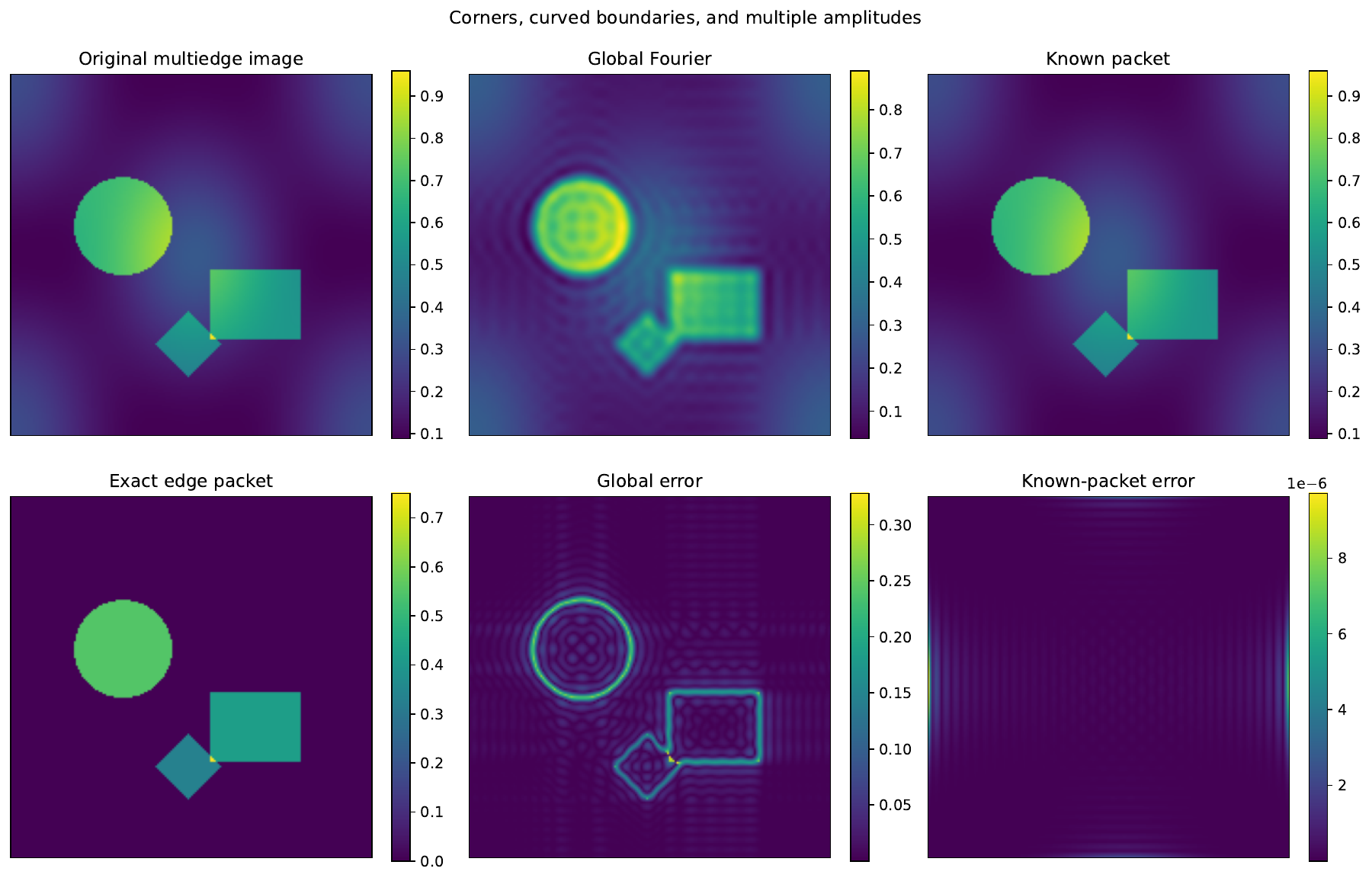
Numerical certificate 9.2: Multiedge errors
The global reconstruction had RMSE \(3.3740\times10^{-2}\) and maximum error \(3.2807\times10^{-1}\). The known-packet reconstruction had only the remaining smooth-background error. The experiment checks the finite implementation of the theorem for a composite packet; it is not a data-driven multiregion segmentation result.
Permalink · Source line 853 · Claim record · Lean coverage · Code · Worked examples