
6 Known edge packets and spectral reconstruction
On this page · Visual guide: Three objects, three different questions · Visual guide: Why a Fourier cutoff cannot reproduce this jump pointwise · Permalink · Source line 637
Retention changes the approximation target
The retained packet is supplied as part of the model. It passes through synthesis exactly. The approximation operator acts on the smooth remainder, so its error can be studied without forcing a global smooth basis to reproduce the jump. Finding that packet from observations is a separate recovery problem.
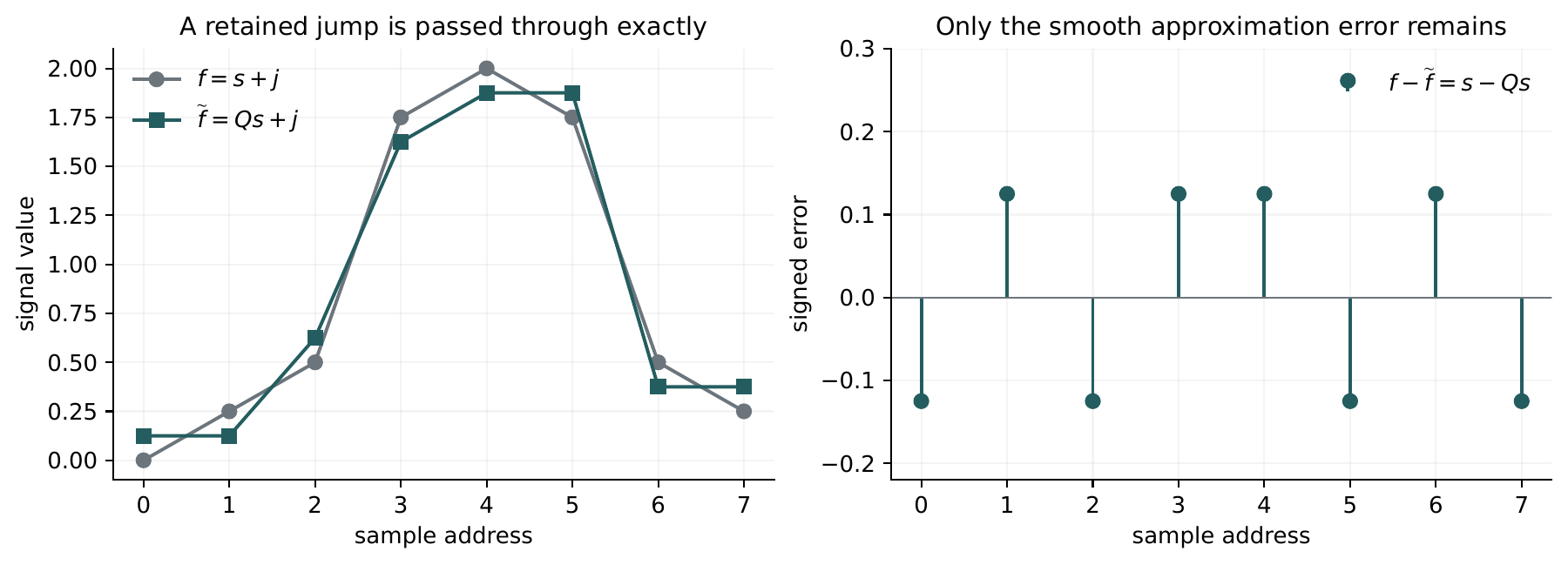
The central distinction is between approximating a jump globally and retaining it as its own packet.
Let
where \(s\) belongs to a smooth approximation class and \(j\) is a known discontinuity packet. Let \(Q_m\) be any approximation operator applied only to \(s\), and define
Theorem 6.1: Exact known-edge theorem
For every norm for which the expressions are defined,
No approximation of \(j\) occurs.
Read proof · Visual guide: Retain the jump and approximate the other packet · Read statement and proof side by side · Permalink · Source line 659 · Claim record · Lean coverage · Code · Worked examples
Proof of Theorem 6.1
Subtract:
Taking the norm gives the second identity.
Back to statement · Read statement and proof side by side · Permalink · Source line 671 · Claim record · Lean coverage · Code · Worked examples
Corollary 6.2: Several exact edge packets
If
and every \(j_q\) is retained exactly, then
Curved edges, corners, and different jump amplitudes do not alter the identity.
Read proof · Visual guide: Retain the jump and approximate the other packet · Read statement and proof side by side · Permalink · Source line 679 · Claim record · Lean coverage · Code · Worked examples
Proof of Corollary 6.2
The finite sum \(j=\sum_{q=1}^M j_q\) is a single retained packet. Applying the preceding cancellation identity gives the result; the empty family \(M=0\) is included with sum zero.
Back to statement · Read statement and proof side by side · Permalink · Source line 691 · Claim record · Lean coverage · Code · Worked examples
Boundary 6.3: What the theorem does and does not say
The theorem explains why global ringing caused by spectrally approximating a known jump is absent from the reconstructed jump packet. It does not discover the packet. If the packet is wrong, its error is reconstructed exactly as well. Nor does the theorem prevent unrelated truncation errors in the smooth packet, domain-boundary errors, noise, or model mismatch.
Permalink · Source line 695 · Claim record · Lean coverage · Code · Worked examples