
11 Finite adaptive packet trees
On this page · Visual guide: Three objects, three different questions · Permalink · Source line 889
Three levels of a finite tree decision
First choose a complete pruning, so every terminal path is represented once and synthesis remains exact. Then assign a finite objective to those feasible choices. Additivity permits the local dynamic recursion. Finally, a positive cost gap protects the selected pruning against a declared perturbation envelope. Each step uses a different hypothesis.
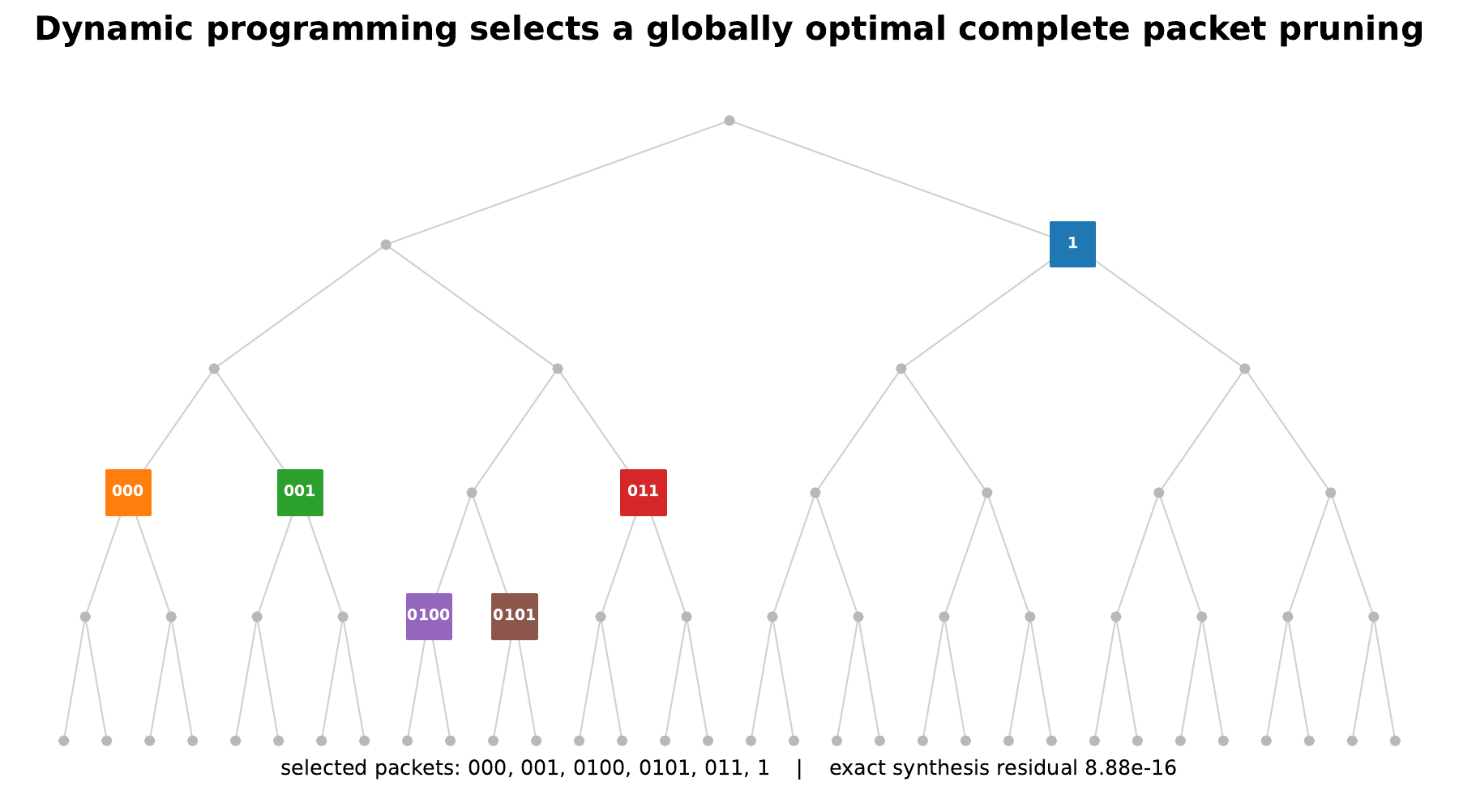
The preceding sparse comparison used one fixed depth-five packet basis. A refinement tree permits a stronger choice: different branches may stop at different depths while the selected packets still form one complete coordinate system.
Definition 11.1: Complete packet pruning
Let \(\mathcal T\) be a finite rooted refinement tree. Every node \(v\) carries a projector \(P_v\), the root satisfies \(P_{\varnothing}=I\), and every internal node satisfies
A set \(\Lambda\) of nodes is a complete pruning if it is an antichain and every root-to-terminal path meets \(\Lambda\) exactly once.
Visual guide: A mixed-depth basis must cover every branch · Permalink · Source line 897 · Claim record · Lean coverage · Code · Worked examples
Theorem 11.2: Exact synthesis from every complete pruning
For every complete pruning \(\Lambda\),
Thus changing the selected tree changes the coordinates but does not introduce reconstruction error.
Read proof · Visual guide: A mixed-depth basis must cover every branch · Read statement and proof side by side · Permalink · Source line 907 · Claim record · Lean coverage · Code · Worked examples
Proof of Theorem 11.2
Starting from the root identity \(P_{\varnothing}=I\), replace every unselected internal node by the exact sum of its children. If a complete pruning contains the root it contains no other node. Otherwise its restriction to each child subtree is itself a complete pruning: every terminal path through that child must be met exactly once. Induction on the finite tree therefore justifies the substitution and its termination precisely at \(\Lambda\). Child subtrees have distinct node addresses, so their selected-node sets form a disjoint union. The sum identity uses only root identity and parent-to-child conservation; sibling orthogonality gives the additional interpretation as nonoverlapping projector packets. Applying the resulting identity to \(x\) gives the synthesis formula.
Back to statement · Read statement and proof side by side · Permalink · Source line 917 · Claim record · Lean coverage · Code · Worked examples
Let \(y\) denote the observed data. For a complete pruning \(\Lambda\), consider any finite criterion
where \(R_y\) is a representation cost, \(L_y\) is a cross-packet leakage cost, and \(K\) is a tree-complexity penalty. Here \(R_y,L_y,K\) take finite real values, and \(\eta,\tau\) are fixed real weights (usually nonnegative in applications). No additivity is needed for the first theorem.
Theorem 11.3: Finite globally optimal stable selector
Let \(\mathfrak P(\mathcal T)\) be the finite set of complete prunings of \(\mathcal T\).
A global minimizer
\[ \Lambda_y^*\in\operatorname*{argmin}_{\Lambda\in\mathfrak P(\mathcal T)}J_y(\Lambda) \]always exists.
If the minimizer is unique and at least one competing pruning exists, its gap
\[ \Gamma_y = \min_{\Lambda\ne\Lambda_y^*} \bigl(J_y(\Lambda)-J_y(\Lambda_y^*)\bigr) \]is attained and strictly positive. If the pruning set is a singleton, its only element minimizes every criterion; no real-valued minimum over an empty competitor set is introduced.
In the case with competitors, if new data \(y'\) satisfy
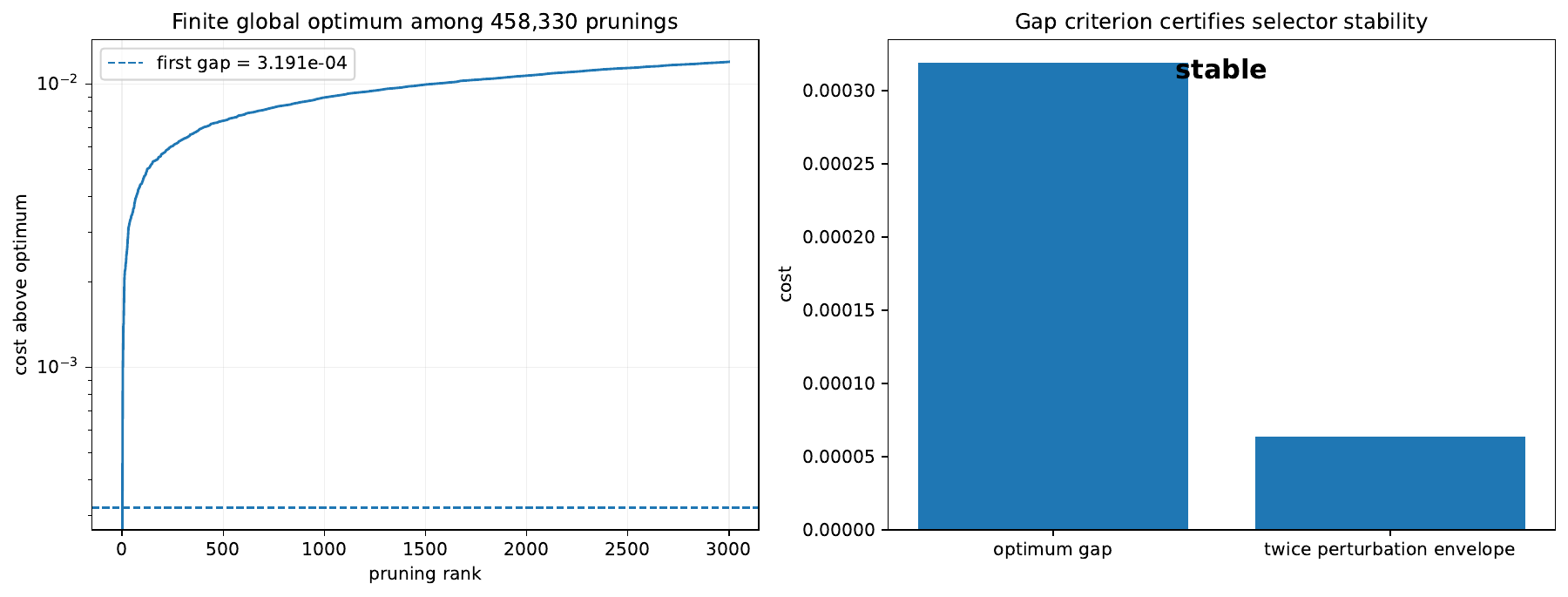
\[ \sup_{\Lambda\in\mathfrak P(\mathcal T)} |J_{y'}(\Lambda)-J_y(\Lambda)| <\frac{\Gamma_y}{2}, \]then \(\Lambda_{y'}^*=\Lambda_y^*\).
Every selected minimizer preserves the exact synthesis identity of the preceding theorem.
Read proof · Visual guide: Solve every alternative without searching every alternative · Visual guide: How far can the costs move before the tree changes? · Read statement and proof side by side · Permalink · Source line 931 · Claim record · Lean coverage · Code · Worked examples
Proof of Theorem 11.3
The root-only pruning exists, and every pruning is a subset of the finite node set, so the feasible set is nonempty and finite. Thus the minimum is attained. If competitors exist, their finitely many differences from a unique optimum are strictly positive, so their minimum is positive and is achieved by a competitor. In the singleton case there is no alternative selector under any objective change. In the remaining case, for any competing pruning \(\Lambda\ne\Lambda_y^*\),
Hence the same pruning remains uniquely optimal. Exact synthesis depends only on completeness of the pruning, not on the cost used to select it.
Back to statement · Read statement and proof side by side · Permalink · Source line 959 · Claim record · Lean coverage · Code · Worked examples
For tree-local costs, the optimum can be found without enumerating all prunings.
Theorem 11.4: Dynamic-programming best packet basis
Suppose
For a node \(v\), define recursively
Stop at \(v\) when \(c_v(y)\le\sum_uV_y(u)\), including equality; refine otherwise. This deterministic rule produces a globally optimal complete pruning. With the node costs supplied and child values cached, the evaluator uses one comparison per internal node, one visit per node, and at most \(|\mathcal T|-1\) additions. Its arithmetic-and-visit count is therefore at most \(3|\mathcal T|\). This is a unit-cost statement about the specified evaluator; it excludes evaluation of the local costs, bit complexity of scalar arithmetic, and materialization or sorting of packet-address strings.
Read proof · Visual guide: Solve every alternative without searching every alternative · Read statement and proof side by side · Permalink · Source line 975 · Claim record · Lean coverage · Code · Worked examples
Proof of Theorem 11.4
Proceed upward from the terminal nodes. Every complete pruning below an internal node \(v\) has exactly two possible forms: it either stops at \(v\), with cost \(c_v(y)\), or it refines and is the union of complete child prunings, whose minimum total cost is the sum of the already computed child minima. The recursion therefore gives the exact minimum on every subtree, in particular at the root. This characterization also proves both directions of the correspondence between recursive cuts and complete covering antichains, for arbitrary positive finite branching, including unary branches. Summing cached child values charges at most one addition per child edge; a finite rooted tree has \(|\mathcal T|-1\) such edges. The number of internal nodes is at most \(|\mathcal T|\), which gives the stated work bound. Ties do not affect optimality, but the stop-on-ties rule makes the selected pruning unambiguous.
Back to statement · Read statement and proof side by side · Permalink · Source line 994 · Claim record · Lean coverage · Code · Worked examples
Corollary 11.5: Local perturbation certificate
Assume
Define
For the complete prunings \(\mathfrak P_v\) below \(v\), the envelope is exactly
The maximum is attained. Every complete-pruning cost changes by at most \(E(\varnothing)\), and the two globally optimal values differ by at most this quantity. Consequently, for a unique optimum with competitors,
is a deterministic certificate that the globally optimal pruning is unchanged. A singleton pruning set is stable without a gap condition. Assume the random node costs and the joint local-error event are measurable. If a noise model supplies all local bounds simultaneously on one event of probability at least \(1-\delta\), and the displayed strict-gap condition holds, the same selector is recovered with probability at least \(1-\delta\). Individual nodewise probabilities alone do not give this joint confidence without an additional argument, such as a union bound.
Read proof · Visual guide: How far can the costs move before the tree changes? · Read statement and proof side by side · Permalink · Source line 998 · Claim record · Lean coverage · Code · Worked examples
Proof of Corollary 11.5
For any pruning of the subtree rooted at \(v\), either \(v\) itself is selected, producing perturbation at most \(\varepsilon_v\), or the pruning is the disjoint union of child prunings, producing perturbation at most the sum of the child envelopes. The same decomposition applied to the nonnegative weights \(\varepsilon_a\) proves equality with the maximum weight: at each node choose either the stop option or a maximizing pruning in each child, whichever gives the larger total. Finiteness ensures these choices attain their maxima. Evaluating each cost at a minimizer of the other cost bounds the difference of the two optimal values by the uniform envelope. The selector statement follows from the strict-gap theorem. The finite deterministic comparisons defining the selector make its preservation event measurable when the random node costs are measurable. The joint local-error event is contained in the selector-preservation event, so monotonicity of probability proves the probabilistic assertion.
Back to statement · Read statement and proof side by side · Permalink · Source line 1025 · Claim record · Lean coverage · Code · Worked examples
Numerical certificate 11.6: Adaptive-tree optimum
For the depth-five example, the complete binary tree has \(458{,}330\) admissible prunings. Dynamic programming and exhaustive enumeration returned the same minimum with residual \(0\). The selected pruning was
and mixed-depth synthesis reconstructed the signal with maximum residual \(8.88\times10^{-16}\). The optimum gap was \(3.1909\times10^{-4}\), while twice the declared perturbation envelope was \(6.4\times10^{-5}\), so the finite selector is certified stable.
Permalink · Source line 1043 · Claim record · Lean coverage · Code · Worked examples
Boundary 11.7: Finite versus asymptotic selection
The theorem resolves the finite adaptive-tree existence, exact-synthesis, global-optimality, and margin-stability problem. It does not by itself prove minimax rates, statistical consistency on an infinite tree, or a universal choice of representation and leakage costs for every signal class.
Permalink · Source line 1051 · Claim record · Lean coverage · Code · Worked examples