
10 Sparse wavelet packets and global Fourier modes
On this page · Visual guide: Deleting coefficients is the approximation step · Permalink · Source line 857
A sharp edge is spatially local but spectrally global. Wavelets often provide a more economical coordinate system once enough localized coefficients are retained. To keep the comparison explicit, the numerical study subtracts the signal mean, keeps the largest coefficients in a fixed depth-five Haar packet basis, and compares them with the same number of largest-magnitude discrete Fourier coefficients. These are coefficient-count budgets, not equal bit-storage budgets. The Fourier reconstruction uses the real part of the inverse transform; for the five reported budgets, the selected nonzero-frequency bins occur in conjugate pairs, so this operation removes only floating-point imaginary residuals.
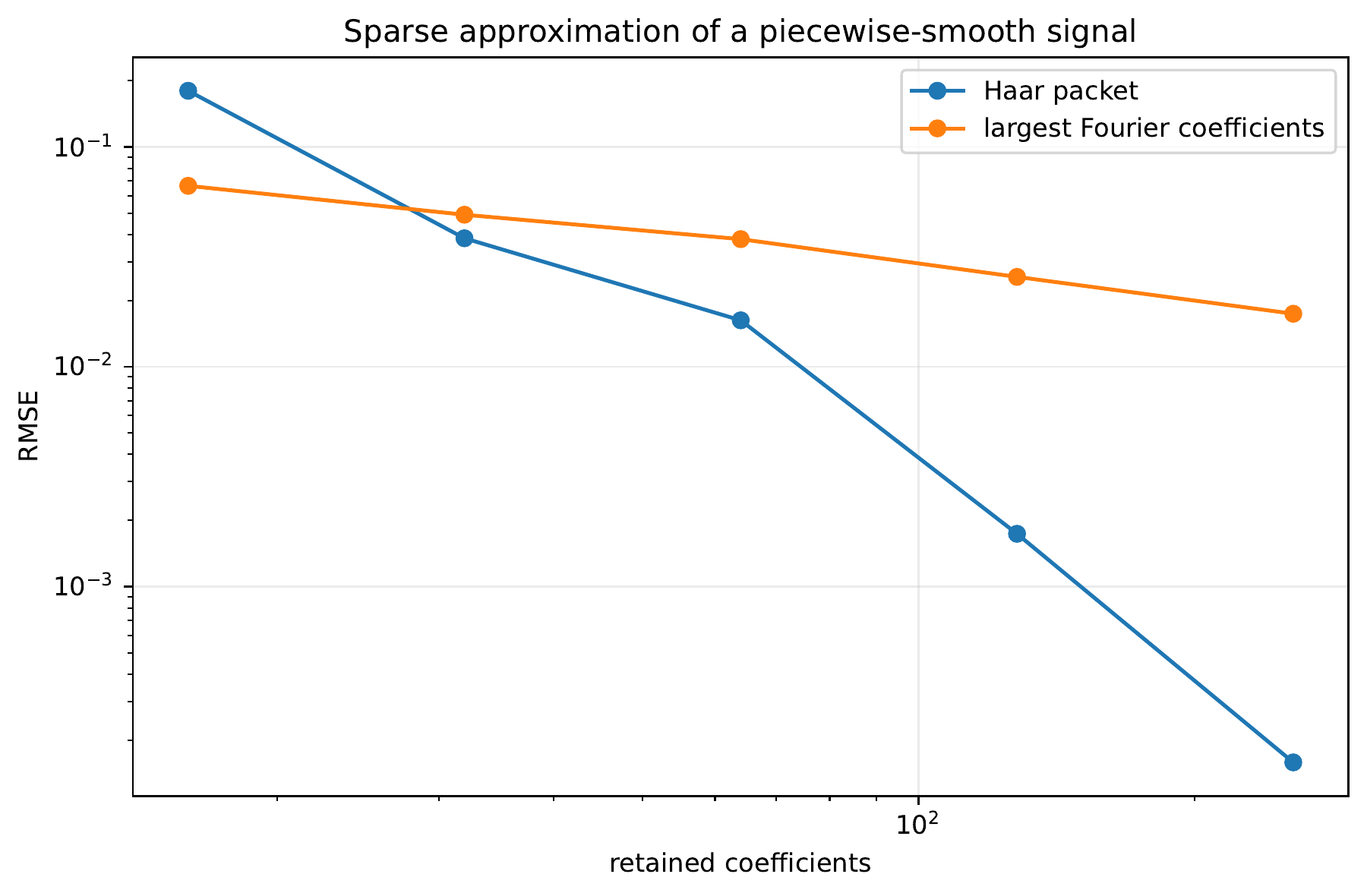
| retained coefficients | Haar packet RMSE | Fourier RMSE |
|---|---|---|
| 16 | \(1.7999\times10^{-1}\) | \(6.6522\times10^{-2}\) |
| 32 | \(3.8414\times10^{-2}\) | \(4.9153\times10^{-2}\) |
| 64 | \(1.6267\times10^{-2}\) | \(3.8056\times10^{-2}\) |
| 128 | \(1.7387\times10^{-3}\) | \(2.5631\times10^{-2}\) |
| 256 | \(1.5870\times10^{-4}\) | \(1.7424\times10^{-2}\) |
Boundary 10.1: Basis selection
This table compares two fixed finite coordinate systems for one signal. It does not prove that Haar packets are optimal, that Fourier is inferior on smooth or oscillatory data, or that a single packet tree is best for every edge geometry. The point is that the seed calculus records both systems with the same analysis, transfer, refinement, and synthesis maps.
Permalink · Source line 885 · Claim record · Lean coverage · Code · Worked examples