
5 Wavelet packets as addressed refinements
On this page · Permalink · Source line 598
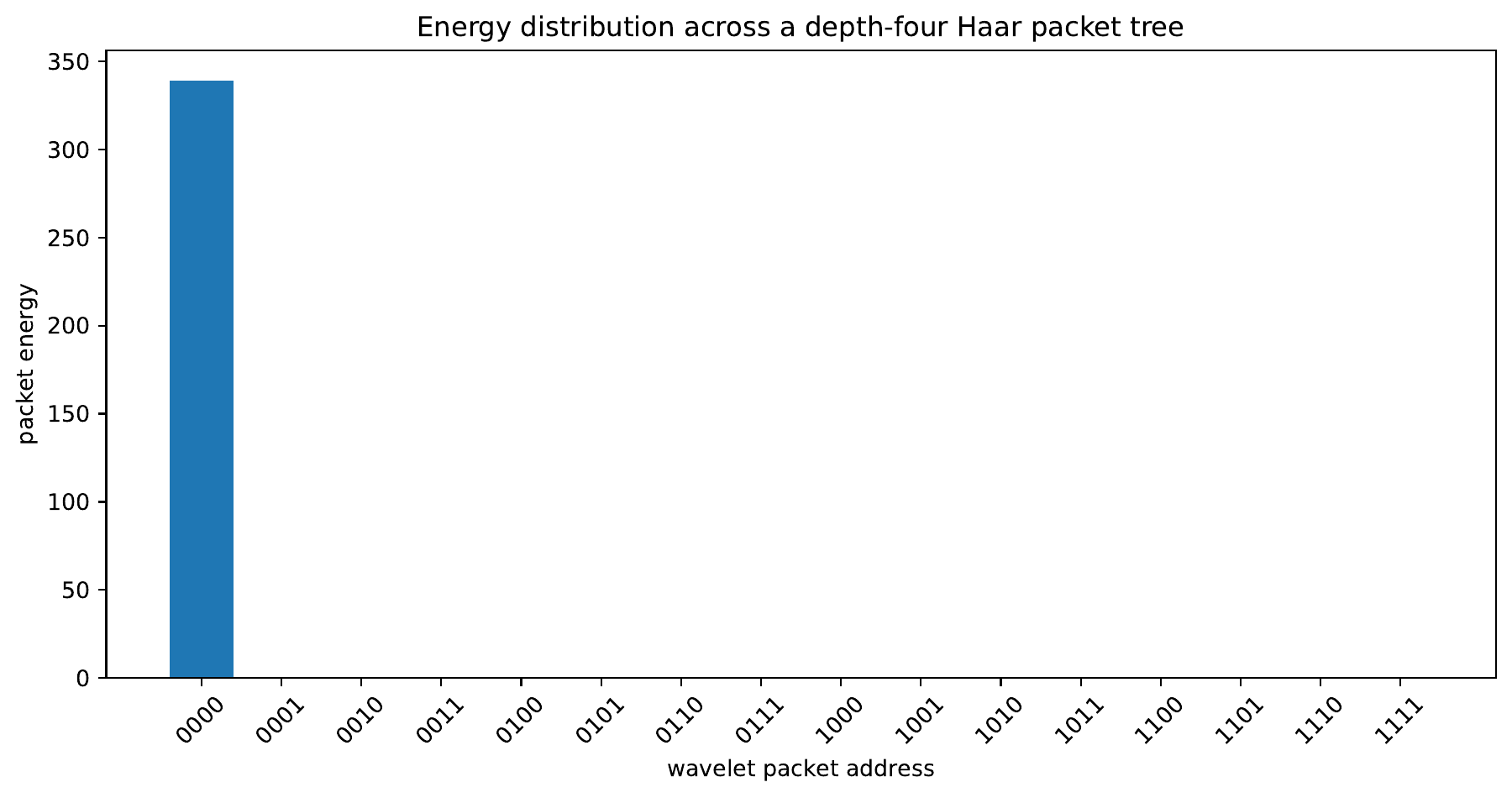
On \(\ell^2({\mathbb Z};{\mathbb C})\), apply the Haar analysis to both children at each stage. For a finite input, assume its length is divisible by \(2^\ell\) when a depth-\(\ell\) transform is used. A binary word \(\alpha\in\{0,1\}^{\ell}\) addresses a depth-\(\ell\) packet, denoted \(W_{\ell,\alpha}x\). Appending \(0\) or \(1\) selects the low or high child.
Theorem 5.1: Wavelet-packet reconstruction and energy
At every finite depth \(\ell\),
and
Read proof · Visual guide: The second level resolves the hidden change · Read statement and proof side by side · Permalink · Source line 602 · Claim record · Lean coverage · Code · Worked examples
Proof of Theorem 5.1
Write \(H_0,H_1\) for the literal low and detail operators. The preceding energy identity implies \(\|H_bx\|_2\le\|x\|_2\), so both have bounded Hilbert adjoints. At depth zero the only packet operator is the identity. If the energy identity holds at depth \(\ell\), apply the one-level identity to each \(W_{\ell,\alpha}x\) and sum; this proves it at depth \(\ell+1\).
Set \(A=\sum_\alpha W_{\ell,\alpha}^*W_{\ell,\alpha}\). This is a finite sum of bounded operators. The energy result says \(\langle x,Ax\rangle=\langle x,x\rangle\) for every \(x\). Complex polarization, applied also to \(x+y\) and \(x+{\mathrm i} y\), gives \(\langle y,(A-I)x\rangle=0\) for all \(x,y\), hence \(A=I\). Applying the operator identity to \(x\) proves synthesis. This argument uses the actual Hilbert adjoints of the decimation operators, not a separately postulated inverse symbol.
Back to statement · Read statement and proof side by side · Permalink · Source line 620 · Claim record · Lean coverage · Code · Worked examples
Classical input 5.2: Wavelet boundary
The existence and perfect-reconstruction theory of wavelets and filter banks are classical. Their role here is structural: they provide a fully developed realization in which seed generation, packet addressing, refinement, transfer blocks, and exact synthesis can all be read literally in the common operator language.
Permalink · Source line 633 · Claim record · Lean coverage · Code · Worked examples