
4 Analysis banks, synthesis banks, and perfect reconstruction
On this page · Permalink · Source line 480
Read the delay in the coordinate system used
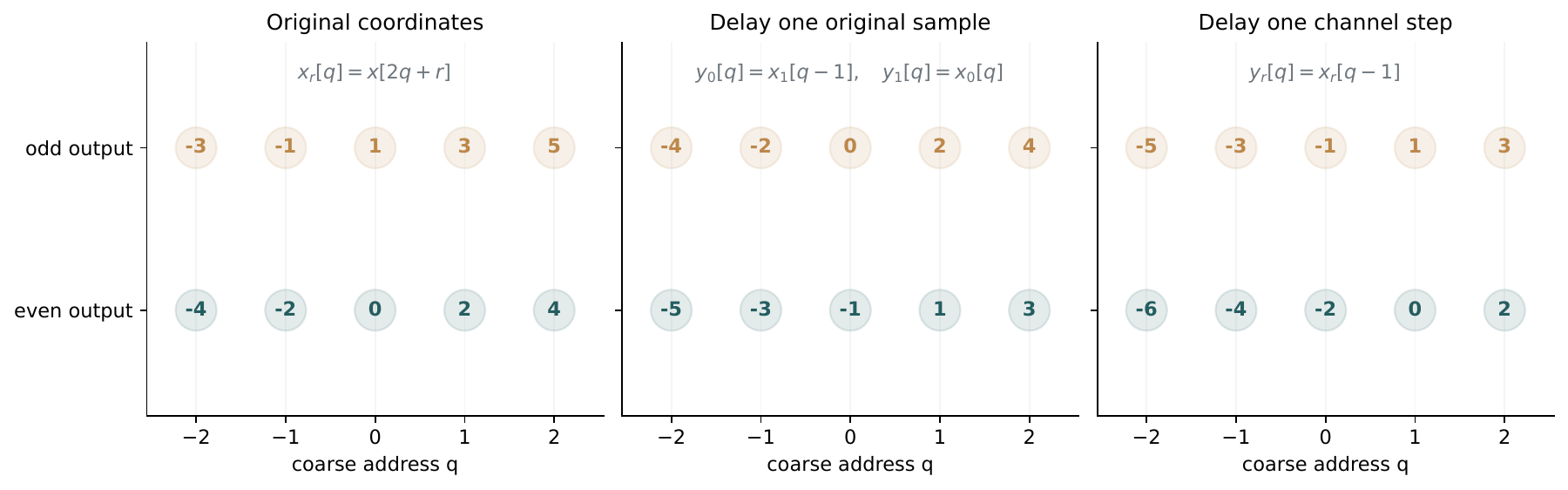
A step in one decimated channel crosses a full block of original samples. A one-sample shift also permutes the residue labels. At two phases, these operations have different matrices. The following calculation keeps the original sample delay visible instead of hiding it in a channel convention.
Work with finite impulse-response banks. Let \(\mathcal L={\mathbb C}[z,z^{-1}]\) be the Laurent-polynomial algebra, with the monomial \(z^{-m}\) acting on a bilateral sequence by \(x[n]\mapsto x[n-m]\). Let \({\boldsymbol{E}}\in\operatorname{Mat}_{N\times N}(\mathcal L)\) and \({\boldsymbol{R}}\in\operatorname{Mat}_{N\times N}(\mathcal L)\) be analysis and synthesis matrices. Their composition acts on all bilateral channel sequences by finite convolutions. At a nonzero \(z\) where the input transforms are absolutely convergent, this gives
Theorem 4.1: Perfect-reconstruction criterion
For \(d\in{\mathbb Z}\), such a bank reconstructs every input up to a delay of \(d\) channel indices exactly when the following Laurent-polynomial identity holds:
If the right side is \(c z^{-d}I_N\) with \(c\ne0\), reconstruction holds up to gain \(c\) and channel delay \(d\). After interleaving, this is a delay of \(Nd\) original samples. A negative delay denotes an advance.
Read proof · Visual guide: One sample is not one channel step · Visual guide: Perfect reconstruction is an operator identity · Read statement and proof side by side · Permalink · Source line 495 · Claim record · Lean coverage · Code · Worked examples
Proof of Theorem 4.1
Finite convolution represents Laurent-polynomial multiplication: composing shifts adds their delays, and distributivity handles finite sums. Thus the matrix identity implies the asserted action. Conversely, let \({\boldsymbol{B}}={\boldsymbol{R}}{\boldsymbol{E}}-cz^{-d}I_N\) and suppose its action vanishes on every channel sequence. Insert an impulse at channel \(s\), address zero, with every other channel zero. Output channel \(k\) reads the coefficients of the Laurent polynomial \(B_{ks}\) at all addresses. All of these coefficients vanish, so \(B_{ks}=0\) for every \(k,s\). The representation is faithful, proving necessity as a polynomial identity rather than merely equality at one evaluation point. The displayed unit-gain case is \(c=1\).
Back to statement · Read statement and proof side by side · Permalink · Source line 505 · Claim record · Lean coverage · Code · Worked examples
Original-sample delay.
On this page · Permalink · Source line 509
For an arbitrary original-sample delay \(D\in{\mathbb Z}\), the output phase \(k\) has
Its channel matrix has the sole nonzero entry \(z^{q_k}\) in row \(k\), column \(r_k\). In particular, a one-sample delay at \(N=2\) has matrix
whereas \(z^{-1}I_2\) delays the original signal by two samples. The general address identity is valid for negative sample addresses as well.
4.1 The Haar bank
On this page · Permalink · Source line 521
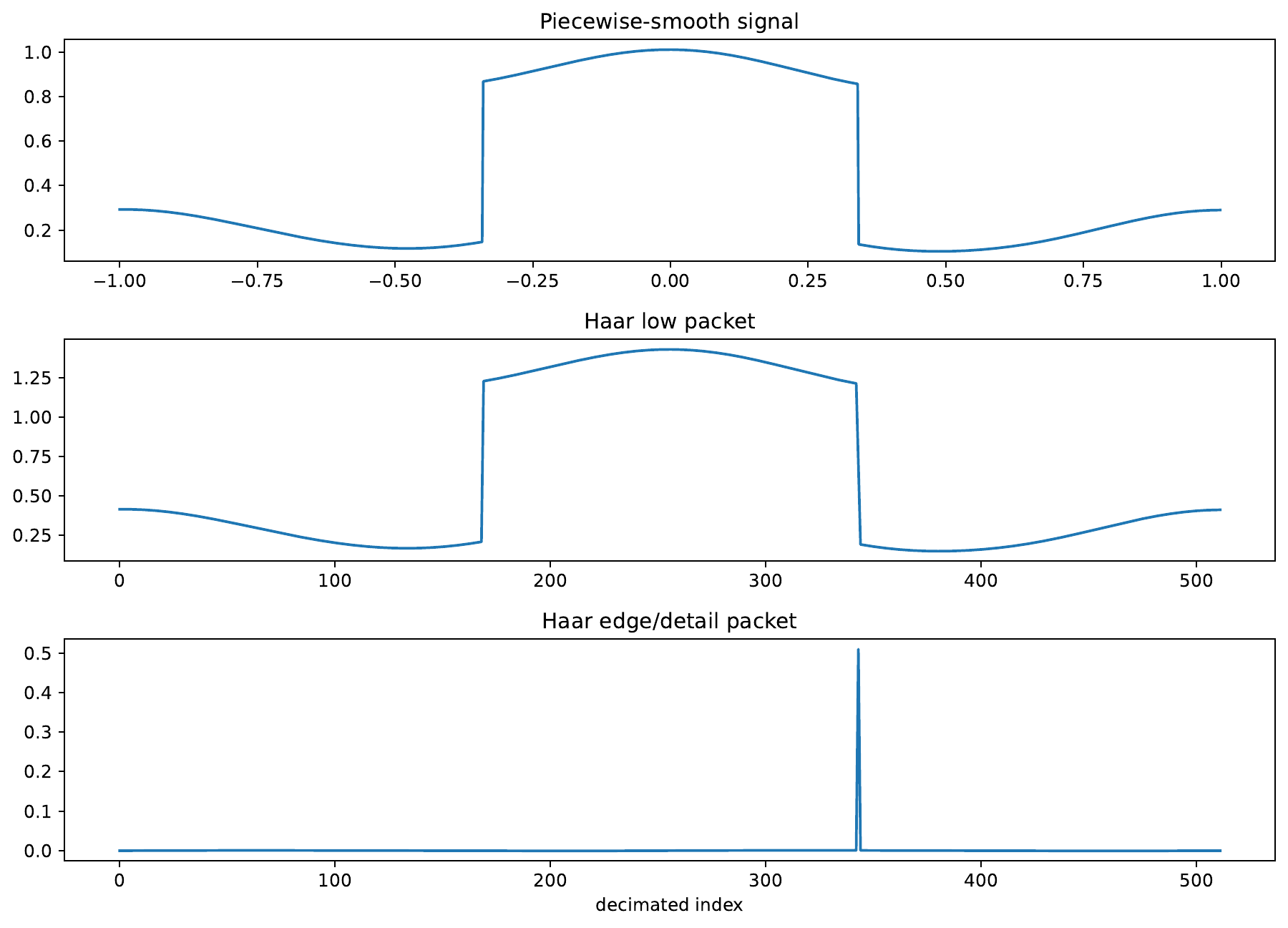
The Haar analysis matrix is
It is orthogonal, so \({\boldsymbol{R}}_{\mathrm{H}}={\boldsymbol{E}}_{\mathrm{H}}^{\mathsf T}\) and
The channels are
Corollary 4.2: Haar energy identity
Read proof · Visual guide: A jump can hide from the first Haar split · Read statement and proof side by side · Permalink · Source line 544 · Claim record · Lean coverage · Code · Worked examples
Proof of Corollary 4.2
For any \(u,v\in{\mathbb C}\), the parallelogram identity gives
Apply this to \(u=x[2n]\), \(v=x[2n+1]\) and sum over \(n\in{\mathbb Z}\). Each summand is nonnegative; the right side is \(\|x\|_2^2\) by the two-channel address equivalence. This also proves that the literal low and detail channels belong to \(\ell^2\). The real Haar matrix is unitary over \({\mathbb C}\), so the finite-signal statement is the same calculation with a finite sum.
Back to statement · Read statement and proof side by side · Permalink · Source line 552 · Claim record · Lean coverage · Code · Worked examples
4.2 Predict–update lifting
On this page · Permalink · Source line 568
Split \(x\) into even and odd channels \(e,o\). Define
The inverse is
Theorem 4.3: Exact lifting reconstruction
The predict–update map \((e,o)\mapsto(s,d)\) is invertible with determinant one and the displayed inverse. Consequently the associated finite transform reconstructs every even-length signal exactly.
Read proof · Visual guide: Lifting preserves information, not energy · Read statement and proof side by side · Permalink · Source line 583 · Claim record · Lean coverage · Code · Worked examples
Proof of Theorem 4.3
The forward matrix is
whose determinant is one. Direct substitution gives the inverse formulas.
Back to statement · Read statement and proof side by side · Permalink · Source line 587 · Claim record · Lean coverage · Code · Worked examples